Moltrasio Chiara, Tricarico Paola Maura, Romagnuolo Maurizio, Marzano Angelo Valerio, Crovella Sergio
Dermatology Unit, Fondazione IRCCS Ca' Granda Ospedale Maggiore Policlinico, 20122 Milan, Italy.
Department of Medical Surgical and Health Sciences, University of Trieste, 34137 Trieste, Italy.
Biomedicines. 2022 Aug 21;10(8):2039. doi: 10.3390/biomedicines10082039.
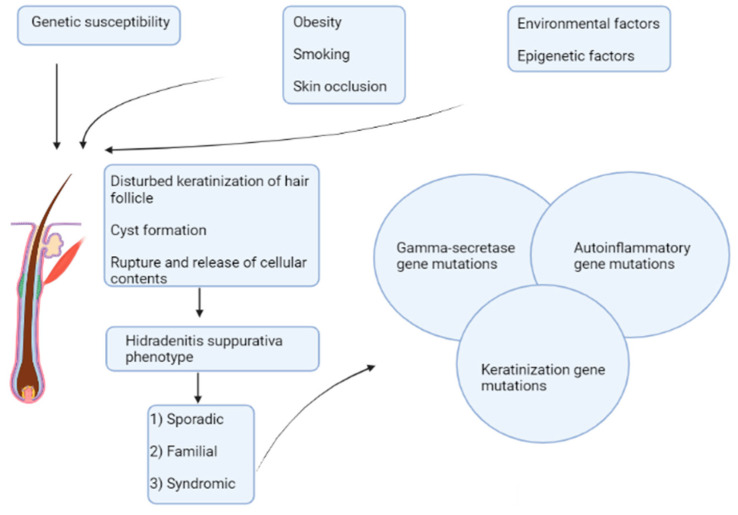
Hidradenitis Suppurativa (HS) is a chronic inflammatory skin disease of the pilosebaceous unit, clinically consisting of painful nodules, abscesses, and sinus tracts mostly in, but not limited to, intertriginous skin areas. HS can be defined as a complex skin disease with multifactorial etiologies, including-among others-genetic, immunologic, epigenetic, and environmental factors. Based on genetic heterogeneity and complexity, three different forms can be recognized and considered separately as sporadic, familial, and syndromic. To date, several genetic variants associated to disease susceptibility, disease-onset, and/or treatment response have been reported; some of these reside in genes encoding the gamma-secretase subunits whereas others involve autoinflammatory and/or keratinization genes. The aim of this perspective work is to provide an overview of the contribution of several genetic studies encompassing family linkage analyses, target candidate gene studies, and -omic studies in this field. In our viewpoint, we discuss the role of genetics in Hidradenitis suppurativa considering findings based on Sanger sequencing as well as the more recent Next Generation Sequencing (i.e., exome sequencing or RNA Sequencing) with the aim of better understanding the etio-pathogenesis of the disease as well as identifying novel therapeutic strategies.
化脓性汗腺炎(HS)是一种累及毛囊皮脂腺单位的慢性炎症性皮肤病,临床上主要表现为疼痛性结节、脓肿和窦道,好发于但不限于皮肤褶皱部位。HS可被定义为一种病因复杂的皮肤病,其病因包括遗传、免疫、表观遗传和环境等多种因素。基于遗传异质性和复杂性,可识别出三种不同形式,并分别视为散发性、家族性和综合征性。迄今为止,已报道了几种与疾病易感性、发病和/或治疗反应相关的基因变异;其中一些位于编码γ-分泌酶亚基的基因中,而其他一些则涉及自身炎症和/或角化基因。本前瞻性研究的目的是概述该领域中包括家族连锁分析、目标候选基因研究和组学研究在内的多项遗传学研究的贡献。我们认为,我们将讨论遗传学在化脓性汗腺炎中的作用,考虑基于桑格测序以及更新的下一代测序(即外显子组测序或RNA测序)的研究结果,旨在更好地理解该疾病的病因发病机制,并确定新的治疗策略。