Wong Shuk-Ching, Chau Pui-Hing, So Simon Yung-Chun, Lam Germaine Kit-Ming, Chan Veronica Wing-Man, Yuen Lithia Lai-Ha, Au Yeung Christine Ho-Yan, Chen Jonathan Hon-Kwan, Ho Pak-Leung, Yuen Kwok-Yung, Cheng Vincent Chi-Chung
Infection Control Team, Queen Mary Hospital, Hong Kong West Cluster, Hong Kong SAR, China.
School of Nursing, Li Ka Shing Faculty of Medicine, The University of Hong Kong, Hong Kong SAR, China.
Antibiotics (Basel). 2022 Aug 8;11(8):1076. doi: 10.3390/antibiotics11081076.
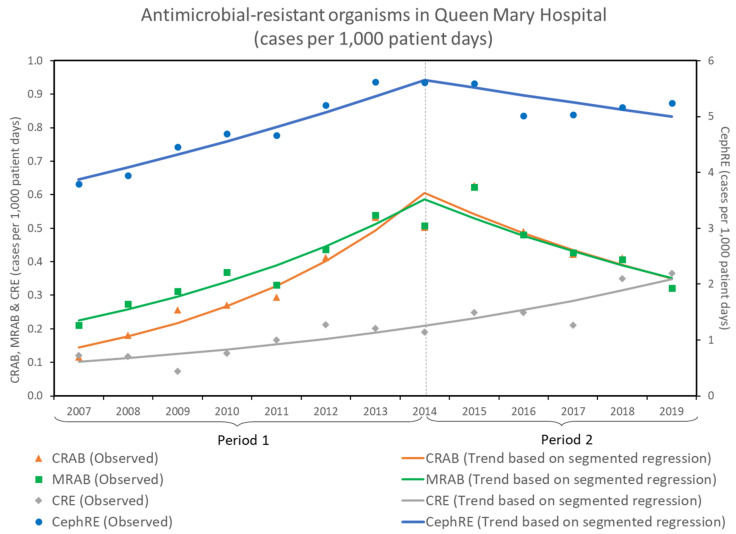
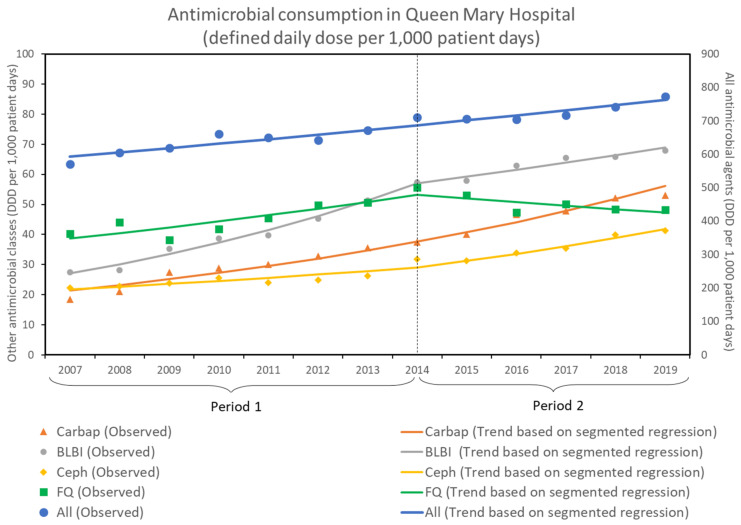
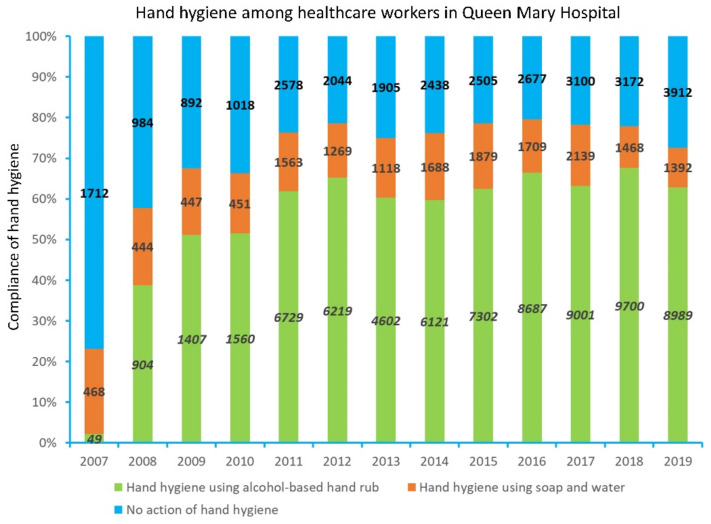
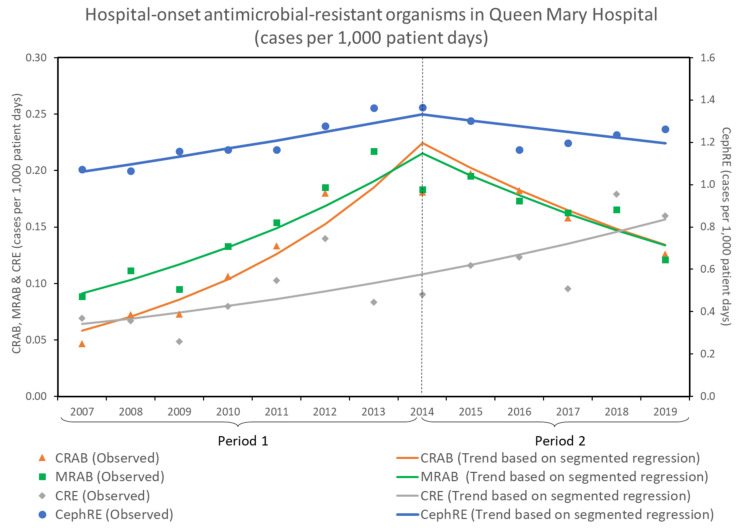
Antimicrobial stewardship and infection control measures are equally important in the control of antimicrobial-resistant organisms. We conducted a retrospective analysis of the incidence rate of hospital-onset carbapenem-resistant Acinetobacter baumannii (CRAB) infection (per 1000 patient days) in the Queen Mary Hospital, a 1700-bed, university-affiliated teaching hospital, from period 1 (1 January 2007 to 31 December 2013) to period 2 (1 January 2014 to 31 December 2019), where enhanced infection control measures, including directly observed hand hygiene before meal and medication rounds to conscious patients, and the priority use of single room isolation, were implemented during period 2. This study aimed to investigate the association between enhanced infection control measures and changes in the trend in the incidence rate of hospital-onset CRAB infection. Antimicrobial consumption (defined daily dose per 1000 patient days) was monitored. Interrupted time series, in particular segmented Poisson regression, was used. The hospital-onset CRAB infection increased by 21.3% per year [relative risk (RR): 1.213, 95% confidence interval (CI): 1.162−1.266, p < 0.001], whereas the consumption of the extended spectrum betalactam-betalactamase inhibitor (BLBI) combination and cephalosporins increased by 11.2% per year (RR: 1.112, 95% CI: 1.102−1.122, p < 0.001) and 4.2% per year (RR: 1.042, 95% CI: 1.028−1.056, p < 0.001), respectively, in period 1. With enhanced infection control measures, the hospital-onset CRAB infection decreased by 9.8% per year (RR: 0.902, 95% CI: 0.854−0.953, p < 0.001), whereas the consumption of the extended spectrum BLBI combination and cephalosporins increased by 3.8% per year (RR: 1.038, 95% CI: 1.033−1.044, p < 0.001) and 7.6% per year (RR: 1.076, 95% CI: 1.056−1.097, p < 0.001), respectively, in period 2. The consumption of carbapenems increased by 8.4% per year (RR: 1.84, 95% CI: 1.073−1.094, p < 0.001) in both period 1 and period 2. The control of healthcare-associated CRAB could be achieved by infection control measures with an emphasis on directly observed hand hygiene, despite an increasing trend of antimicrobial consumption.
抗菌药物管理和感染控制措施在控制耐抗菌药物微生物方面同样重要。我们对玛丽医院(一家拥有1700张床位的大学附属教学医院)在第1阶段(2007年1月1日至2013年12月31日)至第2阶段(2014年1月1日至2019年12月31日)期间医院获得性耐碳青霉烯鲍曼不动杆菌(CRAB)感染的发病率(每1000患者日)进行了回顾性分析,在第2阶段实施了强化感染控制措施,包括对意识清醒的患者在饭前和用药查房时直接监督手部卫生,以及优先使用单人房间隔离。本研究旨在调查强化感染控制措施与医院获得性CRAB感染发病率趋势变化之间的关联。监测了抗菌药物消耗量(每1000患者日的限定日剂量)。使用了中断时间序列,特别是分段泊松回归。在第1阶段,医院获得性CRAB感染每年增加21.3%[相对风险(RR):1.213,95%置信区间(CI):1.162−1.266,p<0.001],而广谱β-内酰胺-β-内酰胺酶抑制剂(BLBI)组合和头孢菌素的消耗量分别每年增加11.2%(RR:1.112,95%CI:1.102−1.122,p<0.001)和4.2%(RR:1.042,95%CI:1.028−1.056,p<0.001)。随着感染控制措施的强化,在第2阶段,医院获得性CRAB感染每年下降9.8%(RR:0.902,95%CI:0.854−0.953,p<0.001),而广谱BLBI组合和头孢菌素的消耗量分别每年增加3.8%(RR:1.038,95%CI:1.033−1.044,p<0.001)和7.6%(RR:1.076,95%CI:1.056−1.097,p<0.001)。在第1阶段和第2阶段,碳青霉烯类药物的消耗量每年均增加8.4%(RR:1.084,95%CI:1.073−1.094,p<0.001)。尽管抗菌药物消耗量呈上升趋势,但通过强调直接监督手部卫生的感染控制措施,可以实现对医疗保健相关CRAB的控制。