Wong Shuk-Ching, Chau Pui-Hing, So Simon Yung-Chun, Chiu Kelvin Hei-Yeung, Yuen Lithia Lai-Ha, AuYeung Christine Ho-Yan, Lam Germaine Kit-Ming, Chan Veronica Wing-Man, Chen Jonathan Hon-Kwan, Chen Hong, Li Xin, Ho Pak-Leung, Chan Sophia Siu-Chee, Yuen Kwok-Yung, Cheng Vincent Chi-Chung
Infection Control Team, Queen Mary Hospital, Hong Kong West Cluster, Hong Kong Special Administrative Region, China.
School of Nursing, Li Ka Shing Faculty of Medicine, The University of Hong Kong, Hong Kong Special Administrative Region, China.
Infect Prev Pract. 2023 Jun;5(2):100286. doi: 10.1016/j.infpip.2023.100286. Epub 2023 May 8.
The coronavirus disease 2019 (COVID-19) has influenced antimicrobial consumption and incidence of multidrug-resistant organisms (MDROs). We aimed to study the epidemiology of MDROs before and during the COVID-19 pandemic in Hong Kong.
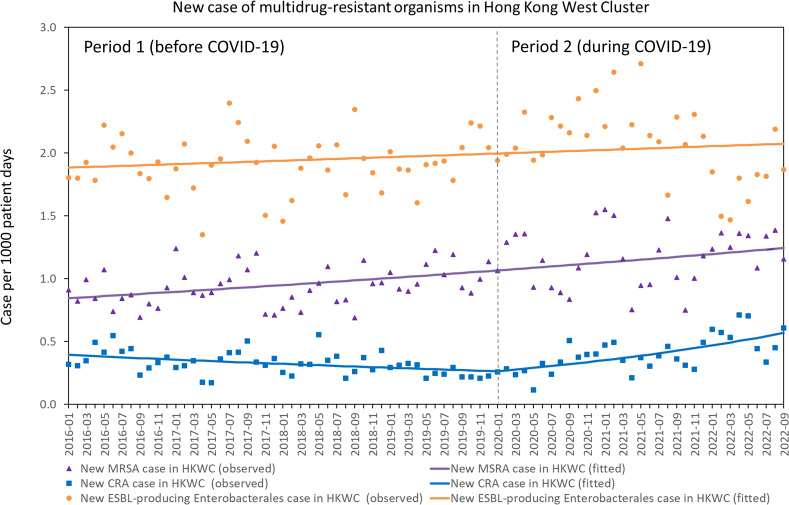
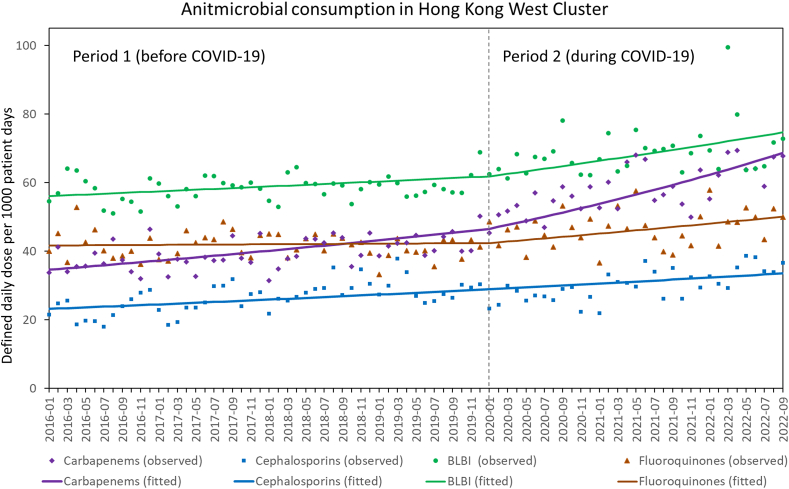
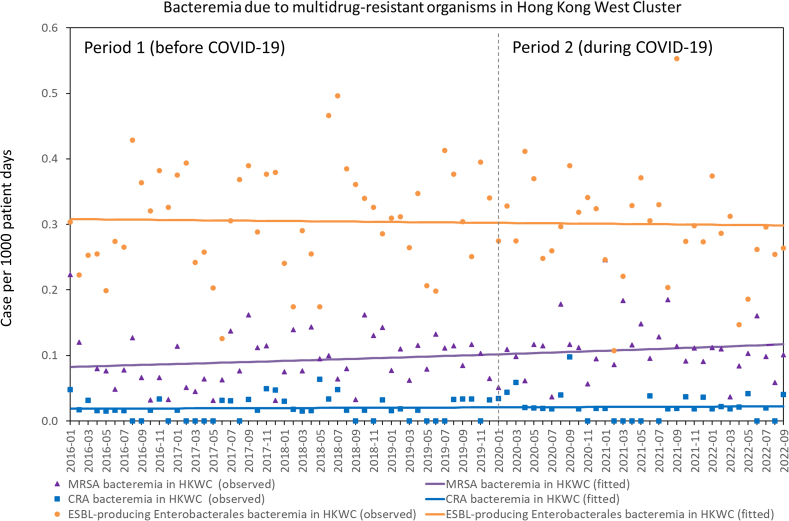
With the maintenance of infection control measures, we described the trend of MDRO infections, including methicillin-resistant (MRSA), carbapenem-resistant (CRA), and extended-spectrum-beta-lactamase-(ESBL)-producing Enterobacterales, in a healthcare region with 3100-bed before (1 January 2016 to 31 December 2019, period 1) and during COVID-19 (1 January 2020 to 30 September 2022, period 2), together with the antimicrobial consumption using piecewise Poisson regression. The epidemiological characteristics of newly diagnosed COVID-19 patients with or without MDRO infections were analyzed.
Between period 1 and 2, we observed a significant increase in the trend of CRA infections (<0.001), while there was no significant increase in the trend of MRSA (=0.742) and ESBL-producing Enterobacterales (=0.061) infections. Meanwhile, a significant increase in the trend of carbapenems (<0.001), extended-spectrum beta-lactam-beta-lactamase inhibitor combinations (BLBI) (=0.045), and fluoroquinolones (=0.009) consumption was observed. The observed opportunity (23,540 ± 3703 vs 26,145 ± 2838, =0.359) and compliance (81.6% ± 0.5% vs 80.1% ± 0.8%, =0.209) of hand hygiene per year was maintained. In a multivariable model, older age, male sex, referral from residential care home for the elderly, presence of indwelling device, presence of endotracheal tube, and use of carbapenems, use of BLBI, use of proton pump inhibitors and history of hospitalization in the past 3 months were associated with higher risks of infections by MDROs among COVID-19 patients.
Infection control measures may control the surge of MDROs despite an increasing trend of antimicrobial consumption.
2019年冠状病毒病(COVID-19)影响了抗菌药物的使用以及多重耐药菌(MDROs)的发生率。我们旨在研究香港COVID-19大流行之前和期间MDROs的流行病学情况。
在维持感染控制措施的情况下,我们描述了一个拥有3100张床位的医疗区域中MDRO感染的趋势,包括耐甲氧西林金黄色葡萄球菌(MRSA)、耐碳青霉烯类(CRA)以及产超广谱β-内酰胺酶(ESBL)的肠杆菌科细菌,时间跨度为COVID-19之前(2016年1月1日至2019年12月31日,时期1)和COVID-19期间(2020年1月1日至2022年9月30日,时期2),同时使用分段泊松回归分析抗菌药物的使用情况。分析了新诊断的COVID-19患者有无MDRO感染的流行病学特征。
在时期1和时期2之间,我们观察到CRA感染趋势显著增加(<0.001),而MRSA(=0.742)和产ESBL肠杆菌科细菌(=0.061)感染趋势没有显著增加。同时,观察到碳青霉烯类(<0.001)、超广谱β-内酰胺-β-内酰胺酶抑制剂合剂(BLBI)(=0.045)和氟喹诺酮类(=0.009)的使用趋势显著增加。每年观察到的手卫生时机(23540±3703对26145±2838,=0.359)和依从性(81.6%±0.5%对80.1%±0.8%,=0.209)得以维持。在多变量模型中,年龄较大、男性、来自老年护理院的转诊、存在留置装置、存在气管内插管、使用碳青霉烯类、使用BLBI、使用质子泵抑制剂以及过去3个月内有住院史与COVID-19患者中MDRO感染的较高风险相关。
尽管抗菌药物使用呈增加趋势,但感染控制措施可能控制MDROs的激增。