Klontzas Michail E, Stathis Ioannis, Spanakis Konstantinos, Zibis Aristeidis H, Marias Kostas, Karantanas Apostolos H
Department of Medical Imaging, University Hospital, 71110 Heraklion, Greece.
Computational BioMedicine Laboratory, Institute of Computer Science, Foundation for Research and Technology (FORTH), 70013 Heraklion, Greece.
Diagnostics (Basel). 2022 Aug 2;12(8):1870. doi: 10.3390/diagnostics12081870.
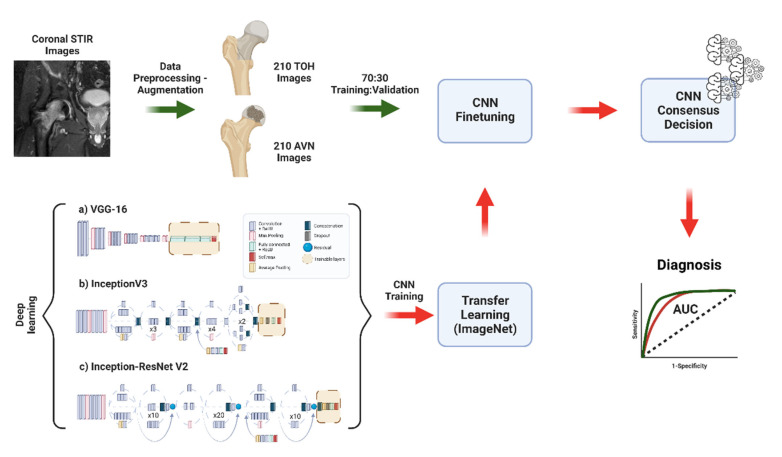
Differential diagnosis between avascular necrosis (AVN) and transient osteoporosis of the hip (TOH) can be complicated even for experienced MSK radiologists. Our study attempted to use MR images in order to develop a deep learning methodology with the use of transfer learning and a convolutional neural network (CNN) ensemble, for the accurate differentiation between the two diseases. An augmented dataset of 210 hips with TOH and 210 hips with AVN was used to finetune three ImageNet-trained CNNs (VGG-16, InceptionResNetV2, and InceptionV3). An ensemble decision was reached in a hard-voting manner by selecting the outcome voted by at least two of the CNNs. Inception-ResNet-V2 achieved the highest AUC (97.62%) similar to the model ensemble, followed by InceptionV3 (AUC of 96.82%) and VGG-16 (AUC 96.03%). Precision for the diagnosis of AVN and recall for the detection of TOH were higher in the model ensemble compared to Inception-ResNet-V2. Ensemble performance was significantly higher than that of an MSK radiologist and a fellow (P < 0.001). Deep learning was highly successful in distinguishing TOH from AVN, with a potential to aid treatment decisions and lead to the avoidance of unnecessary surgery.
即使对于经验丰富的肌肉骨骼放射科医生来说,区分股骨头缺血性坏死(AVN)和髋关节暂时性骨质疏松症(TOH)也可能很复杂。我们的研究试图使用磁共振成像(MR)图像,以便利用迁移学习和卷积神经网络(CNN)集成开发一种深度学习方法,用于准确区分这两种疾病。使用一个由210例TOH髋关节和210例AVN髋关节组成的增强数据集对三个在ImageNet上训练的CNN(VGG-16、InceptionResNetV2和InceptionV3)进行微调。通过选择至少两个CNN投票的结果,以硬投票方式达成总体决策。Inception-ResNet-V2与模型集成类似,获得了最高的AUC(97.62%),其次是InceptionV3(AUC为96.82%)和VGG-16(AUC为96.03%)。与Inception-ResNet-V2相比,模型集成中AVN诊断的精度和TOH检测的召回率更高。总体性能显著高于一名肌肉骨骼放射科医生和一名同行(P<0.001)。深度学习在区分TOH和AVN方面非常成功,有可能帮助做出治疗决策并避免不必要的手术。