Blatter Tobias Ueli, Witte Harald, Nakas Christos Theodoros, Leichtle Alexander Benedikt
Department of Clinical Chemistry, Inselspital-University Hospital Bern, 3010 Bern, Switzerland.
Laboratory of Biometry, University of Thessaly, 384 46 Volos, Greece.
Diagnostics (Basel). 2022 Aug 9;12(8):1923. doi: 10.3390/diagnostics12081923.
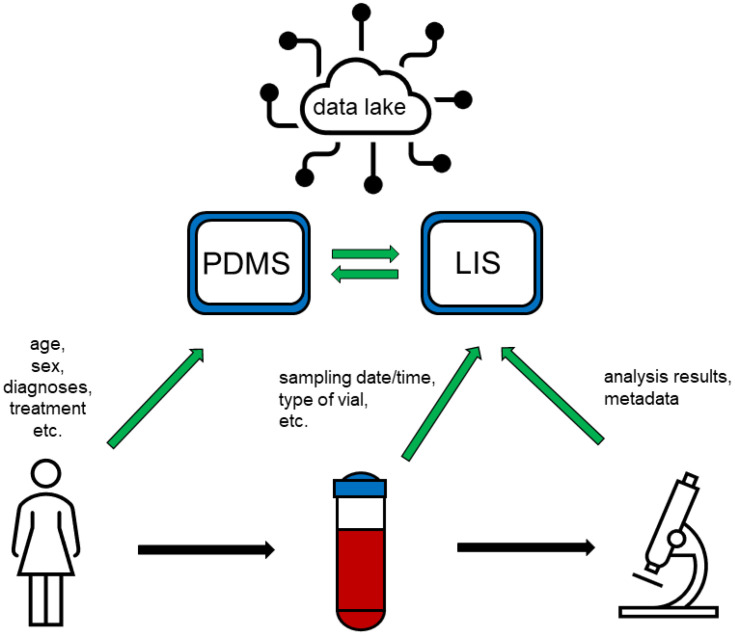
Laboratory medicine is a digital science. Every large hospital produces a wealth of data each day-from simple numerical results from, e.g., sodium measurements to highly complex output of "-omics" analyses, as well as quality control results and metadata. Processing, connecting, storing, and ordering extensive parts of these individual data requires Big Data techniques. Whereas novel technologies such as artificial intelligence and machine learning have exciting application for the augmentation of laboratory medicine, the Big Data concept remains fundamental for any sophisticated data analysis in large databases. To make laboratory medicine data optimally usable for clinical and research purposes, they need to be FAIR: findable, accessible, interoperable, and reusable. This can be achieved, for example, by automated recording, connection of devices, efficient ETL (Extract, Transform, Load) processes, careful data governance, and modern data security solutions. Enriched with clinical data, laboratory medicine data allow a gain in pathophysiological insights, can improve patient care, or can be used to develop reference intervals for diagnostic purposes. Nevertheless, Big Data in laboratory medicine do not come without challenges: the growing number of analyses and data derived from them is a demanding task to be taken care of. Laboratory medicine experts are and will be needed to drive this development, take an active role in the ongoing digitalization, and provide guidance for their clinical colleagues engaging with the laboratory data in research.
检验医学是一门数字科学。每天,每家大型医院都会产生大量数据——从简单的数值结果(例如钠测量结果)到“组学”分析的高度复杂输出,以及质量控制结果和元数据。处理、连接、存储和整理这些单个数据的大量部分需要大数据技术。虽然人工智能和机器学习等新技术在检验医学的拓展方面有令人兴奋的应用,但大数据概念对于大型数据库中的任何复杂数据分析仍然至关重要。为了使检验医学数据能最佳地用于临床和研究目的,它们需要具备FAIR原则:可查找、可访问、可互操作和可重用。这可以通过自动记录、设备连接、高效的ETL(提取、转换、加载)流程、谨慎的数据治理和现代数据安全解决方案来实现。丰富了临床数据的检验医学数据能够增进对病理生理学的理解,改善患者护理,或者可用于制定诊断参考区间。然而,检验医学中的大数据并非没有挑战:分析数量及其衍生数据的不断增加是一项需要关注的艰巨任务。需要检验医学专家来推动这一发展,在正在进行的数字化进程中发挥积极作用,并为其临床同事在研究中使用实验室数据提供指导。