Kim Yong-Seok, Kim In-Byung, Kim Seon-Rye, Cho Byung-Jun
Department of Emergency Medical Service, College of Medical Science, Konyang University, 158, Gwanjeodong-ro, Seo-gu, Daejeon 35365, Korea.
Department of Emergency Medicine, Myongji Hospital, Goyang, 24 Hwajung-dong, Deokyang-gu, Goyang-si 41227, Gyeonggi-do, Korea.
Healthcare (Basel). 2022 Aug 14;10(8):1540. doi: 10.3390/healthcare10081540.
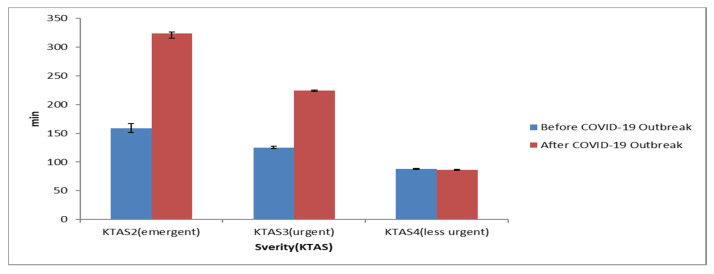
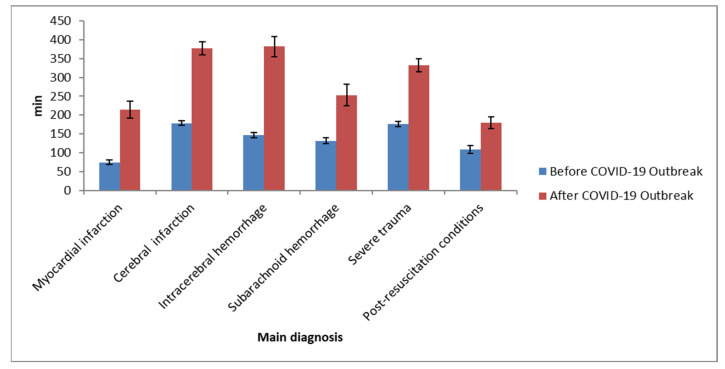
Severe patients visited regional emergency centers more frequently during the COVID-19 period, and disposition status warranting admission to the intensive care unit or resulting in death was more common during the COVID-19 period. This study was conducted to compare the characteristics and severity of patients, and emergency department length of stay before and after the COVID-19 outbreak. Subjects were 75,409 patients who visited the regional emergency medical center from 1 February 2019 to 19 January 2020 and from 1 February 2020 to 19 January 2021. Data was analyzed using the SPSS/WIN 22.0 program. The significance level was p < 0.05. The chi-square test and t-test were used for variables, and Cramer V was used for correlation. We found that the total number of patients visiting the emergency room decreased by 37.6% after COVID-19, but emergency department length of stay among severely ill patients increased by 203.7%. Additionally, the utilization rate of 119 ambulances and relatively more severe patients increased by 9.0% and by 2.1%. More studies about emergency department designs and operational programs should be conducted for better action not only during regular periods but also during periods of pandemic.
在新冠疫情期间,重症患者更频繁地前往地区急诊中心,且需要入住重症监护病房或导致死亡的处置情况在新冠疫情期间更为常见。本研究旨在比较新冠疫情爆发前后患者的特征和严重程度以及急诊科住院时间。研究对象为2019年2月1日至2020年1月19日以及2020年2月1日至2021年1月19日期间前往地区急诊医疗中心就诊的75409名患者。使用SPSS/WIN 22.0程序对数据进行分析。显著性水平为p < 0.05。对变量使用卡方检验和t检验,对相关性使用克莱姆V系数。我们发现,新冠疫情后前往急诊室的患者总数减少了37.6%,但重症患者的急诊科住院时间增加了203.7%。此外,119救护车的使用率和相对病情更严重的患者分别增加了9.0%和2.1%。为了不仅在正常时期而且在大流行时期都能采取更好的行动,应该开展更多关于急诊科设计和运营方案的研究。