Department of Ophthalmology, Faculty of Medicine, Chiang Mai University, Chiang Mai 50200, Thailand.
Neurophysiology Unit, Cardiac Electrophysiology Research and Training Center, Faculty of Medicine, Chiang Mai University, Chiang Mai 50200, Thailand.
Int J Mol Sci. 2022 Aug 21;23(16):9431. doi: 10.3390/ijms23169431.
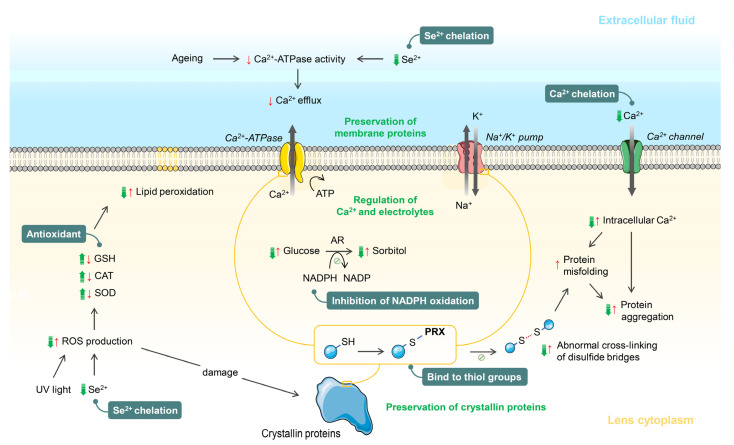
Cataract is the leading cause of blindness worldwide. A diverse range of medication has been invented to prevent or treat cataract. Pirenoxine (PRX), a drug with strong antioxidant properties, has been used topically to treat cataract, and there is much evidence to demonstrate the beneficial effects of PRX on lens opacity from in vitro and in vivo models. In clinical use, PRX has been prescribed worldwide by ophthalmologists for over six decades; however, there is still controversy with regard to its efficacy, and thus PRX remains an off-label use for cataract treatment. This comprehensive review summarizes and discusses evidence pertinent to the mechanisms of PRX and its efficacy mainly on cataract models. The issues that have been deemed uncertain over the six-decade use of PRX are examined. The information summarized in this review should provide insights into contriving novel approaches for the treatment of cataract.
白内障是全球致盲的主要原因。为了预防或治疗白内障,已经发明了多种药物。派立明(PRX)是一种具有很强抗氧化性能的药物,已被局部用于治疗白内障,有大量证据表明 PRX 对体外和体内模型的晶状体混浊有有益作用。在临床应用中,PRX 已被眼科医生在全球范围内使用了六十多年; 然而,其疗效仍存在争议,因此 PRX 仍然是治疗白内障的非适应证。这篇全面的综述总结并讨论了与 PRX 的机制及其疗效相关的证据,主要是关于白内障模型的。检查了 PRX 使用六十年来被认为不确定的问题。本综述中总结的信息应该为治疗白内障的新方法提供思路。