Aloizou Athina-Maria, Richter Daniel, Charles James Jeyanthan, Lukas Carsten, Gold Ralf, Krogias Christos
Department of Neurology, St. Josef-Hospital, Ruhr University Bochum, 44892 Bochum, Germany.
Institute of Neuroradiology, St. Josef-Hospital Bochum, Ruhr University Bochum, 44892 Bochum, Germany.
J Clin Med. 2022 Aug 11;11(16):4696. doi: 10.3390/jcm11164696.
Ischemic stroke is a common occurrence in patients with concomitant malignancy. Systemic thrombolysis is often contraindicated in these patients, and mechanical thrombectomy (MT) is the preferred method of intervention. This review aims to collect the available data on the safety and efficacy of MT in cancer patients (CPs).
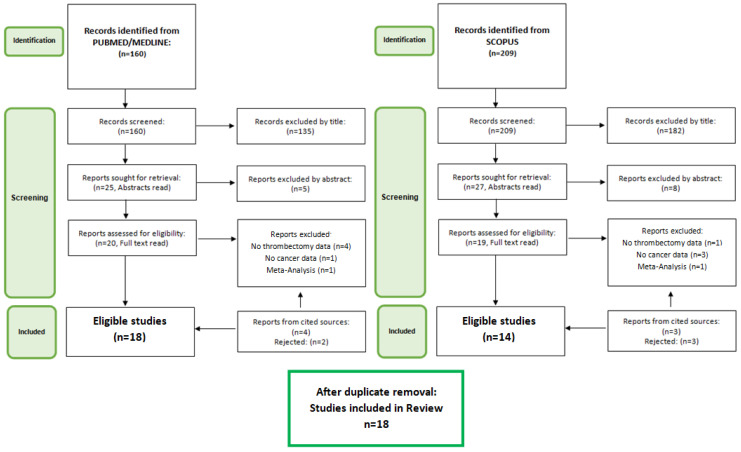
The PubMed/MEDLINE and SCOPUS databases were systematically searched for studies assessing safety (mortality, intracranial hemorrhage) and efficacy (reperfusion, functional outcome) indices in CPs receiving MT. Potentially relevant parameters examined in solitary studies were also extracted (e.g., stroke recurrence, brain malignancy).
A total of 18 retrospective studies of various methodologies and objectives were identified. Rates of in-hospital mortality, intracranial hemorrhage of any kind, reperfusion rates, and discharge condition did not seem to present any considerable differences between CPs and patients without cancer. On the contrary, 90-day mortality was higher and 90-day functional independence was lower in CPs. Three studies on cancer-related stroke (no other identifiable etiology and high D-dimer levels in the presence of active cancer) showed constant tendencies towards unfavorable conditions.
Per the available evidence, MT appears to be a safe treatment option for CPs. It is still unclear whether the 90-day mortality and outcome rates are more heavily influenced by the malignancy and not the intervention itself, so MT can be considered in CPs with prospects of a good functional recovery, undertaking an individualized approach.
缺血性中风在合并恶性肿瘤的患者中很常见。这些患者通常禁忌全身溶栓,机械取栓术(MT)是首选的干预方法。本综述旨在收集有关MT治疗癌症患者(CPs)安全性和有效性的现有数据。
系统检索PubMed/MEDLINE和SCOPUS数据库,以查找评估接受MT治疗的CPs安全性(死亡率、颅内出血)和有效性(再灌注、功能结局)指标的研究。还提取了单项研究中检查的潜在相关参数(例如,中风复发、脑恶性肿瘤)。
共确定了18项方法和目标各异的回顾性研究。CPs与无癌症患者之间的住院死亡率、任何类型的颅内出血发生率、再灌注率和出院情况似乎没有显著差异。相反,CPs的90天死亡率更高,90天功能独立性更低。三项关于癌症相关性中风(无其他可识别病因且在活动性癌症存在时D-二聚体水平高)的研究显示,病情不利的趋势持续存在。
根据现有证据,MT似乎是CPs的一种安全治疗选择。目前尚不清楚90天死亡率和结局率是否更多地受恶性肿瘤而非干预本身的影响,因此对于有望实现良好功能恢复的CPs,可考虑采用个体化方法进行MT治疗。