Department of Neurology, University Emergency Hospital Bucharest, 050098 Bucharest, Romania.
Department of Clinical Neurosciences, "Carol Davila" University of Medicine and Pharmacy Bucharest, 020021 Bucharest, Romania.
Medicina (Kaunas). 2022 Jul 27;58(8):1003. doi: 10.3390/medicina58081003.
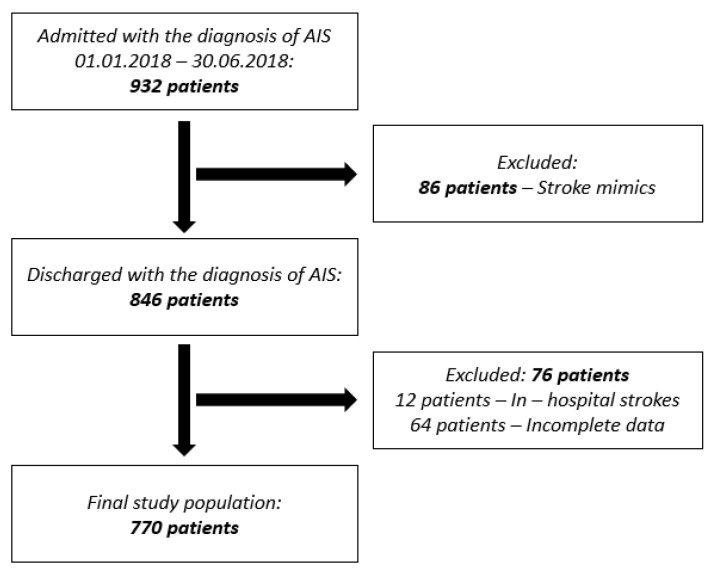
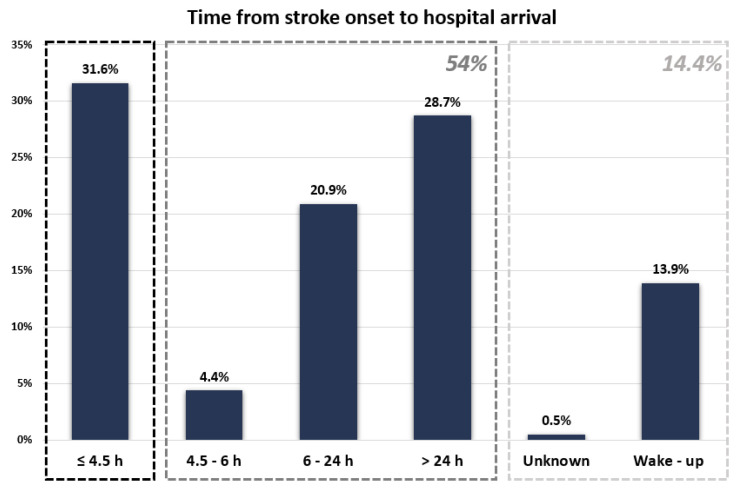
Background and objectives: The time interval between stroke onset and hospital arrival is a major barrier for reperfusion therapies in acute ischemic stroke and usually accounts for most of the onset-to-treatment delay. The present study aimed to analyze the pre-hospital delays for patients with acute ischemic stroke admitted to a tertiary stroke center in Romania and to identify the factors associated with a late hospital arrival. Material and methods: The study population consisted of 770 patients hospitalized with the diagnosis of acute ischemic stroke in the University Emergency Hospital Bucharest during a 6-month period, between 1 January and 30 June 2018. Data regarding pre-hospital delays were prospectively collected and analyzed together with the demographic and clinical characteristics of the patients. Results: In total, 31.6% of patients arrived at the hospital within 4.5 h from stroke onset and 4.4% in time intervals between 4.5 and 6 h from the onset, and 28.7% of the patients reached the hospital more than 24 h after onset of symptoms. Transport to hospital by own means was the only factor positively associated with arrival to hospital > 4.5 h from stroke onset and more than doubled the odds of late arrival. Factors negatively associated with hospital arrival > 4.5 h after stroke onset were prior diagnosis of atrial fibrillation, initial National Institute of Health Stroke Scale (NIHSS) score ≥ 16 points, presence of hemianopsia, facial palsy and sensory disturbance. Factors increasing the odds of hospital arrival after 24 h from stroke onset were living alone and living in rural areas. Conclusions: Almost one in three ischemic stroke patients presenting to our center reaches hospital more than 24 h after onset of symptoms. These findings highlight the need for urgent measures to improve not only stroke awareness but also pre-hospital protocols in order to provide timely and appropriate care for our stroke patients.
卒中发作与医院到达之间的时间间隔是急性缺血性卒中再灌注治疗的主要障碍,通常占发病至治疗延迟的大部分时间。本研究旨在分析罗马尼亚一家三级卒中中心收治的急性缺血性卒中患者的院前延迟,并确定与延迟到达医院相关的因素。
研究人群包括 2018 年 1 月 1 日至 6 月 30 日期间在布加勒斯特大学急诊医院住院的 770 例急性缺血性卒中患者。前瞻性收集并分析了与患者人口统计学和临床特征相关的院前延迟数据。
共有 31.6%的患者在卒中发作后 4.5 小时内到达医院,4.4%的患者在 4.5 至 6 小时的时间间隔内到达医院,28.7%的患者在症状发作后 24 小时以上到达医院。自行前往医院是唯一与发病后 4.5 小时以上到达医院相关的积极因素,使到达时间晚的几率增加一倍以上。与发病后 4.5 小时内到达医院相关的负性因素是先前诊断为心房颤动、初始国立卫生研究院卒中量表(NIHSS)评分≥16 分、存在偏盲、面瘫和感觉障碍。增加发病后 24 小时到达医院的几率的因素是独居和居住在农村地区。
我们中心就诊的缺血性卒中患者中,近三分之一在症状发作后 24 小时以上到达医院。这些发现强调需要采取紧急措施,不仅要提高卒中意识,还要改进院前方案,以便为我们的卒中患者提供及时和适当的护理。