Division of Nephrology, National Clinical Research Center for Kidney Disease, State Key Laboratory of Organ Failure Research, Guangdong Provincial Institute of Nephrology, Guangdong Provincial Key Laboratory of Renal Failure Research, Nanfang Hospital, Southern Medical University, Guangzhou 510515, China.
Department of Epidemiology and Biostatistics, School of Public Health, Anhui Medical University, Hefei 230032, China.
Nutrients. 2022 Aug 9;14(16):3251. doi: 10.3390/nu14163251.
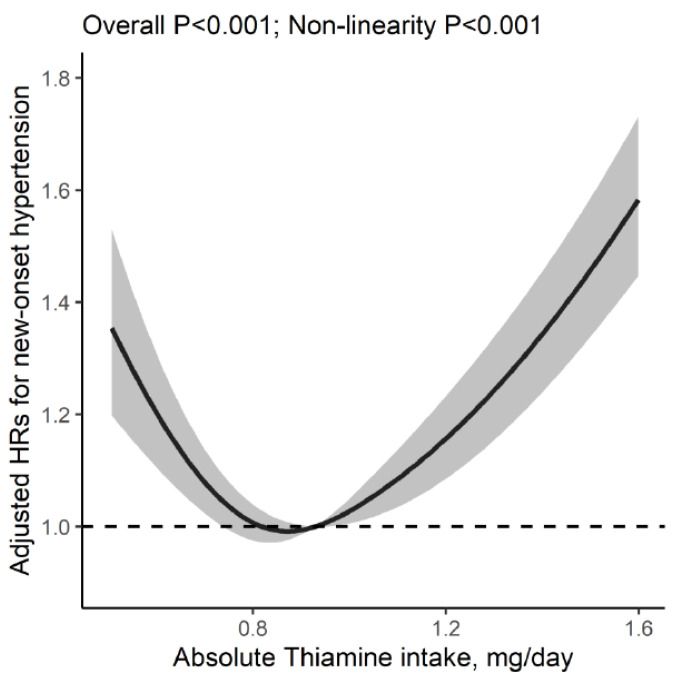
Background: To examine the relation of dietary thiamine intake with risk of new-onset hypertension in the general adults. Methods: A total of 12,177 participants without hypertension at baseline from China Health and Nutrition Survey (CHNS) were included. The study outcome was new-onset hypertension, which was defined as a systolic blood pressure ≥140 mm Hg or a diastolic blood pressure ≥90 mm Hg or under antihypertensive treatment or diagnosed by physician during the follow-up. Results: A total of 4269 participants occurred new-onset hypertension over a median follow-up of 6.1 years. Overall, there was a U-shaped relation (p for nonlinearity <0.001) of dietary thiamine intake with new-onset hypertension, with an inflection point at 0.93 mg/day. Accordingly, in the threshold effect analysis, there was an inverse association between dietary thiamine intake (per SD increment: HR, 0.62; 95% CI: 0.53, 0.72) and new-onset hypertension in participants with dietary thiamine intake <0.93 mg/day, and a positive association between dietary thiamine intake (per SD increment: HR, 1.38; 95% CI: 1.32, 1.44) and new-onset hypertension in those with dietary thiamine intake ≥0.93 mg/day. Conclusion: The association between dietary thiamine intake and the risk of new-onset hypertension followed a U-shaped relation in the general Chinese population, with an inflection point at 0.93 mg/day of dietary thiamine intake.
研究饮食中硫胺素摄入量与一般成年人新发高血压风险的关系。
本研究共纳入了来自中国健康与营养调查(CHNS)的 12177 名基线时无高血压的参与者。研究结局为新发高血压,定义为收缩压≥140mmHg 或舒张压≥90mmHg 或正在接受降压治疗或在随访期间被医生诊断为高血压。
在中位随访 6.1 年后,共有 4269 名参与者发生了新发高血压。总体而言,饮食中硫胺素摄入量与新发高血压之间呈 U 形关系(p 非线性<0.001),拐点为 0.93mg/天。因此,在阈值效应分析中,饮食中硫胺素摄入量(每标准差增加:HR,0.62;95%CI:0.53,0.72)与饮食中硫胺素摄入量<0.93mg/天的参与者新发高血压呈负相关,而饮食中硫胺素摄入量(每标准差增加:HR,1.38;95%CI:1.32,1.44)与饮食中硫胺素摄入量≥0.93mg/天的参与者新发高血压呈正相关。
在中国一般人群中,饮食中硫胺素摄入量与新发高血压风险之间呈 U 形关系,拐点为 0.93mg/天的饮食中硫胺素摄入量。