Center for Research and Innovation in Clinical Pharmaceutical Sciences, University Hospital of Lausanne, CH-1011 Lausanne, Switzerland.
Department of Intensive Care Medicine, Inselspital, Bern University Hospital, University of Bern, CH-3010 Bern, Switzerland.
Viruses. 2022 Aug 16;14(8):1792. doi: 10.3390/v14081792.
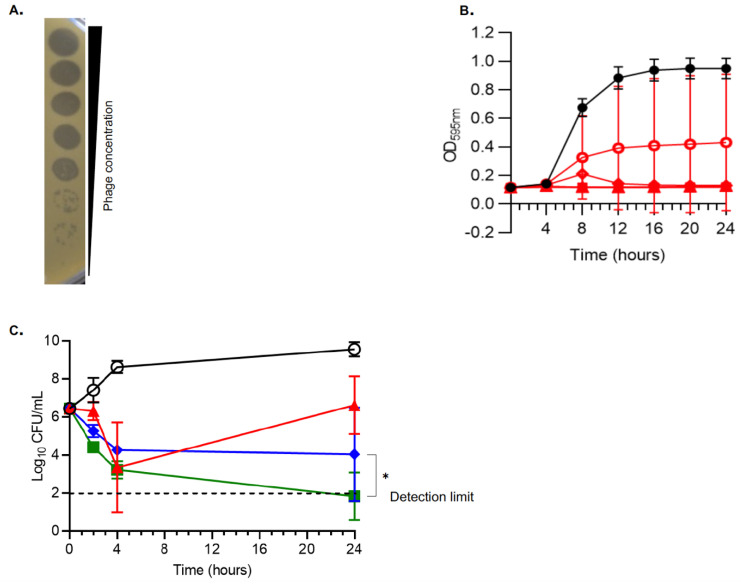
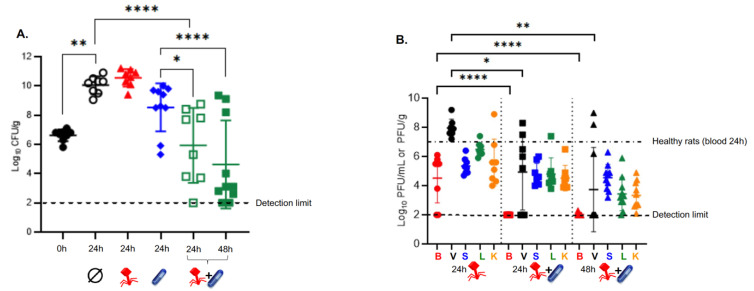
Background. Recurrent therapeutic failures reported for the treatment of methicillin-resistant Staphylococcus aureus (MRSA) infective endocarditis (IE) with vancomycin may be due to poor bactericidal activity. Alternative antibacterial approaches using bacteriophages may overcome this limitation. Objectives. An experimental rat model of MRSA IE (EE) was used to examine the efficacy of vancomycin combined with a 1:1 bacteriophage (phage) cocktail composed of Herelleviridae vB_SauH_2002 and Routreeviridae 66. Methods. Six hours after inoculation with ca. 5 log10 colony forming units (CFU) of MRSA strain AW7, animals were treated with either: (i) saline, (ii) an equimolar two-phage cocktail (bolus of 1 mL followed by a 0.3 mL/h continuous infusion of 10 log10 plaque forming units (PFU)/mL phage suspension), (iii) vancomycin (at a dose mimicking the kinetics in humans of 0.5 g b.i.d.), or (iv) a combination of both. Bacterial loads in vegetations, and phage loads in vegetations, liver, kidney, spleen, and blood, were measured outcomes. Results. Phage cocktail alone was unable to control the growth of strain AW7 in cardiac vegetations. However, when combined with subtherapeutic doses of vancomycin, a statistically significant decrease of ∆4.05 ± 0.94 log10 CFU/g at 24 h compared to placebo was detected (p < 0.001). The administration of vancomycin was found to significantly impact on the local concentrations of phages in the vegetations and in the organs examined. Conclusions. Lytic bacteriophages as an adjunct treatment to the standard of care antibiotics could potentially improve the management of MRSA IE. Further studies are needed to investigate the impact of antibiotics on phage replication in vivo.
万古霉素治疗耐甲氧西林金黄色葡萄球菌(MRSA)感染性心内膜炎(IE)的治疗失败率反复报告,这可能是由于杀菌活性差所致。使用噬菌体的替代抗菌方法可能克服这一限制。
使用 MRSA IE(EE)实验大鼠模型,研究万古霉素联合由 Herelleviridae vB_SauH_2002 和 Routreeviridae 66 组成的 1:1 噬菌体鸡尾酒的疗效。
在接种约 5 个对数 10 菌落形成单位(CFU)的 MRSA 菌株 AW7 6 小时后,动物接受以下治疗之一:(i)生理盐水,(ii)等摩尔两噬菌体鸡尾酒(1 毫升弹丸,随后以 0.3 毫升/小时的速度连续输注 10 对数 10 噬菌斑形成单位(PFU)/毫升噬菌体悬浮液),(iii)万古霉素(模拟人类动力学剂量为 0.5 g 每日两次),或(iv)两者的组合。测量植被、肝脏、肾脏、脾脏和血液中的细菌负荷和噬菌体负荷作为结果。
噬菌体鸡尾酒单独不能控制 AW7 菌株在心脏植被中的生长。然而,当与亚治疗剂量的万古霉素联合使用时,与安慰剂相比,24 小时时细菌负荷降低了统计学上显著的 ∆4.05 ± 0.94 log10 CFU/g(p < 0.001)。万古霉素的给药被发现显著影响植被和检查器官中噬菌体的局部浓度。
作为标准治疗抗生素的辅助治疗,裂解噬菌体有可能改善 MRSA IE 的治疗管理。需要进一步研究抗生素对体内噬菌体复制的影响。