Department of Neurology, Keelung Hospital,Ministry of Health and Welfare, No. 268, Xin 2nd Rd., Xinyi Dist, Keelung, 20148, Taiwan, ROC.
Neurological Institute, Taipei Veterans General Hospital, No. 201, Sec.2, Shipai Rd., Beitou Dist, Taipei, 112201, Taiwan, ROC.
Sci Rep. 2022 Aug 26;12(1):14590. doi: 10.1038/s41598-022-17619-9.
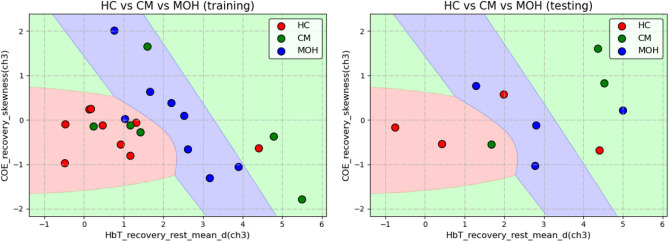
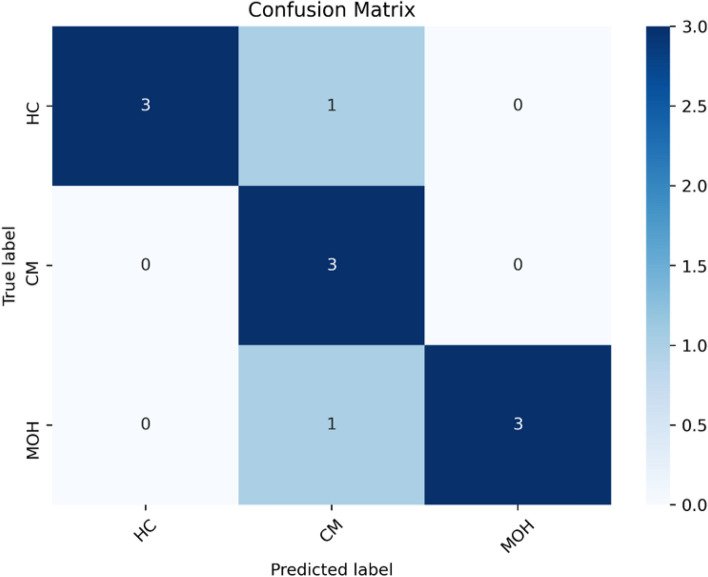
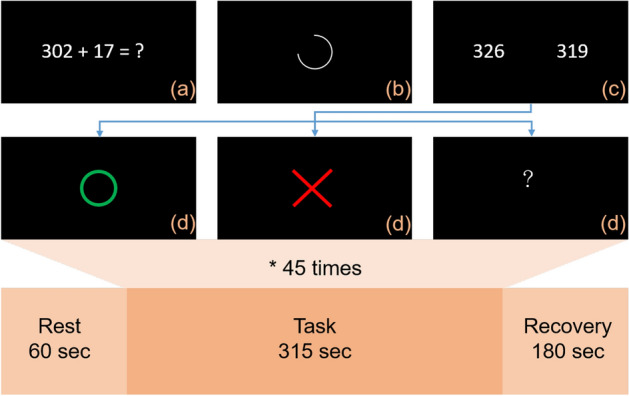
Migraine is a common and complex neurovascular disorder. Clinically, the diagnosis of migraine mainly relies on scales, but the degree of pain is too subjective to be a reliable indicator. It is even more difficult to diagnose the medication-overuse headache, which can only be evaluated by whether the symptom is improved after the medication adjustment. Therefore, an objective migraine classification system to assist doctors in making a more accurate diagnosis is needed. In this research, 13 healthy subjects (HC), 9 chronic migraine subjects (CM), and 12 medication-overuse headache subjects (MOH) were measured by functional near-infrared spectroscopy (fNIRS) to observe the change of the hemoglobin in the prefrontal cortex (PFC) during the mental arithmetic task (MAT). Our model shows the sensitivity and specificity of CM are 100% and 75%, and that of MOH is 75% and 100%.The results of the classification of the three groups prove that fNIRS combines with machine learning is feasible for the migraine classification.
偏头痛是一种常见且复杂的神经血管性疾病。临床上,偏头痛的诊断主要依赖于量表,但疼痛程度过于主观,无法作为可靠的指标。药物过度使用性头痛的诊断则更为困难,只能通过药物调整后症状是否改善来评估。因此,需要一种客观的偏头痛分类系统来帮助医生做出更准确的诊断。在这项研究中,通过功能性近红外光谱(fNIRS)对 13 名健康受试者(HC)、9 名慢性偏头痛受试者(CM)和 12 名药物过度使用性头痛受试者(MOH)进行测量,观察他们在心理算术任务(MAT)中前额叶皮层(PFC)中血红蛋白的变化。我们的模型显示,CM 的灵敏度和特异性分别为 100%和 75%,MOH 的灵敏度和特异性分别为 75%和 100%。三组的分类结果证明,fNIRS 与机器学习相结合可用于偏头痛的分类。