College of Public Health, Medical and Veterinary Sciences, James Cook University, Cairns, Australia.
Australian Institute of Tropical Health and Medicine, James Cook University, Cairns, Australia.
Parasit Vectors. 2022 Aug 27;15(1):303. doi: 10.1186/s13071-022-05413-5.
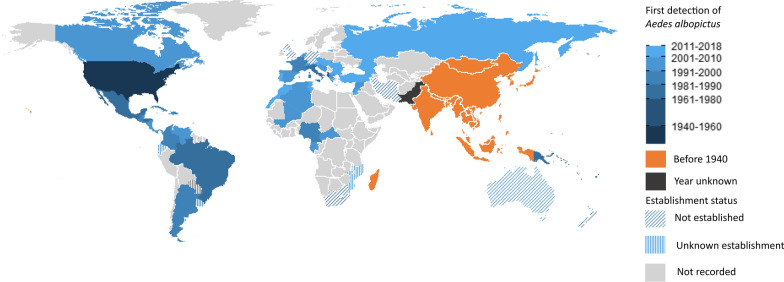
Aedes albopictus is a highly invasive species and an important vector of dengue and chikungunya viruses. Indigenous to Southeast Asia, Ae. albopictus has successfully invaded every inhabited continent, except Antarctica, in the past 80 years. Vector surveillance and control at points of entry (PoE) is the most critical front line of defence against the introduction of Ae. albopictus to new areas. Identifying the pathways by which Ae. albopictus are introduced is the key to implementing effective vector surveillance to rapidly detect introductions and to eliminate them.
A literature review was conducted to identify studies and data sources reporting the known and suspected dispersal pathways of human-mediated Ae. albopictus dispersal between 1940-2020. Studies and data sources reporting the first introduction of Ae. albopictus in a new country were selected for data extraction and analyses.
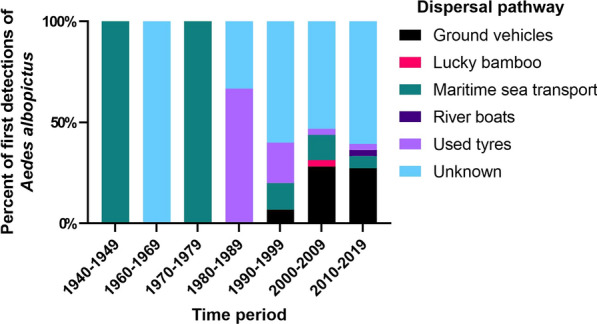
Between 1940-2020, Ae. albopictus was reported via various dispersal pathways into 86 new countries. Two main dispersal pathways were identified: (1) at global and continental spatial scales, maritime sea transport was the main dispersal pathway for Ae. albopictus into new countries in the middle to late 20th Century, with ships carrying used tyres of particular importance during the 1980s and 1990s, and (2) at continental and national spatial scales, the passive transportation of Ae. albopictus in ground vehicles and to a lesser extent the trade of used tyres and maritime sea transport appear to be the major drivers of Ae. albopictus dispersal into new countries, especially in Europe. Finally, the dispersal pathways for the introduction and spread of Ae. albopictus in numerous countries remains unknown, especially from the 1990s onwards.
This review identified the main known and suspected dispersal pathways of human-mediated Ae. albopictus dispersal leading to the first introduction of Ae. albopictus into new countries and highlighted gaps in our understanding of Ae. albopictus dispersal pathways. Relevant advances in vector surveillance and genomic tracking techniques are presented and discussed in the context of improving vector surveillance.
白纹伊蚊是一种高度入侵性物种,也是登革热和基孔肯雅热病毒的重要传播媒介。原产于东南亚,白纹伊蚊在过去的 80 年里成功地入侵了除南极洲以外的每一个有人居住的大陆。在入境点(PoE)进行病媒监测和控制是防止白纹伊蚊传入新地区的最重要的第一道防线。确定白纹伊蚊传入的途径是实施有效病媒监测以快速发现传入并加以消除的关键。
对 1940 年至 2020 年间报告的已知和疑似白纹伊蚊通过人为媒介传播的路径的研究和数据源进行了文献回顾。选择报告新国家首次引入白纹伊蚊的研究和数据源进行数据提取和分析。
在 1940 年至 2020 年间,通过各种传播途径向 86 个新国家报告了白纹伊蚊。确定了两种主要的传播途径:(1)在全球和大陆尺度上,海上运输是 20 世纪中后期白纹伊蚊传入新国家的主要传播途径,船只携带的旧轮胎在 20 世纪 80 年代和 90 年代尤为重要;(2)在大陆和国家尺度上,白纹伊蚊在陆地车辆中的被动运输,以及在较小程度上的旧轮胎贸易和海上运输,似乎是白纹伊蚊传入新国家的主要驱动因素,尤其是在欧洲。最后,白纹伊蚊在许多国家的引入和传播的传播途径仍然未知,特别是在 20 世纪 90 年代以后。
本综述确定了导致白纹伊蚊首次传入新国家的主要已知和疑似人为媒介白纹伊蚊传播的传播途径,并强调了我们对白纹伊蚊传播途径理解上的差距。在提高病媒监测的背景下,提出并讨论了病媒监测和基因组跟踪技术的相关进展。