Department of Pathogen Biology, School of Public Health, Southern Medical University, Guangzhou, China.
Program in Public Health, College of Health Sciences, University of California, Irvine, USA.
Parasit Vectors. 2019 Nov 21;12(1):552. doi: 10.1186/s13071-019-3801-4.
The Asian tiger mosquito, Aedes albopictus, is one of the 100 worst invasive species in the world and the vector for several arboviruses including dengue, Zika and chikungunya viruses. Understanding the population spatial genetic structure, migration, and gene flow of vector species is critical to effectively preventing and controlling vector-borne diseases. Little is known about the population structure and genetic differentiation of native Ae. albopictus in China. The aim of this study was to examine the patterns of the spatial genetic structures of native Ae. albopictus populations, and their relationship to dengue incidence, on a large geographical scale.
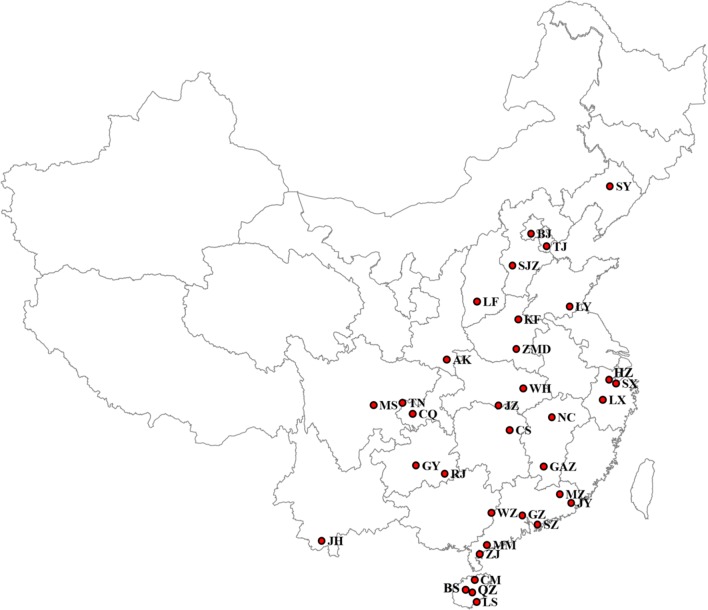
During 2016-2018, adult female Ae. albopictus mosquitoes were collected by human landing catch (HLC) or human-bait sweep-net collections in 34 localities across China. Thirteen microsatellite markers were used to examine the patterns of genetic diversity, population structure, and gene flow among native Ae. albopictus populations. The correlation between population genetic indices and dengue incidence was also examined.
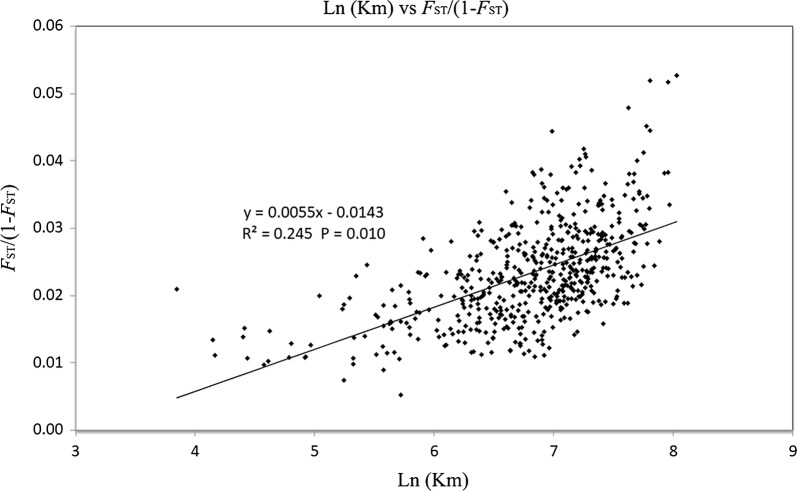
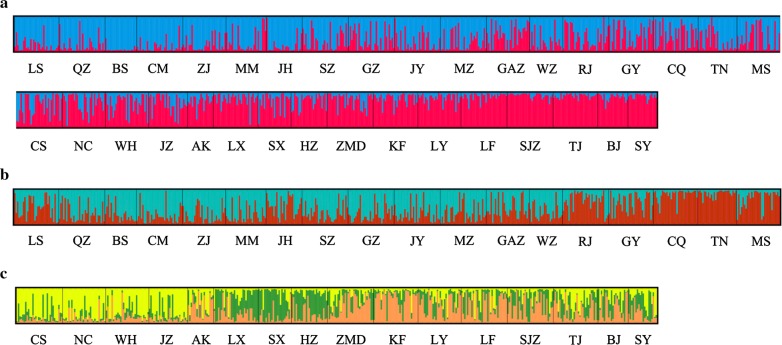
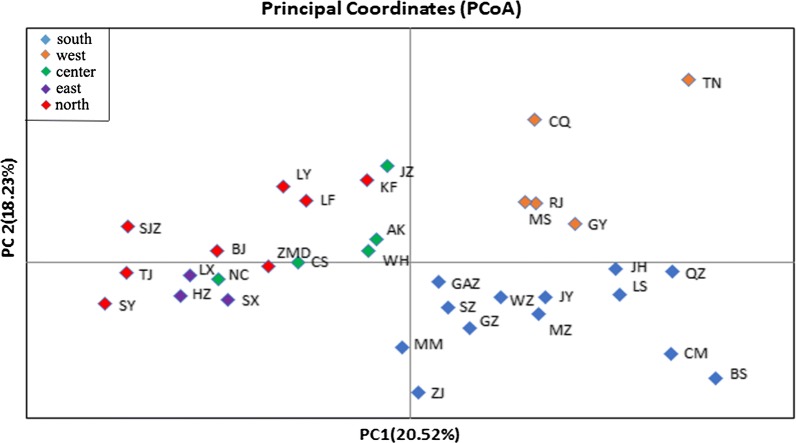
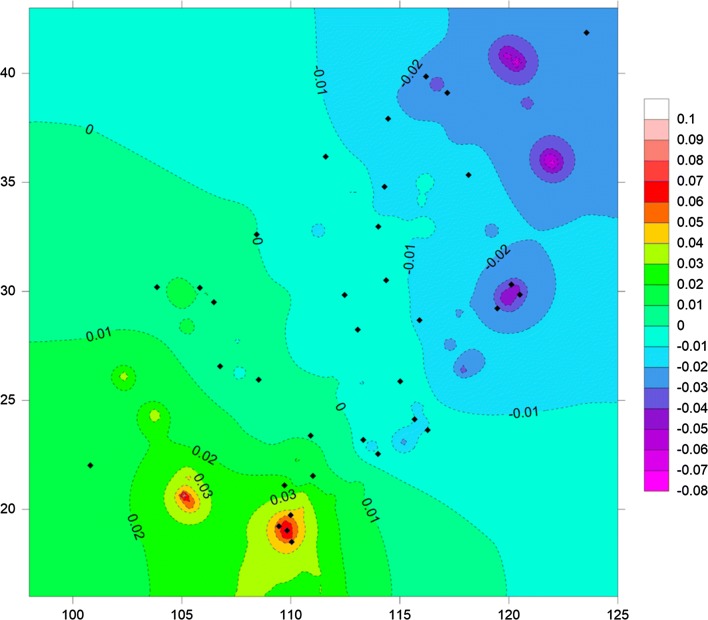
A total of 153 distinct alleles were identified at the 13 microsatellite loci in the tested populations. All loci were polymorphic, with the number of distinct alleles ranging from eight to sixteen. Genetic parameters such as PIC, heterozygosity, allelic richness and fixation index (F) revealed highly polymorphic markers, high genetic diversity, and low population genetic differentiation. In addition, Bayesian analysis of population structure showed two distinct genetic groups in southern-western and eastern-central-northern China. The Mantel test indicated a positive correlation between genetic distance and geographical distance (R = 0.245, P = 0.01). STRUCTURE analysis, PCoA and GLS interpolation analysis indicated that Ae. albopictus populations in China were regionally clustered. Gene flow and relatedness estimates were generally high between populations. We observed no correlation between population genetic indices of microsatellite loci in Ae. albopictus populations and dengue incidence.
Strong gene flow probably assisted by human activities inhibited population differentiation and promoted genetic diversity among populations of Ae. albopictus. This may represent a potential risk of rapid spread of mosquito-borne diseases. The spatial genetic structure, coupled with the association between genetic indices and dengue incidence, may have important implications for understanding the epidemiology, prevention, and control of vector-borne diseases.
亚洲虎蚊,白纹伊蚊,是世界上 100 种最具入侵性的物种之一,也是登革热、寨卡和基孔肯雅热等几种虫媒病毒的传播媒介。了解病媒物种的种群空间遗传结构、迁移和基因流对于有效预防和控制虫媒疾病至关重要。目前,对于中国本土白纹伊蚊种群的种群结构和遗传分化知之甚少。本研究旨在检验中国本土白纹伊蚊种群的空间遗传结构模式及其与登革热发病率的关系。
2016-2018 年,通过人体诱捕(HLC)或人工诱饵扫网法在全国 34 个地点采集成年雌性白纹伊蚊。使用 13 个微卫星标记来检验本土白纹伊蚊种群的遗传多样性、种群结构和基因流模式。还检验了种群遗传指标与登革热发病率之间的相关性。
在检测的种群中,13 个微卫星位点共鉴定出 153 个独特等位基因。所有位点均为多态性,独特等位基因数从 8 到 16 不等。遗传参数,如 PIC、杂合度、等位基因丰富度和固定指数(F),揭示了高度多态性的标记、高遗传多样性和低种群遗传分化。此外,种群结构的贝叶斯分析显示,中国西南部和中东部-北部存在两个不同的遗传群体。Mantel 检验表明遗传距离与地理距离呈正相关(R=0.245,P=0.01)。STRUCTURE 分析、PCoA 和 GLS 插值分析表明,中国的白纹伊蚊种群呈区域性聚类。种群之间的基因流和相关性估计通常较高。我们没有观察到白纹伊蚊种群微卫星位点的种群遗传指标与登革热发病率之间的相关性。
可能是人类活动引起的强烈基因流抑制了种群分化,并促进了白纹伊蚊种群之间的遗传多样性。这可能代表了蚊媒疾病快速传播的潜在风险。空间遗传结构,加上遗传指标与登革热发病率之间的关联,可能对理解虫媒疾病的流行病学、预防和控制具有重要意义。