
国际实地试验中使用雄蚊声诱捕器的结果:在捕获目标物种与兼捕数量的关系方面,频率依赖性有效性。
Outcomes from international field trials with Male Aedes Sound Traps: Frequency-dependent effectiveness in capturing target species in relation to bycatch abundance.
机构信息
College of Public Health, Medical and Veterinary Sciences, James Cook University, Smithfield, Australia.
Australian Institute of Tropical Health and Medicine, James Cook University, Smithfield, Australia.
出版信息
PLoS Negl Trop Dis. 2021 Feb 25;15(2):e0009061. doi: 10.1371/journal.pntd.0009061. eCollection 2021 Feb.
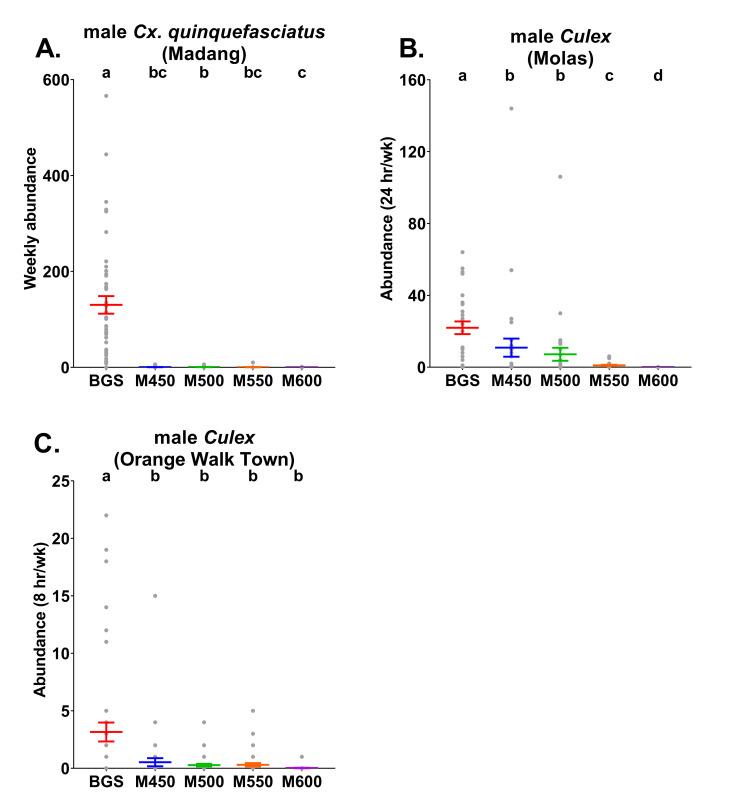
Aedes aegypti and Aedes albopictus vector dengue, chikungunya and Zika viruses. With both species expanding their global distributions at alarming rates, developing effective surveillance equipment is a continuing priority for public health researchers. Sound traps have been shown, in limited testing, to be highly species-specific when emitting a frequency corresponding to a female mosquito wingbeat. Determining male mosquito capture rates in sound traps based on lure frequencies in endemic settings is the next step for informed deployment of these surveillance tools. We field-evaluated Male Aedes Sound Traps (MASTs) set to either 450 Hz, 500 Hz, 550 Hz or 600 Hz for sampling Aedes aegypti and/or Aedes albopictus and compared catch rates to BG-Sentinel traps within Pacific (Madang, Papua New Guinea) and Latin American (Molas, Mexico and Orange Walk Town, Belize) locations. MASTs set to 450-550 Hz consistently caught male Ae. aegypti at rates comparable to BG-Sentinel traps in all locations. A peak in male Ae. albopictus captures in MASTs set at 550 Hz was observed, with the lowest mean abundance recorded in MASTs set to 450 Hz. While significantly higher abundances of male Culex were sampled in MASTs emitting lower relative frequencies in Molas, overall male Culex were captured in significantly lower abundances in the MASTs, relative to BG-Sentinel traps within all locations. Finally, significant differences in rates at which male Aedes and Culex were positively detected in trap-types per weekly collections were broadly consistent with trends in abundance data per trap-type. MASTs at 550 Hz effectively captured both male Ae. aegypti and Ae. albopictus while greatly reducing bycatch, especially male Culex, in locations where dengue transmission has occurred. This high species-specificity of the MAST not only reduces staff-time required to sort samples, but can also be exploited to develop an accurate smart-trap system-both outcomes potentially reducing public health program expenses.
埃及伊蚊和白纹伊蚊可传播登革热、基孔肯雅热和寨卡病毒。由于这两个物种的分布范围正在以惊人的速度扩大,因此开发有效的监测设备仍然是公共卫生研究人员的当务之急。在有限的测试中,已经证明声音陷阱在发出与雌性蚊子翅膀拍打相对应的频率时具有非常高的物种特异性。在地方性环境中,根据诱饵频率确定声音陷阱中雄性蚊子的捕获率是明智部署这些监测工具的下一步。我们在实地评估了基于 450 Hz、500 Hz、550 Hz 和 600 Hz 频率设置的雄性伊蚊声音陷阱(MAST),用于采样埃及伊蚊和/或白纹伊蚊,并将捕获率与太平洋(巴布亚新几内亚的马当)和拉丁美洲(墨西哥的莫拉斯和伯利兹的奥兰治沃克镇)的 BG-Sentinel 陷阱进行了比较。在所有地点,MAST 设置在 450-550 Hz 时始终以与 BG-Sentinel 陷阱相当的速率捕获雄性埃及伊蚊。在 MAST 中观察到 550 Hz 时雄性白纹伊蚊捕获量的峰值,而在 MAST 中记录到的最低平均丰度为 450 Hz。虽然在莫拉斯的相对低频 MAST 中采样到的雄性库蚊数量明显较高,但总体而言,与所有地点的 BG-Sentinel 陷阱相比,MAST 中捕获的雄性库蚊数量明显较少。最后,每周采集时每种诱捕器类型中雄性伊蚊和库蚊的阳性检出率差异显著,这与每种诱捕器类型的丰度数据趋势基本一致。在已经发生登革热传播的地点,550 Hz 的 MAST 不仅有效地捕获了雄性埃及伊蚊和白纹伊蚊,而且大大减少了副捕获物,尤其是雄性库蚊。这种 MAST 的高物种特异性不仅减少了分类样本所需的员工时间,还可以用于开发一种准确的智能陷阱系统,这两种结果都有可能降低公共卫生计划的费用。


 Zotero 插件