Department of General Surgery, Second Hospital of Lanzhou University, Lanzhou, China.
Key Laboratory of the Digestive System Tumors of Gansu Province, Second Hospital of Lanzhou University, Lanzhou, China.
Front Immunol. 2022 Aug 11;13:937327. doi: 10.3389/fimmu.2022.937327. eCollection 2022.
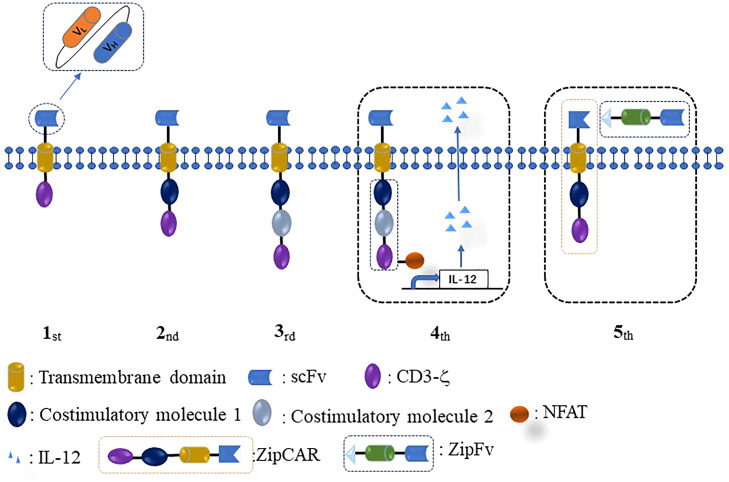
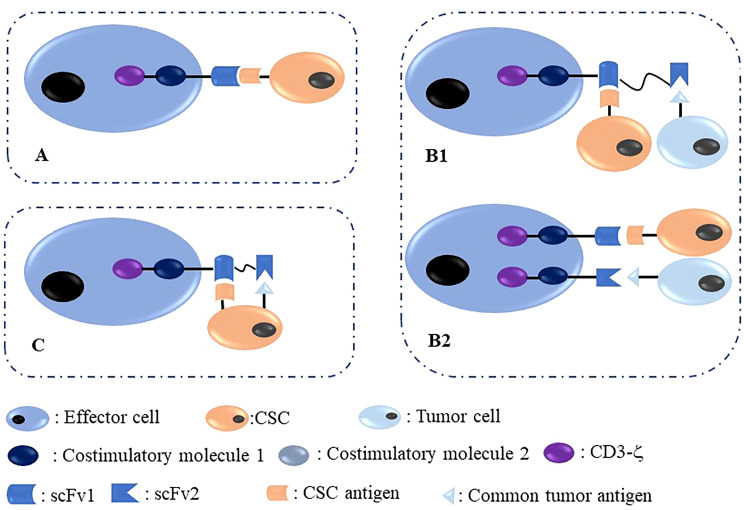
Tumors pose a great threat to human health; as a subgroup of tumor cells, cancer stem cells (CSCs) contribute to the genesis, development, metastasis, and recurrence of tumors because of their enhanced proliferation and multidirectional differentiation. Thus, a critical step in tumor treatment is to inhibit CSCs. Researchers have proposed many methods to inhibit or reduce CSCs, including monoclonal antibodies targeting specific surface molecules of CSCs, signal pathway inhibitors, and energy metabolic enzyme inhibitors and inducing differentiation therapy. Additionally, immunotherapy with immune cells engineered with a chimeric antigen receptor (CAR) showed favorable results. However, there are few comprehensive reviews in this area. In this review, we summarize the recent CSC targets used for CSC inhibition and the different immune effector cells (T cells, natural killer (NK) cells, and macrophages) which are engineered with CAR used for CSC therapy. Finally, we list the main challenges and options in targeting CSC with CAR-based immunotherapy. The design targeting two tumor antigens (one CSC antigen and one mature common tumor antigen) should be more reasonable and practical; meanwhile, we highlight the potential of CAR-NK in tumor treatment.
肿瘤对人类健康构成了巨大威胁;作为肿瘤细胞的亚群,肿瘤干细胞(CSC)由于其增强的增殖和多向分化能力,促进了肿瘤的发生、发展、转移和复发。因此,肿瘤治疗的关键步骤是抑制 CSC。研究人员提出了许多抑制或减少 CSC 的方法,包括针对 CSC 特定表面分子的单克隆抗体、信号通路抑制剂和能量代谢酶抑制剂以及诱导分化治疗。此外,嵌合抗原受体(CAR)修饰的免疫细胞的免疫疗法也显示出良好的效果。然而,该领域的全面综述较少。在这篇综述中,我们总结了最近用于 CSC 抑制的 CSC 靶点和用 CAR 修饰的不同免疫效应细胞(T 细胞、自然杀伤(NK)细胞和巨噬细胞)用于 CSC 治疗。最后,我们列出了 CAR 免疫疗法靶向 CSC 的主要挑战和选择。设计针对两种肿瘤抗原(一种 CSC 抗原和一种成熟的常见肿瘤抗原)应该更合理和实用;同时,我们强调了 CAR-NK 在肿瘤治疗中的潜力。