Klaus Federica, Nguyen Tanya T, Thomas Michael L, Liou Sharon C, Soontornniyomkij Benchawanna, Mitchell Kyle, Daly Rebecca, Sutherland Ashley N, Jeste Dilip V, Eyler Lisa T
Department of Psychiatry, UC San Diego, La Jolla, CA, United States.
VA San Diego Healthcare System, La Jolla, CA, United States.
Front Psychiatry. 2022 Aug 12;13:966439. doi: 10.3389/fpsyt.2022.966439. eCollection 2022.
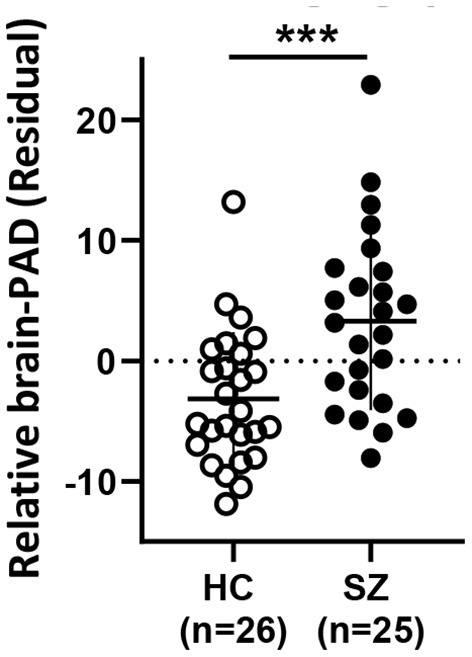
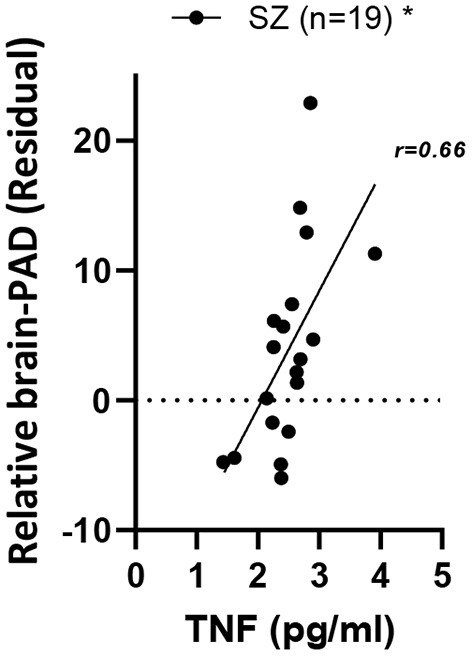
Brain structural abnormalities have been demonstrated in schizophrenia (SZ); these resemble those seen in typical aging, but are seen at younger ages. Furthermore, SZ is associated with accelerated global brain aging, as measured by brain structure-based brain predicted age difference (Brain-PAD). High heterogeneity exists in the degree of brain abnormalities in SZ, and individual differences may be related to levels of peripheral inflammation and may relate to cognitive deficits and negative symptoms. The goal of our study was to investigate the relationship between brain aging, peripheral inflammation, and symptoms of SZ. We hypothesized older brain-PAD in SZ vs. healthy comparison (HC) participants, as well as positive relationships of brain-PAD with peripheral inflammation markers and symptoms in SZ. We analyzed data from two cross-sectional studies in SZ ( = 26; M/F: 21/5) and HC ( = 28; 20/8) (22-64 years). Brain-PAD was calculated using a previously validated Gaussian process regression model applied to raw T1-weighted MRI data. Plasma levels of inflammatory biomarkers (CRP, Eotaxin, Fractalkine, IP10, IL6, IL10, ICAM1, IFNγ, MCP1, MIP1β, SAA, TNFα, VEGF, VCAM1) and cognitive and negative symptoms were assessed. We observed a higher brain-PAD in SZ vs. HC, and advanced brain age relative to chronological age was related to higher peripheral levels of TNFα in the overall group and in the SZ group; other inflammatory markers were not related to brain-PAD. Within the SZ group, we observed no association between cognitive or negative symptoms and brain-PAD. These results support our hypothesis of advanced brain aging in SZ. Furthermore, our findings on the relationship of the pro-inflammatory cytokine TNFα with higher brain-PAD of SZ are relevant to explain heterogeneity of brain ages in SZ, but we did not find strong evidence for cognitive or negative symptom relationships with brain-PAD.
精神分裂症(SZ)患者已被证实存在脑结构异常;这些异常与典型衰老过程中出现的异常相似,但在更年轻的年龄段就会出现。此外,通过基于脑结构的脑预测年龄差异(Brain-PAD)来衡量,SZ与加速的全脑衰老有关。SZ患者脑异常程度存在高度异质性,个体差异可能与外周炎症水平有关,也可能与认知缺陷和阴性症状有关。我们研究的目的是调查脑衰老、外周炎症与SZ症状之间的关系。我们假设SZ患者相较于健康对照(HC)参与者的Brain-PAD更大,并且在SZ患者中Brain-PAD与外周炎症标志物及症状呈正相关。我们分析了来自两项关于SZ(n = 26;男/女:21/5)和HC(n = 28;20/8)(年龄22 - 64岁)的横断面研究的数据。使用先前验证的高斯过程回归模型,将其应用于原始T1加权MRI数据来计算Brain-PAD。评估了炎症生物标志物(CRP、嗜酸性粒细胞趋化因子、 fractalkine、IP10、IL6、IL10、ICAM1、IFNγ、MCP1、MIP1β、SAA、TNFα、VEGF、VCAM1)的血浆水平以及认知和阴性症状。我们观察到SZ患者的Brain-PAD高于HC患者,并且相对于实际年龄,脑年龄提前与总体组和SZ组中更高的外周TNFα水平相关;其他炎症标志物与Brain-PAD无关。在SZ组内,我们未观察到认知或阴性症状与Brain-PAD之间存在关联。这些结果支持了我们关于SZ患者脑衰老提前的假设。此外,我们关于促炎细胞因子TNFα与SZ患者更高的Brain-PAD之间关系的发现,对于解释SZ患者脑年龄的异质性具有重要意义,但我们没有找到认知或阴性症状与Brain-PAD之间关系的有力证据。