Parks Simon, Hookway Helen, Kojima Kazunobu, Bennett Allan
Biosafety, Air and Water Microbiology Group, National Infection Service, Salisbury, United Kingdom.
World Health Organization, Geneva, Switzerland.
Appl Biosaf. 2022 Mar 1;27(1):23-32. doi: 10.1089/apb.2021.0010. Epub 2022 Mar 15.
The operator protection factor (OPF) of four biological safety cabinets (BSCs) has been measured under standard and suboptimal conditions.
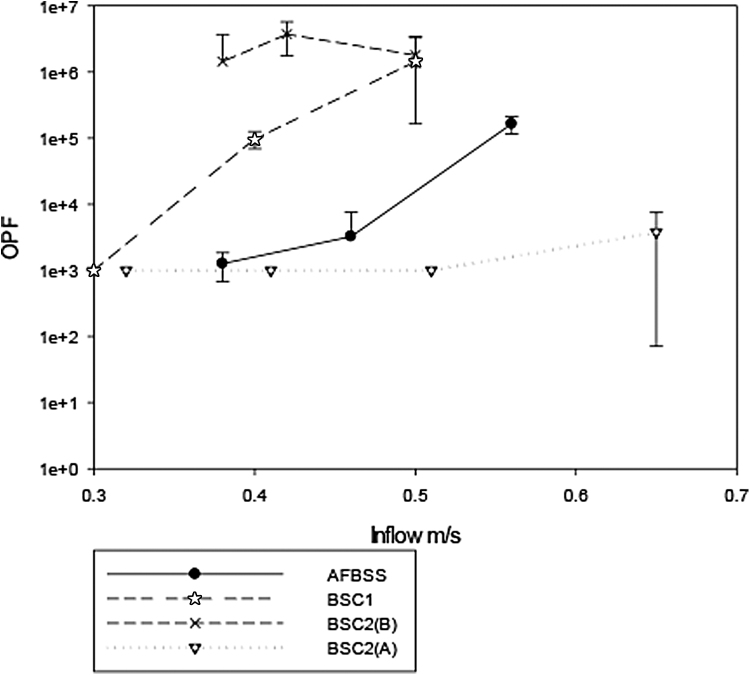
The OPF for one BSC1, two BSC2, and an acid-fast bacilli staining station (AFBSS) was measured using the potassium iodide method for in situ testing of BSCs (CEN12469) over a range of inflow velocities under standard conditions and with common interfering factors (fans, opening doors, and walk pasts).
The BSC1 and the AFBSS gave a high level of protection under standard test conditions at all airflows (down to 0.3 and 0.38 m/s, respectively). During interfering processes, the BSC1 and AFBSS gave a high level of protection (OPF >10) at the specified inward airflow. At lower airflows, there was a predictable deterioration in performance. There was a significant difference in performance between the two BSC2s tested, with one model passing all tests under all interfering conditions at all airflows. The second BSC2 failed the standard test at the lowest airflow and provided poor levels of protection (OPF <10) in all tests carried out with interfering processes.
Although BSC2s are capable of giving a high level of performance, this is design dependent and the BSC1 and AFBSS give a more predictable level of performance due to their simpler design. In environments where BSC certification is not possible, they may provide more robust and sustainable primary containment.
已在标准和次优条件下测量了四个生物安全柜(BSC)的操作人员保护因子(OPF)。
使用碘化钾法(CEN12469)在标准条件下以及存在常见干扰因素(风扇、开门和人员走过)的一系列流入速度下,对一台BSC1、两台BSC2和一个抗酸杆菌染色站(AFBSS)的OPF进行原位测试。
在所有气流条件下(分别低至0.3和0.38米/秒),BSC1和AFBSS在标准测试条件下提供了高水平的保护。在干扰过程中,BSC1和AFBSS在规定的向内气流条件下提供了高水平的保护(OPF>10)。在较低气流条件下,性能出现了可预测的下降。所测试的两台BSC2之间存在显著的性能差异,其中一个型号在所有气流条件下的所有干扰条件下均通过了所有测试。第二台BSC2在最低气流条件下未通过标准测试,并且在所有带有干扰过程的测试中提供的保护水平较差(OPF<10)。
尽管BSC2能够提供高水平的性能,但这取决于设计,并且由于BSC1和AFBSS设计更简单,其性能水平更可预测。在无法进行BSC认证的环境中,它们可能提供更可靠和可持续的一级防护。