Caster Dawn J, Magalhaes Barbara, Pennese Natali, Zaffalon Andrea, Faiella Marina, Campbell Kirk N, Radhakrishnan Jai, Tesar Vladmir, Trachtman Howard
Division of Nephrology and Hypertension, School of Medicine, University of Louisville, Louisville, Kentucky.
LatticePOINT, Geneva, Switzerland.
Kidney Med. 2022 Jun 11;4(8):100501. doi: 10.1016/j.xkme.2022.100501. eCollection 2022 Aug.
RATIONALE & OBJECTIVE: Focal segmental glomerulosclerosis (FSGS) is a rare condition that can lead to kidney function decline and chronic kidney failure. Immunosuppressants are used to treat primary FSGS. However, their efficacy and safety in FSGS are not clearly established. We assessed current knowledge on clinical effectiveness and safety of immunosuppressants for primary FSGS.
Systematic review of randomized controlled trials, interventional nonrandomized controlled trials, observational studies, retrospective studies, and registries.
SETTING & PARTICIPANTS: Patients with primary and genetic FSGS.
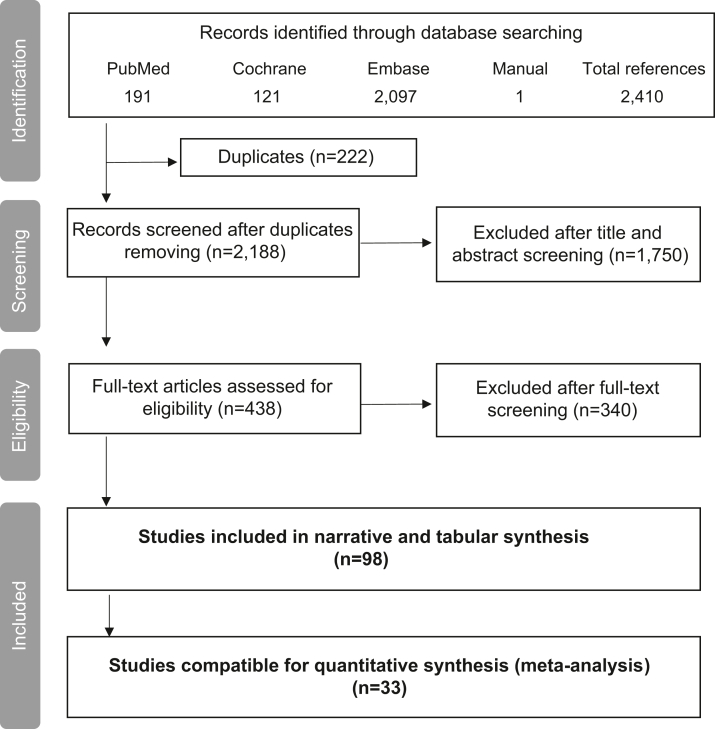
Medline, EMBASE, and the Cochrane Central Register of Controlled Trials were searched for English-language, primary-FSGS studies from inception to 2019. Clinical outcomes were changes from baseline in proteinuria, kidney function, and kidney survival.
2 investigators independently screened studies and extracted data.
Study results were summarized using random-effects models either as ratios of means between follow-up and baseline measurements or as HRs.
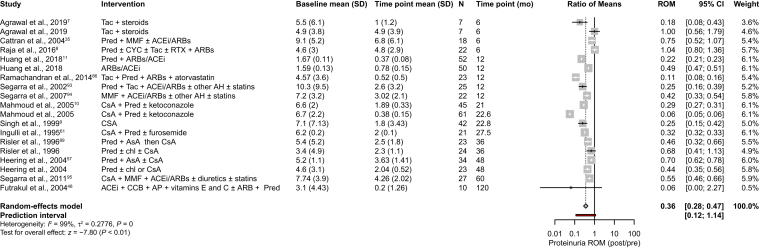
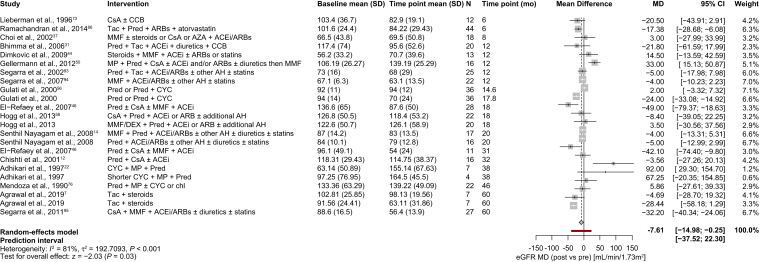
We included 98 articles. Substantial heterogeneity was observed in patient baseline characteristics and study designs. Most studies assessed treatment with corticosteroids alone or combined with other drugs, mainly immunosuppressants. Patients treated with immunosuppressants showed reduced proteinuria (14 studies; ratio of means, 0.36; 95% CI, 0.20-0.47), decreased creatinine clearance (mean difference, -25.03; 95% CI, -59.33 to -9.27) and (significantly) lower estimated glomerular filtration rates (mean difference, -7.61 mL/min/1.73 m; 95% CI, -14.98 to 0.25 mL/min/1.73 m). Immunosuppressant therapy had an uncertain effect on reducing the chronic kidney failure risk. Hypertension and infections were the most commonly reported adverse events.
Heterogeneity in study designs, patient populations, and treatment regimens; no access to individual patient-level data.
This systematic review supports proteinuria reduction with immunosuppressant therapy in primary FSGS over varying follow-up periods. The effects of immunosuppressants on kidney survival remain uncertain. This review underscores the need for better-designed and adequately controlled studies to assess immunosuppressant therapy in patients with primary FSGS.
局灶节段性肾小球硬化(FSGS)是一种罕见病症,可导致肾功能下降和慢性肾衰竭。免疫抑制剂用于治疗原发性FSGS。然而,其在FSGS中的疗效和安全性尚未明确确立。我们评估了关于免疫抑制剂治疗原发性FSGS的临床有效性和安全性的现有知识。
对随机对照试验、非随机对照干预试验、观察性研究、回顾性研究和登记处进行系统评价。
原发性和遗传性FSGS患者。
检索了Medline、EMBASE和Cochrane对照试验中央登记库,以查找从创刊至2019年的英文原发性FSGS研究。临床结局为蛋白尿、肾功能和肾脏存活率相对于基线的变化。
两名研究人员独立筛选研究并提取数据。
使用随机效应模型汇总研究结果,以随访测量值与基线测量值的均值比或风险比表示。
我们纳入了98篇文章。在患者基线特征和研究设计中观察到显著的异质性。大多数研究评估了单独使用皮质类固醇或与其他药物(主要是免疫抑制剂)联合使用的治疗方法。接受免疫抑制剂治疗的患者蛋白尿减少(14项研究;均值比为0.36;95%置信区间为0.20 - 0.47),肌酐清除率降低(平均差值为-25.03;95%置信区间为-59.33至-9.27),且(显著)估计肾小球滤过率较低(平均差值为-7.61 mL/min/1.73 m²;95%置信区间为-14.98至0.25 mL/min/1.73 m²)。免疫抑制剂治疗对降低慢性肾衰竭风险的影响尚不确定。高血压和感染是最常报告的不良事件。
研究设计、患者群体和治疗方案存在异质性;无法获取个体患者层面的数据。
这项系统评价支持在不同随访期内,免疫抑制剂治疗可降低原发性FSGS患者的蛋白尿。免疫抑制剂对肾脏存活率的影响仍不确定。本评价强调需要设计更优且充分对照的研究,以评估原发性FSGS患者的免疫抑制剂治疗。