Saga Yoshitaka, Hamanishi Kohei
Department of Chemistry, Faculty of Science and Engineering, Kindai University, Higashi-Osaka, Osaka 577-8502, Japan.
ACS Omega. 2022 Aug 11;7(33):29231-29235. doi: 10.1021/acsomega.2c03323. eCollection 2022 Aug 23.
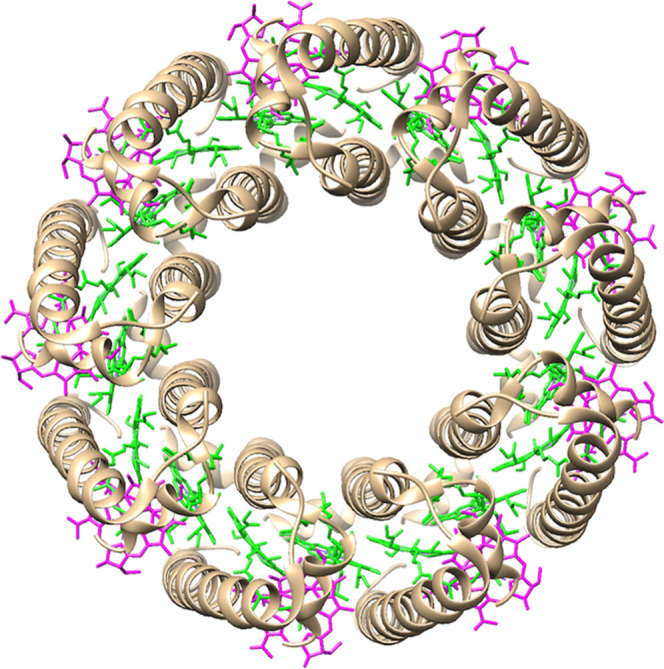
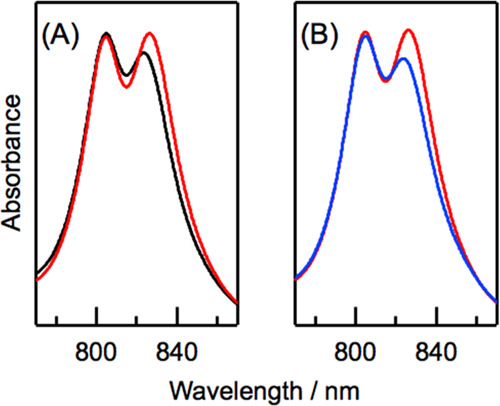
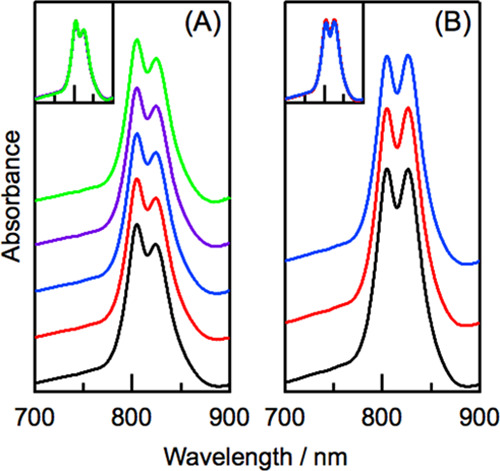
Excitonic coupling of bacteriochlorophyll (BChl) in light-harvesting (LH) proteins of purple photosynthetic bacteria is key for efficient photon capture and energy transfer. Environmental factors can affect the spectral features of these BChl pigments and investigating these effects can provide insight into the molecular mechanisms underlying the photosynthetic spectral tuning. The present study analyzes the spectral alterations of the Q band of B820 BChl within the LH3 protein in relation to the type and concentration of detergents in the buffer. Changing the detergent from lauryl dimethylamine -oxide (LDAO) to -dodecyl-β-d-maltoside (DDM) caused a red shift in the B820 Q band accompanied by hyperchromism; these spectral alterations were completely reversed by exchanging back from DDM to LDAO. These results reflect the different effects of harsh vs mild detergents on the perturbation of LH3. The B820 Q band did not change when LDAO or NaCl concentration was altered, suggesting that electrostatic effects by external components have little influence on the spectral features of B820 BChl in LH3.
紫色光合细菌光捕获(LH)蛋白中细菌叶绿素(BChl)的激子耦合是高效捕获光子和能量转移的关键。环境因素会影响这些BChl色素的光谱特征,研究这些影响可以深入了解光合光谱调谐的分子机制。本研究分析了LH3蛋白中B820 BChl的Q带光谱变化与缓冲液中去污剂的类型和浓度的关系。将去污剂从月桂基二甲基氧化胺(LDAO)换成十二烷基-β-D-麦芽糖苷(DDM)会导致B820 Q带发生红移并伴有增色现象;从DDM换回LDAO时,这些光谱变化完全逆转。这些结果反映了强去污剂和温和去污剂对LH3扰动的不同影响。当改变LDAO或NaCl浓度时,B820 Q带没有变化,这表明外部成分的静电效应对LH3中B820 BChl的光谱特征影响很小。