Zheng Ying, Dou Jinbo, Wang Yan, Zhu Lu, Yao George, Kim Young Hyun, Radke Clayton J, Wu James Yuliang
Alcon Research LLC, 11460 Johns Creek Parkway, Duluth, Georgia 30097, United States.
Alcon Research LLC, 6201 South Freeway, Fort Worth, Texas 76134, United States.
ACS Omega. 2022 Aug 9;7(33):29223-29230. doi: 10.1021/acsomega.2c03310. eCollection 2022 Aug 23.
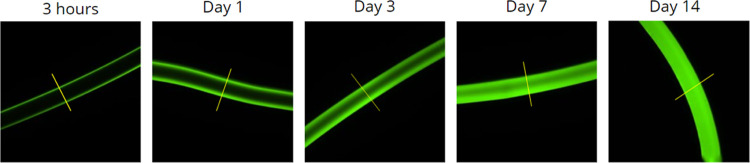
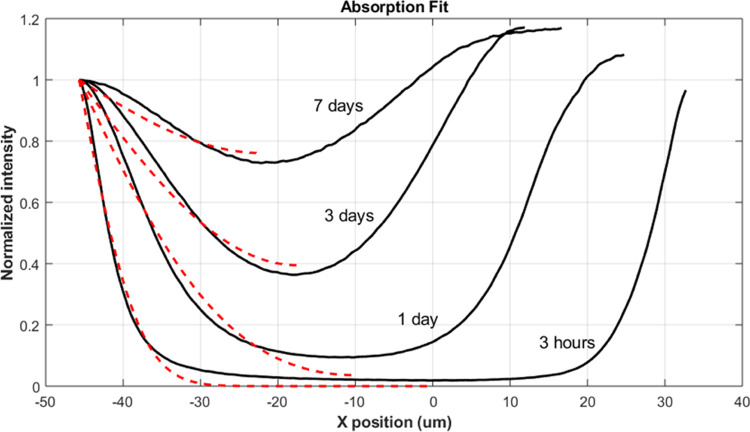
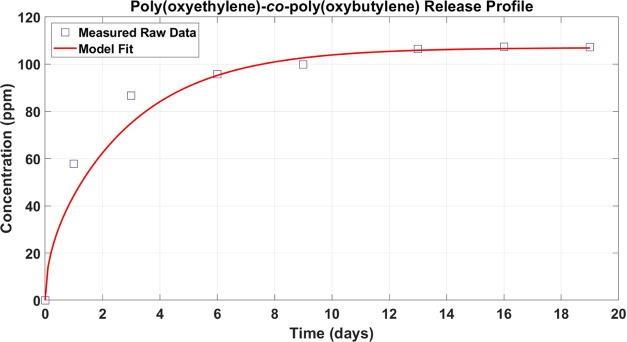
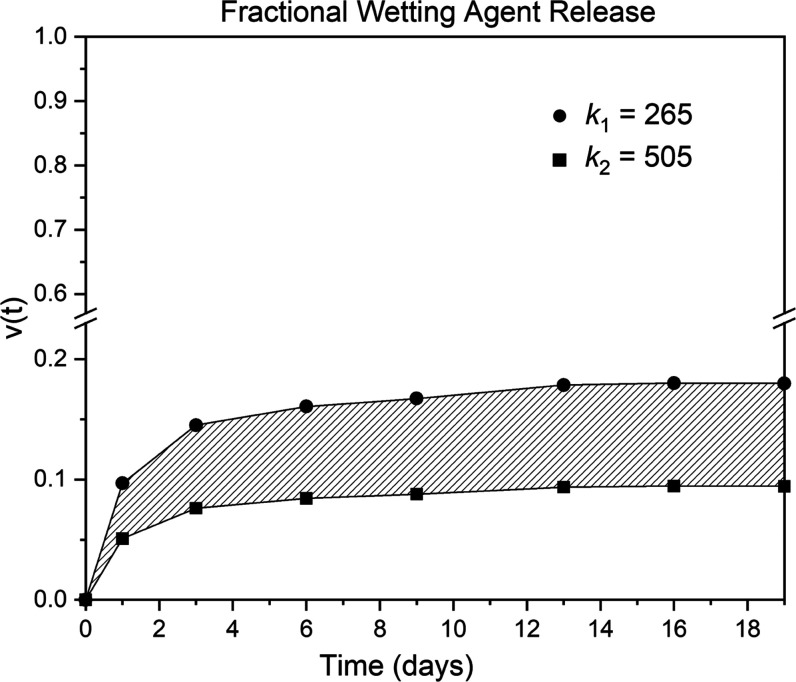
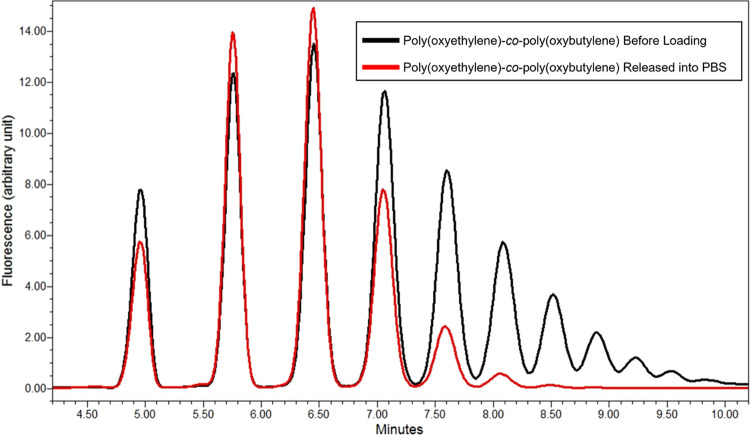
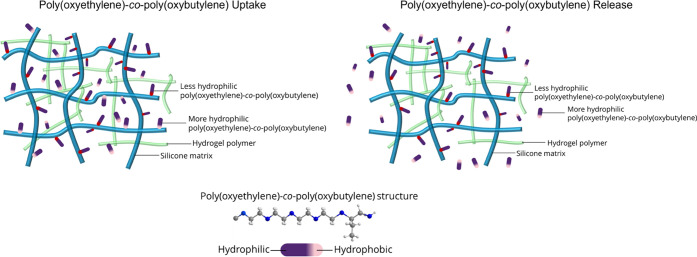
Uptake and release kinetics are investigated of a dilute aqueous polymeric-surfactant wetting agent, (ethylene oxide)-(butylene oxide) copolymer, also referred to as poly(oxyethylene)--poly(oxybutylene), impregnated into a newly designed silicone-hydrogel lens material. Transient scanning concentration profiles of the fluorescently tagged polymeric surfactant follow Fick's second law with a diffusion coefficient near 10 cm/s, a value 3-4 orders smaller than that of the free surfactant in bulk water. The Nernst partition coefficient of the tagged polymeric wetting agent, determined by fluorescence microscopy and by methanol extraction, is near 350, a very large value. Back-extraction of the polymeric-surfactant wetting agent releases only ∼20% of the loaded amount after soaking the fully loaded lens for over 7 days. The remaining ∼80% is irreversibly bound in the lens matrix. Reverse-phase liquid chromatography of the lens-loaded and lens-extracted surfactant demonstrates that the released wetting agent is more hydrophilic with a higher polarity. Aqueous poly(oxyethylene)--poly(oxybutylene) is hypothesized to attach strongly to the lens matrix, most likely to the lens silicone domains. Strong binding leads to slow transient diffusion, to large uptake, and to significant irreversible retention. These characteristics indicate the suitability of using a poly(oxyethylene)--poly(oxybutylene) nonionic polymeric surfactant to maintain enhanced lens wettability over time. Methodology and findings from this study provide useful insights for designing sustained-release contact-lens wetting agents and materials.
对一种稀释的水性聚合物 - 表面活性剂润湿剂(环氧乙烷) - (环氧丁烷)共聚物(也称为聚(氧乙烯) - 聚(氧丁烯))浸渍到新设计的硅水凝胶镜片材料中的摄取和释放动力学进行了研究。荧光标记的聚合物表面活性剂的瞬态扫描浓度分布遵循菲克第二定律,扩散系数接近10⁻⁹ cm²/s,该值比本体水中游离表面活性剂的扩散系数小3 - 4个数量级。通过荧光显微镜和甲醇萃取测定的标记聚合物润湿剂的能斯特分配系数接近350,这是一个非常大的值。在将完全负载的镜片浸泡超过7天后,聚合物 - 表面活性剂润湿剂的反萃取仅释放出约20%的负载量。其余约80%不可逆地结合在镜片基质中。对负载镜片和从镜片中萃取的表面活性剂进行反相液相色谱分析表明,释放出的润湿剂更亲水,极性更高。据推测,水性聚(氧乙烯) - 聚(氧丁烯)与镜片基质强烈结合,最有可能与镜片的硅氧烷区域结合。强结合导致缓慢的瞬态扩散、大量摄取和显著的不可逆保留。这些特性表明使用聚(氧乙烯) - 聚(氧丁烯)非离子聚合物表面活性剂来长期维持增强的镜片润湿性是合适的。本研究的方法和结果为设计缓释隐形眼镜润湿剂和材料提供了有用的见解。