Wang Qi, Li Li, Mao Min, Sun Wei, Zhang Cui, Mao Dewei, Song Qipeng
College of Sports and Health, Shandong Sport University, Jinan, 250102, China.
Department of Health Sciences and Kinesiology, Georgia Southern University, Statesboro, 30460, USA.
J Exerc Sci Fit. 2022 Oct;20(4):328-334. doi: 10.1016/j.jesf.2022.07.004. Epub 2022 Aug 7.
The relationships of postural stability with its three potential contributing factors, namely, muscle strength, tactile sensation, and proprioception, have not been clarified at different ages among older adults. Differences in the relationships may explain the increased incidence of falls among older adults 75 and older. This study compared the postural stability and its three factors between the older adults younger or older than 75 and investigated their age-specific relationships.
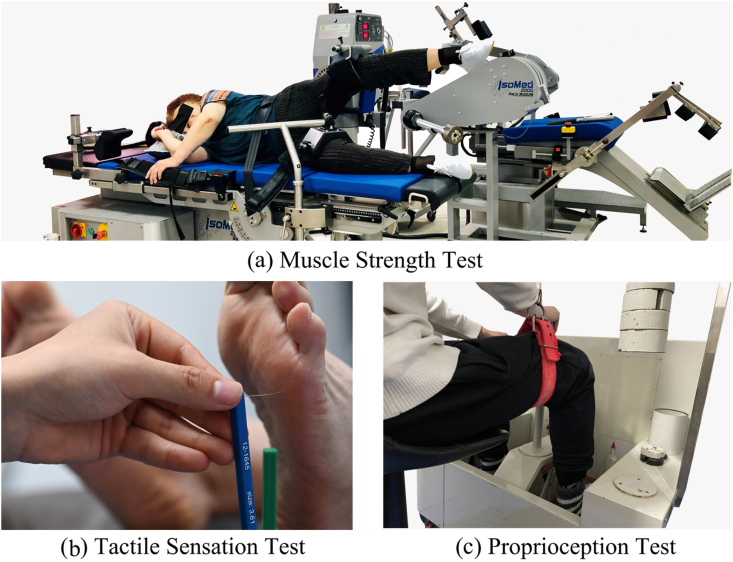
A total of 152 participants were recruited and divided into younger-old (65-74 years, n = 83) or older-old adults (≥75 years, n = 69) groups. Their Berg Balance Scale (BBS) and the Timed Up and Go (TUG) performance, muscle strength, tactile sensation, and proprioception were tested. The group differences and age-specific relationships of the performance with the three factors were examined.
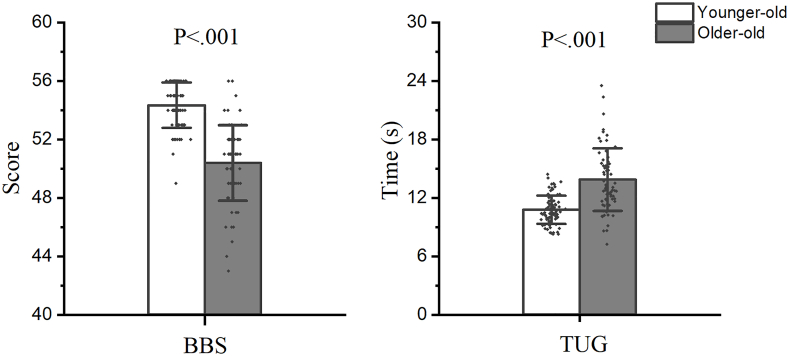
Compared to the younger-older adults, the older-old adults had lower BBS and higher TUG scores, weaker muscle strength, and worse proprioception. Muscle strength and proprioception were correlated with BBS and TUG among the younger-older adults. Only muscle strength but not proprioception among the older-old adults was correlated with BBS and TUG.
The older-old adults over 75 years have poorer postural stability, muscle strength, and proprioception compared to the younger-old adults aged 65-74 years. Proprioception provides information on postural stability among younger-old adults but not among older-old adults. Keeping proprioception from deteriorating with age could be a key to reducing falls in older-old adults.
在老年人的不同年龄段中,姿势稳定性与其三个潜在影响因素,即肌肉力量、触觉和本体感觉之间的关系尚未明确。这些关系的差异可能解释了75岁及以上老年人跌倒发生率增加的原因。本研究比较了75岁及以下和75岁及以上老年人的姿势稳定性及其三个因素,并研究了它们在特定年龄阶段的关系。
共招募了152名参与者,分为年轻老年人(65 - 74岁,n = 83)或年长老年人(≥75岁,n = 69)组。测试了他们的伯格平衡量表(BBS)、定时起立行走测试(TUG)表现、肌肉力量、触觉和本体感觉。检验了两组之间的差异以及表现与这三个因素在特定年龄阶段的关系。
与年轻老年人相比,年长老年人的BBS得分较低,TUG得分较高,肌肉力量较弱,本体感觉较差。在年轻老年人中,肌肉力量和本体感觉与BBS和TUG相关。在年长老年人中,只有肌肉力量而非本体感觉与BBS和TUG相关。
与65 - 74岁的年轻老年人相比,75岁及以上的年长老年人姿势稳定性、肌肉力量和本体感觉较差。本体感觉为年轻老年人的姿势稳定性提供信息,但年长老年人并非如此。防止本体感觉随年龄衰退可能是减少年长老年人跌倒的关键。