Thomas Bina, Mohandas Anu, Jayadev V K, Bindu V
Department of Community Medicine, Government Medical College, Kozhikode, Kerala, India.
Indian J Community Med. 2022 Apr-Jun;47(2):262-265. doi: 10.4103/ijcm.ijcm_600_21. Epub 2022 Jul 11.
Hepatitis B virus infection is a global health priority, and health-care personnel (HCP) have 10 times higher prevalence than the general population. Seromonitoring identifies those with low titers and vaccine nonresponders with increased risk.
The objective of the study was to assess hepatitis B surface antibody (anti-HBs) titers and associated factors among HCP vaccinated against hepatitis B in a teaching hospital in Kerala.
A cross-sectional study was done among 454 vaccinated HCP, and anti-HBs antibody titers were assessed by enzyme-linked immunosorbent assay method.
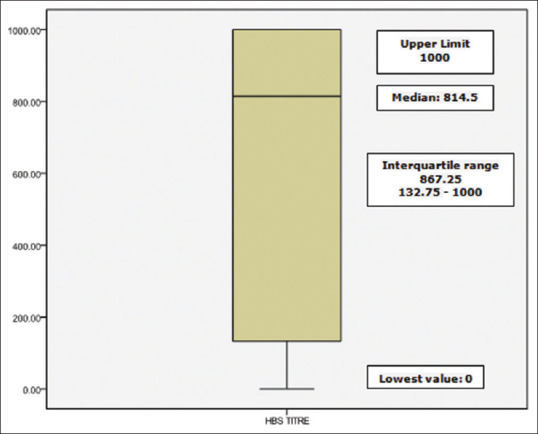
Participants included 162 (35.7%) doctors, 132 (29.3%) nursing and laboratory personnel, and 160 (35.3%) supporting staff. The mean age was 38.06 ± 11.33 years, and 72% were female. Majority (92.5%, 420) were seroprotected and 78.9% (358) with high (>100 mIU) titers. Moderate (10-100 mIU) and low (<10 mIU) level seroprotection was seen in 13.7% (62) and 7.5% (34), respectively. Incomplete vaccination, >10 years since vaccination, and age >40 years were independent predictors for poor seroprotection, while increasing doses and boosters were positively associated.
Majority of vaccinated HCP were seroprotected. Incomplete schedules, older age, and prolonged time since vaccination can lead to decline in titers, and periodical seromonitoring should guide hepatitis B revaccination strategies.
乙型肝炎病毒感染是全球卫生重点问题,医护人员(HCP)的感染率比普通人群高10倍。血清学监测可识别出滴度较低者和疫苗无应答者,其风险更高。
本研究的目的是评估喀拉拉邦一家教学医院中接种乙型肝炎疫苗的医护人员的乙型肝炎表面抗体(抗-HBs)滴度及相关因素。
对454名接种疫苗的医护人员进行了横断面研究,采用酶联免疫吸附测定法评估抗-HBs抗体滴度。
参与者包括162名(35.7%)医生、132名(29.3%)护理和实验室人员以及160名(35.3%)辅助人员。平均年龄为38.06±11.33岁,72%为女性。大多数(92.5%,420人)有血清保护作用,78.9%(358人)滴度高(>100 mIU)。中度(10-100 mIU)和低度(<10 mIU)血清保护分别见于13.7%(62人)和7.5%(34人)。接种不完整、接种后超过10年以及年龄>40岁是血清保护不佳的独立预测因素,而增加剂量和加强免疫则呈正相关。
大多数接种疫苗的医护人员有血清保护作用。接种方案不完整、年龄较大以及接种后时间延长可导致滴度下降,定期血清学监测应指导乙型肝炎再接种策略。