Abu-Farha Rana, Alzoubi Karem H, Rizik Mai, Karout Samar, Itani Rania, Mukattash Tareq, Alefishat Eman
Department of Clinical Pharmacy and Therapeutics, Faculty of Pharmacy, Applied Science Private University, Amman, 11931, Jordan.
Department of Pharmacy Practice and Pharmacotherapeutics, University of Sharjah, Sharjah, United Arab Emirates.
Patient Prefer Adherence. 2022 Aug 22;16:2259-2269. doi: 10.2147/PPA.S377558. eCollection 2022.
Home medication delivery service is a major service for the public. It reduces overcrowding and unnecessary visits to health centers. This study aims to investigate the public perception of home delivery of medication service in Jordan and evaluate factors affecting the use of this service.
The study was conducted in March 2022 using an online survey. Participants were asked to fill out a validated questionnaire to evaluate their perception of home delivery of medication service.
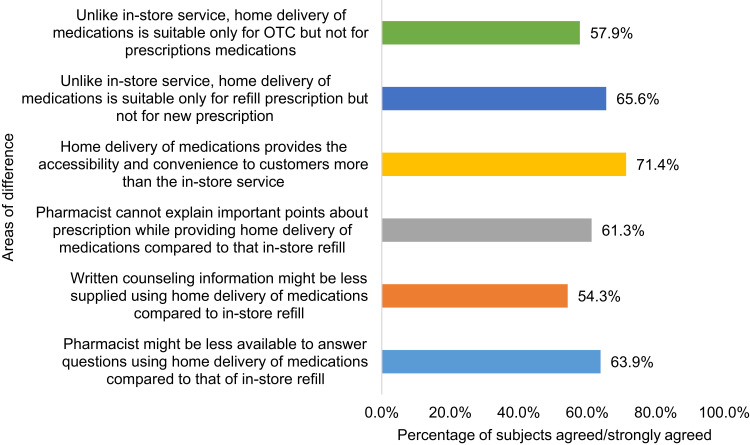
Among the 1032 adult participated in this study, the majority reported that they had heard of home delivery of medication service (n = 832, 80.6%). However, only 30.9% of them have used this service before. Results showed that 71.4% of the participants (n = 737) believe that home delivery of medication service is more convenient and accessible than in-store drug refill. In addition, 65.6% of the participants (n = 677) believed that home delivery of medication service is suitable only for refill-prescription drugs (65.0%). The main pros of the service as perceived by the study participants were to serve sick patients, elderly, and disabled people (n = 822, 79.7%). In contrast, the inability of patients to build a professional relationship with pharmacists using home delivery of medications service was the most perceived con of this service (n = 627, 60.8%). Finally, regression analysis revealed that older participants, those with chronic diseases, and those who visit community pharmacies two times or more per month revealed higher use of the service (P = <0.05).
This study has shown that most participants showed positive perceptions toward the home delivery of medication services. However, participants believed that this service may decrease pharmacist's patient contact time, thus affecting the quality of medication counseling. More comprehensive future studies are necessary to examine the financial aspects of such a service and its associated drawbacks.
家庭送药服务是一项面向公众的主要服务。它减少了过度拥挤以及前往健康中心的不必要就诊。本研究旨在调查约旦公众对家庭送药服务的看法,并评估影响该服务使用的因素。
该研究于2022年3月采用在线调查进行。参与者被要求填写一份经过验证的问卷,以评估他们对家庭送药服务的看法。
在参与本研究的1032名成年人中,大多数人报告称他们听说过家庭送药服务(n = 832,80.6%)。然而,他们中只有30.9%的人以前使用过这项服务。结果显示,71.4%的参与者(n = 737)认为家庭送药服务比店内药品再填充更方便、更容易获得。此外,65.6%的参与者(n = 677)认为家庭送药服务仅适用于再填充处方药(65.0%)。研究参与者认为该服务的主要优点是为患病患者、老年人和残疾人提供服务(n = 822,79.7%)。相比之下,患者无法通过家庭送药服务与药剂师建立专业关系是该服务最常被提及的缺点(n = 627,60.8%)。最后,回归分析显示,年龄较大的参与者、患有慢性病的参与者以及每月前往社区药店两次或更多次的参与者使用该服务的比例更高(P = <0.05)。
本研究表明,大多数参与者对家庭送药服务表现出积极的看法。然而,参与者认为这项服务可能会减少药剂师与患者的接触时间,从而影响用药咨询的质量。未来有必要进行更全面的研究,以考察此类服务的财务方面及其相关缺点。