Duckworth James, O'Brien Susan, Petersen Ib K, Petersen Aevar, Benediktsson Guðmundur, Johnson Logan, Lehikoinen Petteri, Okill David, Väisänen Roni, Williams Jim, Williams Stuart, Daunt Francis, Green Jonathan A
University of Liverpool Liverpool UK.
Scottish Government, Marine Laboratory Aberdeen UK.
Ecol Evol. 2022 Aug 23;12(8):e9209. doi: 10.1002/ece3.9209. eCollection 2022 Aug.
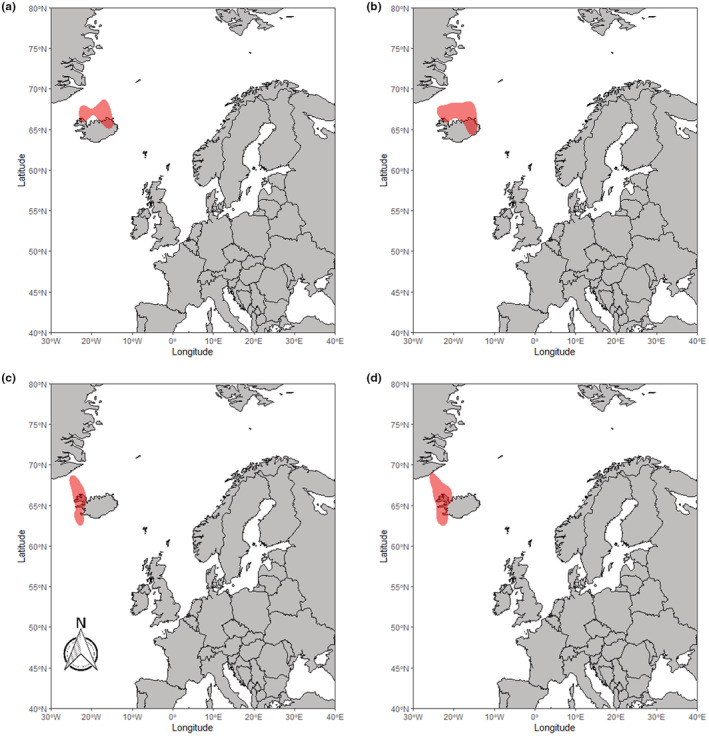
Migratory species have geographically separate distributions during their annual cycle, and these areas can vary between populations and individuals. This can lead to differential stress levels being experienced across a species range. Gathering information on the areas used during the annual cycle of red-throated divers (RTDs; ) has become an increasingly pressing issue, as they are a species of concern when considering the effects of disturbance from offshore wind farms and the associated ship traffic. Here, we use light-based geolocator tags, deployed during the summer breeding season, to determine the non-breeding winter location of RTDs from breeding locations in Scotland, Finland, and Iceland. We also use δN and δC isotope signatures, from feather samples, to link population-level differences in areas used in the molt period to population-level differences in isotope signatures. We found from geolocator data that RTDs from the three different breeding locations did not overlap in their winter distributions. Differences in isotope signatures suggested this spatial separation was also evident in the molting period, when geolocation data were unavailable. We also found that of the three populations, RTDs breeding in Iceland moved the shortest distance from their breeding grounds to their wintering grounds. In contrast, RTDs breeding in Finland moved the furthest, with a westward migration from the Baltic into the southern North Sea. Overall, these results suggest that RTDs breeding in Finland are likely to encounter anthropogenic activity during the winter period, where they currently overlap with areas of future planned developments. Icelandic and Scottish birds are less likely to be affected, due to less ship activity and few or no offshore wind farms in their wintering distributions. We also demonstrate that separating the three populations isotopically is possible and suggest further work to allocate breeding individuals to wintering areas based solely on feather samples.
迁徙物种在其年度周期内具有地理上分离的分布区域,并且这些区域在不同种群和个体之间可能有所不同。这可能导致整个物种分布范围内经历不同程度的压力。获取红喉潜鸟(RTDs)年度周期中使用区域的信息已成为一个日益紧迫的问题,因为在考虑海上风电场干扰及相关船舶交通的影响时,它们是一个受关注的物种。在这里,我们使用在夏季繁殖季节部署的基于光的地理定位器标签,来确定来自苏格兰、芬兰和冰岛繁殖地的红喉潜鸟的非繁殖冬季位置。我们还使用羽毛样本中的δN和δC同位素特征,将换羽期使用区域的种群水平差异与同位素特征的种群水平差异联系起来。我们从地理定位器数据中发现,来自三个不同繁殖地的红喉潜鸟在冬季分布上没有重叠。同位素特征的差异表明,在无法获取地理定位数据的换羽期,这种空间分离也很明显。我们还发现,在这三个种群中,在冰岛繁殖的红喉潜鸟从繁殖地到越冬地移动的距离最短。相比之下,在芬兰繁殖的红喉潜鸟移动得最远,它们从波罗的海向西迁徙到北海南部。总体而言,这些结果表明,在芬兰繁殖的红喉潜鸟在冬季可能会遇到人为活动,它们目前与未来规划开发区域重叠。冰岛和苏格兰的鸟类受影响的可能性较小,因为它们越冬分布区域的船舶活动较少,且几乎没有或没有海上风电场。我们还证明了仅根据羽毛样本从同位素角度区分这三个种群是可能的,并建议开展进一步工作,以便仅根据羽毛样本将繁殖个体分配到越冬区域。