Institute of Human Genetics, School of Medicine, Pontificia Universidad Javeriana, Bogotá, Colombia.
Clinical Laboratory, Hospital Universitario San Ignacio, Bogotá, Colombia.
Infect Genet Evol. 2022 Oct;104:105357. doi: 10.1016/j.meegid.2022.105357. Epub 2022 Aug 28.
The ACE2 protein acts as a gateway for SARS-CoV-2 in the host cell, playing an essential role in susceptibility to infection by this virus. Genetics and epigenetic mechanisms related to the ACE2 gene are associated with changes in its expression and, therefore, linked to increased susceptibility to infection. Although some variables such as sex, age, and obesity have been described as risk factors for COVID-19, the molecular causes involved in the disease susceptibility are still unknown.
To evaluate the ACE2 gene expression profiles and their association with epigenetic mechanisms and demographic or clinical variables.
In 500 adult volunteers, the mRNA expression levels of the ACE2 gene in nasopharyngeal swab samples and its methylation status in peripheral blood samples were quantified by RT-qPCR and qMSP, respectively. The existence of significant differences in the ACE2 gene expression and its determinants were evaluated in different study groups according to several demographic or clinical variables such as sex, age, body mass index (BMI), smoking, SARS-CoV-2 infection, and presence of underlying diseases such as type II diabetes mellitus (DM2), asthma and arterial hypertension (AHT).
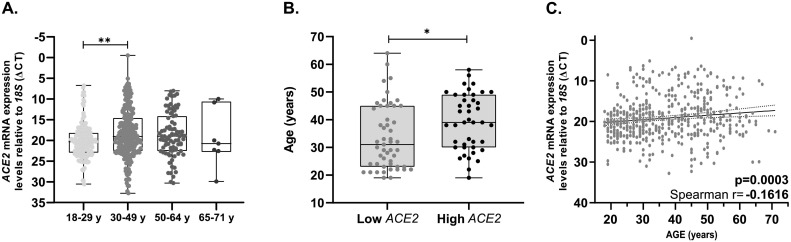
Our results show that ACE2 gene overexpression, directly involved in susceptibility to SARS-CoV-2 infection, depends on multiple host factors such as male sex, age over 30 years, smoking, the presence of obesity, and DM2. Likewise, it was determined that the ACE2 gene expression is regulated by changes in the DNA methylation patterns in its promoter region.
The ACE2 gene expression is highly variable, and this variability is related to habits such as smoking and demographic or clinical variables, which details the impact of environmental and host factors on our epigenome and, therefore, in susceptibility to SARS-CoV-2 infection.
ACE2 蛋白是宿主细胞中 SARS-CoV-2 的入口蛋白,在易感染该病毒方面发挥着重要作用。与 ACE2 基因相关的遗传和表观遗传机制与 ACE2 基因的表达变化有关,因此与易感染性增加有关。尽管已经描述了一些变量,如性别、年龄和肥胖是 COVID-19 的危险因素,但疾病易感性所涉及的分子原因仍不清楚。
评估 ACE2 基因的表达谱及其与表观遗传机制以及人口统计学或临床变量的关系。
在 500 名成年志愿者中,通过 RT-qPCR 和 qMSP 分别定量鼻咽拭子样本中 ACE2 基因的 mRNA 表达水平及其在外周血样本中的甲基化状态。根据性别、年龄、体重指数(BMI)、吸烟、SARS-CoV-2 感染以及是否存在 2 型糖尿病(DM2)、哮喘和动脉高血压(AHT)等潜在疾病等几种人口统计学或临床变量,评估 ACE2 基因表达及其决定因素在不同研究组中的差异。
我们的结果表明,直接参与 SARS-CoV-2 感染易感性的 ACE2 基因过表达取决于多种宿主因素,如男性、年龄超过 30 岁、吸烟、肥胖的存在和 DM2。同样,确定 ACE2 基因表达受其启动子区域 DNA 甲基化模式变化的调节。
ACE2 基因表达高度可变,这种可变性与吸烟等习惯以及人口统计学或临床变量有关,这详细说明了环境和宿主因素对我们的表观基因组的影响,因此对 SARS-CoV-2 感染的易感性有影响。