Medicine, Guru Teg Bahadur Hospital, New Delhi, India
Postgrad Med J. 2021 May;97(1147):312-320. doi: 10.1136/postgradmedj-2020-138577. Epub 2020 Sep 25.
The severe acute respiratory syndrome (SARS) coronavirus-2 is a novel coronavirus belonging to the family Coronaviridae and is now known to be responsible for the outbreak of a series of recent acute atypical respiratory infections originating in Wuhan, China. The disease caused by this virus, termed coronavirus disease 19 or simply COVID-19, has rapidly spread throughout the world at an alarming pace and has been declared a pandemic by the WHO on March 11, 2020. In this review, an update on the pathophysiology, clinical presentation and the most recent management strategies for COVID-19 has been described.
A search was conducted for literature and various articles/case reports from 1997 to 2020 in PUBMED/MEDLINE for the keywords coronavirus, SARS, Middle East respiratory syndrome and mRNA virus.
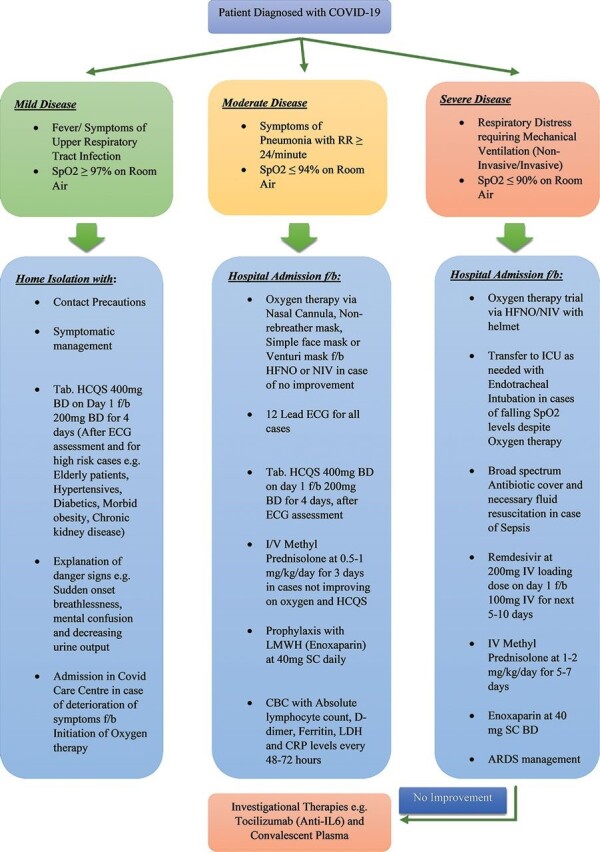
COVID-19 has now spread globally with increasing morbidity and mortality among all populations. In the absence of a proper and effective antibody test, the diagnosis is presently based on a reverse-transcription PCR of nasopharyngeal and oropharyngeal swab samples. The clinical spectrum of the disease presents in the form of a mild, moderate or severe illness. Most patients are either asymptomatic carriers who despite being without symptoms have the potential to be infectious to others coming in close contact, or have a mild influenza-like illness which cannot be differentiated from a simple upper respiratory tract infection. Moderate and severe cases require hospitalisation as well as intensive therapy which includes non-invasive as well as invasive ventilation, along with antipyretics, antivirals, antibiotics and steroids. Complicated cases may require treatment by immunomodulatory drugs and plasma exchange therapy. The search for an effective vaccine for COVID-19 is presently in full swing, with pharmaceutical corporations having started human trials in many countries.
严重急性呼吸综合征(SARS)冠状病毒-2 是一种新型冠状病毒,属于冠状病毒科,现已被认为是导致一系列源自中国武汉的急性非典型呼吸道感染爆发的罪魁祸首。由该病毒引起的疾病,称为 2019 年冠状病毒病或简称 COVID-19,已以惊人的速度在全球迅速蔓延,并于 2020 年 3 月 11 日被世界卫生组织宣布为大流行。在这篇综述中,描述了 COVID-19 的病理生理学、临床表现和最新的管理策略的最新进展。
在 PUBMED/MEDLINE 上搜索了 1997 年至 2020 年的文献和各种文章/病例报告,关键词为冠状病毒、SARS、中东呼吸综合征和 mRNA 病毒。
COVID-19 现已在全球范围内传播,所有人群的发病率和死亡率都在增加。在没有适当和有效的抗体测试的情况下,目前的诊断基于鼻咽和口咽拭子样本的逆转录 PCR。该疾病的临床谱表现为轻度、中度或重度疾病。大多数患者是无症状携带者,尽管没有症状,但有可能对密切接触的其他人具有传染性,或者患有轻度流感样疾病,无法与简单的上呼吸道感染区分开来。中度和重度病例需要住院治疗以及强化治疗,包括非侵入性和侵入性通气,以及退热、抗病毒、抗生素和类固醇。复杂病例可能需要免疫调节药物和血浆置换治疗。目前正在全力寻找 COVID-19 的有效疫苗,许多国家的制药公司已经开始进行人体试验。