Department of Neuroscience, Karolinska Institutet, Solnavägen 9, 171 77, Stockholm, Sweden.
Department of Psychiatry, Amsterdam UMC, University of Amsterdam, Amsterdam, The Netherlands.
Sci Rep. 2022 Aug 29;12(1):14658. doi: 10.1038/s41598-022-18703-w.
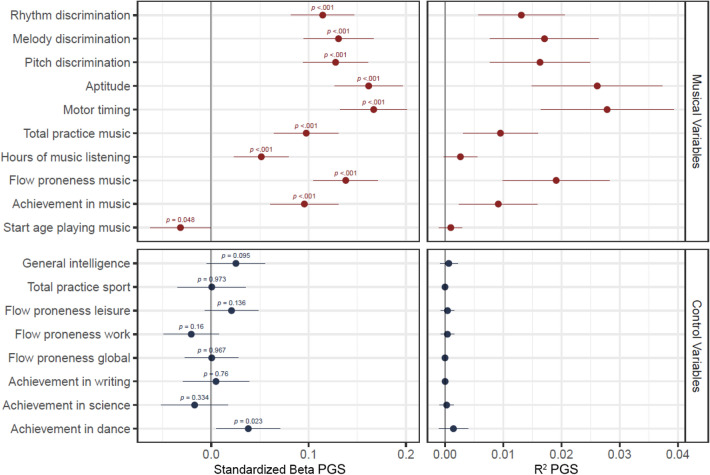
To further our understanding of the genetics of musicality, we explored associations between a polygenic score for self-reported beat synchronization ability (PGS) and objectively measured rhythm discrimination, as well as other validated music skills and music-related traits. Using family data, we were able to further explore potential pathways of direct genetic, indirect genetic (through passive gene-environment correlation) and confounding effects (such as population structure and assortative mating). In 5648 Swedish twins, we found PGS to predict not only rhythm discrimination, but also melody and pitch discrimination (betas between 0.11 and 0.16, p < 0.001), as well as other music-related outcomes (p < 0.05). In contrast, PGS was not associated with control phenotypes not directly related to music. Associations did not deteriorate within families (N = 243), implying that indirect genetic or confounding effects did not inflate PGS effects. A correlation (r = 0.05, p < 0.001) between musical enrichment of the family childhood environment and individuals' PGS, suggests gene-environment correlation. We conclude that the PGS captures individuals' general genetic musical propensity, affecting musical behavior more likely direct than through indirect or confounding effects.
为了进一步了解音乐才能的遗传学基础,我们探讨了自我报告的节拍同步能力多基因评分(PGS)与客观测量的节奏辨别能力之间的关联,以及其他经过验证的音乐技能和与音乐相关的特征。利用家族数据,我们能够进一步探索直接遗传、间接遗传(通过被动基因-环境关联)和混杂效应(如群体结构和同型交配)的潜在途径。在 5648 对瑞典双胞胎中,我们发现 PGS 不仅可以预测节奏辨别能力,还可以预测旋律和音高辨别能力(β 值在 0.11 到 0.16 之间,p<0.001),以及其他与音乐相关的结果(p<0.05)。相比之下,PGS 与不直接与音乐相关的对照表型没有关联。在家族内(N=243),关联并没有恶化,这意味着间接遗传或混杂效应并没有夸大 PGS 效应。个体的 PGS 与家庭童年环境的音乐丰富度之间存在相关性(r=0.05,p<0.001),这表明存在基因-环境关联。我们得出的结论是,PGS 捕捉到了个体的一般遗传音乐倾向,对音乐行为的影响更可能是直接的,而不是通过间接或混杂效应。