Lafontant Alec, Mahanna Gabrielli Elizabeth, Bergonzi Karla, Forti Rodrigo M, Ko Tiffany S, Shah Ronak M, Arkles Jeffrey S, Licht Daniel J, Yodh Arjun G, Kofke W Andrew, White Brian R, Baker Wesley B
Children's Hospital of Philadelphia and Perelman School of Medicine at the University of Pennsylvania, Department of Pediatrics, Division of Neurology, Philadelphia, Pennsylvania, United States.
University of Miami Miller School of Medicine, Department of Anesthesiology, Perioperative Medicine and Pain Management, Miami, Florida, United States.
Neurophotonics. 2022 Jul;9(3):035004. doi: 10.1117/1.NPh.9.3.035004. Epub 2022 Aug 25.
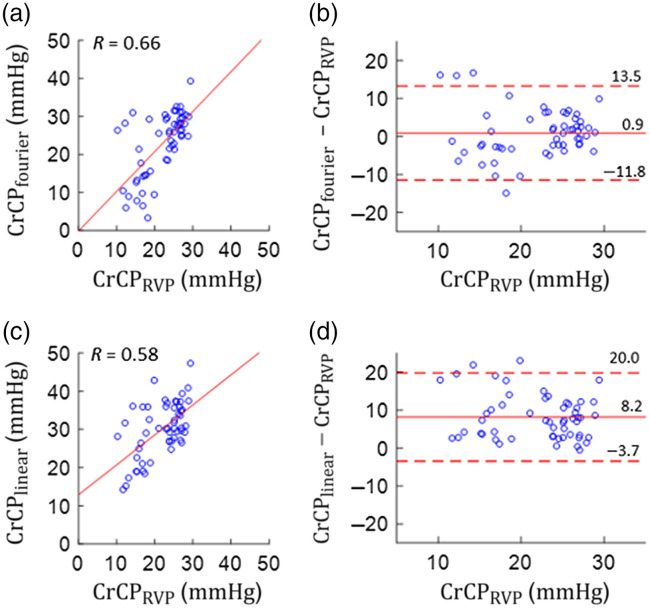
The critical closing pressure (CrCP) of cerebral circulation, as measured by diffuse correlation spectroscopy (DCS), is a promising biomarker of intracranial hypertension. However, CrCP techniques using DCS have not been assessed in gold standard experiments. CrCP is typically calculated by examining the variation of cerebral blood flow (CBF) during the cardiac cycle (with normal sinus rhythm). We compare this typical CrCP measurement with a gold standard obtained during the drops in arterial blood pressure (ABP) caused by rapid ventricular pacing (RVP) in patients undergoing invasive electrophysiologic procedures. Adults receiving electrophysiology procedures with planned ablation were enrolled for DCS CBF monitoring. CrCP was calculated from CBF and ABP data by three methods: (1) linear extrapolation of data during RVP ( ; the gold standard); (2) linear extrapolation of data during regular heartbeats ( ); and (3) fundamental harmonic Fourier filtering of data during regular heartbeats ( ). CBF monitoring was performed prior to and during 55 episodes of RVP in five adults. and demonstrated agreement ( , (95%CI, 0.72 to 1.38). Agreement between and was worse; was higher than (mean ± SD; ). Our results suggest that DCS-measured CrCP can be accurately acquired during normal sinus rhythm.
通过扩散相关光谱法(DCS)测量的脑循环临界关闭压(CrCP)是一种很有前景的颅内高压生物标志物。然而,使用DCS的CrCP技术尚未在金标准实验中得到评估。CrCP通常通过检查心动周期(窦性心律正常)期间脑血流量(CBF)的变化来计算。我们将这种典型的CrCP测量值与在接受侵入性电生理手术的患者中通过快速心室起搏(RVP)导致动脉血压(ABP)下降期间获得的金标准进行比较。纳入计划进行消融的接受电生理手术的成年人进行DCS脑血流量监测。通过三种方法从脑血流量和动脉血压数据计算CrCP:(1)快速心室起搏期间数据的线性外推法( ;金标准);(2)正常心跳期间数据的线性外推法( );(3)正常心跳期间数据的基波谐波傅里叶滤波法( )。对五名成年人在55次快速心室起搏之前和期间进行了脑血流量监测。 和 显示出一致性( , (95%CI,0.72至1.38)。 和 之间的一致性较差; 高于 (平均值±标准差; )。我们的结果表明,在正常窦性心律期间可以准确获取DCS测量的CrCP。