Massachusetts General Hospital and Harvard Medical School, Optics at Athinoula A. Martinos Center fo, United States.
Boston University, Department of Biomedical Engineering, Boston, Massachusetts, United States.
J Biomed Opt. 2021 Mar;26(3). doi: 10.1117/1.JBO.26.3.036008.
Intracranial pressure (ICP), variability in perfusion, and resulting ischemia are leading causes of secondary brain injury in patients treated in the neurointensive care unit. Continuous, accurate monitoring of cerebral blood flow (CBF) and ICP guide intervention and ultimately reduce morbidity and mortality. Currently, only invasive tools are used to monitor patients at high risk for intracranial hypertension.
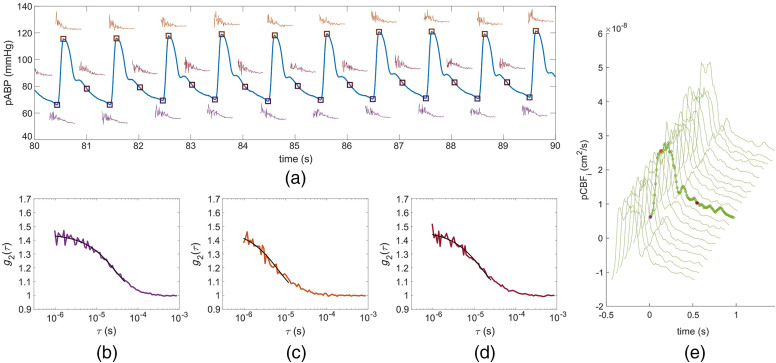
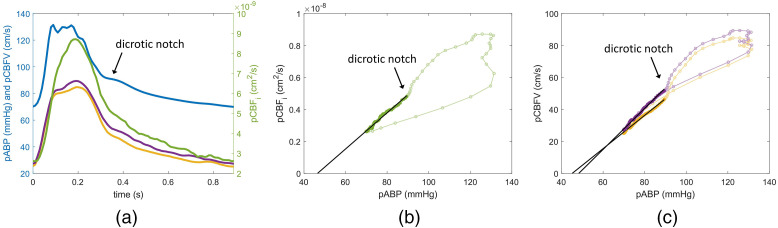
Diffuse correlation spectroscopy (DCS), a noninvasive near-infrared optical technique, is emerging as a possible method for continuous monitoring of CBF and critical closing pressure (CrCP or zero-flow pressure), a parameter directly related to ICP.
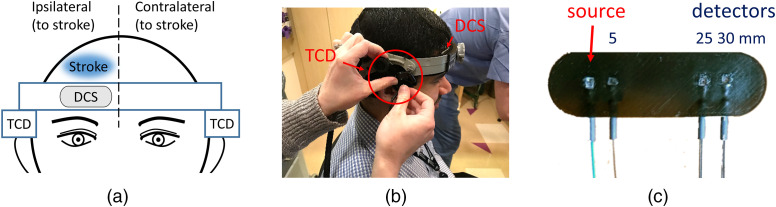
We optimized DCS hardware and algorithms for the quantification of CrCP. Toward its clinical translation, we validated the DCS estimates of cerebral blood flow index (CBFi) and CrCP in ischemic stroke patients with respect to simultaneously acquired transcranial Doppler ultrasound (TCD) cerebral blood flow velocity (CBFV) and CrCP.
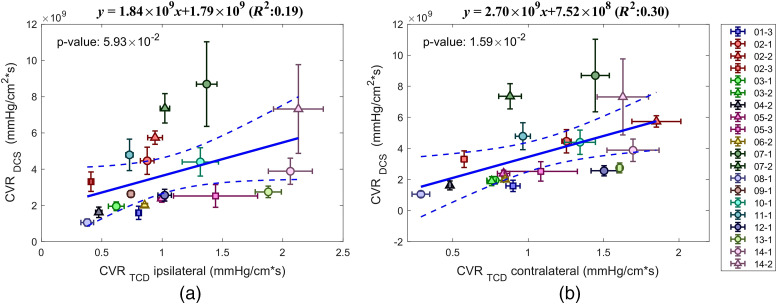
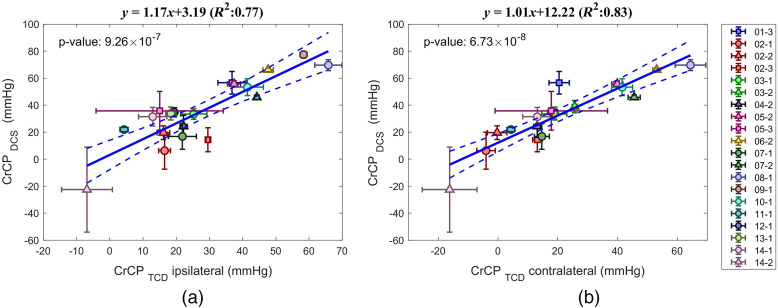
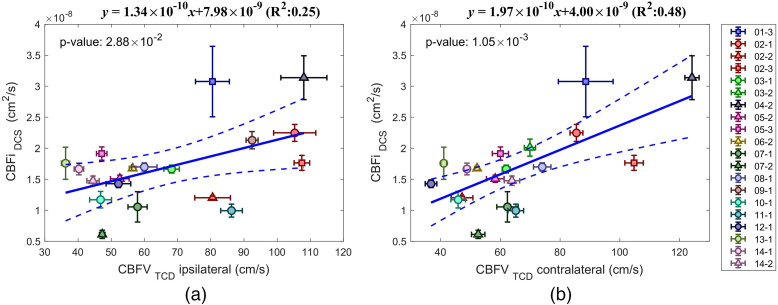
We found CrCP derived from DCS and TCD were highly linearly correlated (ipsilateral R2 = 0.77, p = 9 × 10 - 7; contralateral R2 = 0.83, p = 7 × 10 - 8). We found weaker correlations between CBFi and CBFV (ipsilateral R2 = 0.25, p = 0.03; contralateral R2 = 0.48, p = 1 × 10 - 3) probably due to the different vasculature measured.
Our results suggest DCS is a valid alternative to TCD for continuous monitoring of CrCP.
颅内压(ICP)、灌注变异性和由此导致的缺血是神经重症监护病房患者继发脑损伤的主要原因。连续、准确地监测脑血流(CBF)和 ICP 可指导干预,并最终降低发病率和死亡率。目前,只有侵入性工具用于监测有颅内高压风险的患者。
扩散相关光谱(DCS)是一种非侵入性的近红外光学技术,它正成为一种连续监测 CBF 和临界关闭压(CrCP 或零流量压)的可能方法,而后者是与 ICP 直接相关的参数。
我们优化了 DCS 硬件和算法,以量化 CrCP。为了实现其临床转化,我们针对缺血性脑卒中患者,验证了 DCS 对脑血流指数(CBFi)和 CrCP 的估计值,这些值与同时采集的经颅多普勒超声(TCD)脑血流速度(CBFV)和 CrCP 相关。
我们发现 DCS 和 TCD 得出的 CrCP 高度线性相关(同侧 R2=0.77,p=9×10⁻⁷;对侧 R2=0.83,p=7×10⁻⁸)。我们发现 CBFi 与 CBFV 之间的相关性较弱(同侧 R2=0.25,p=0.03;对侧 R2=0.48,p=1×10⁻³),这可能是由于测量的血管不同所致。
我们的结果表明,DCS 是 TCD 连续监测 CrCP 的有效替代方法。