Department of Microbiology and Immunology, Tulane University, New Orleans, Louisiana, USA.
Neuroscience Program, Tulane Brain Institute, Tulane University, New Orleans, Louisiana, USA.
mBio. 2022 Oct 26;13(5):e0225422. doi: 10.1128/mbio.02254-22. Epub 2022 Aug 30.
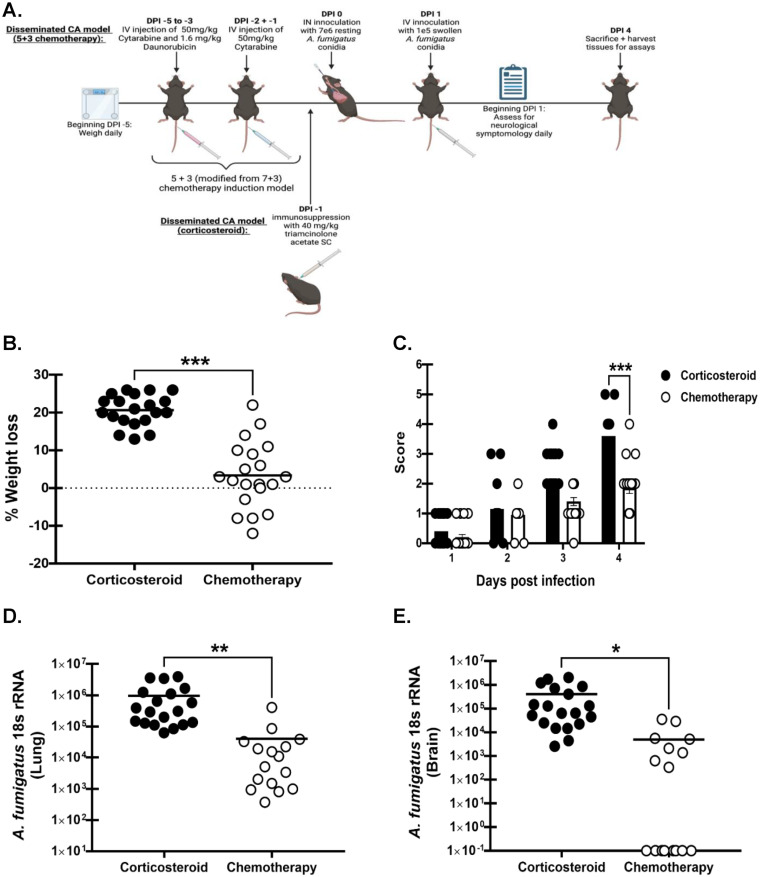
Exposure of immunosuppressed individuals to the opportunistic fungal pathogen Aspergillus fumigatus may result in invasive pulmonary aspergillosis (IPA), which can lead to the development of cerebral aspergillosis (CA), a highly lethal infection localized in the central nervous system (CNS). There are no experimental models of CA that effectively mimic human disease, resulting in a considerable knowledge gap regarding mechanisms of neurological pathogenicity and neuroimmune responses during infection. In this report, immunosuppressed mice (via acute, high-dose corticosteroid administration) challenged with A. fumigatus resting conidia intranasally, followed a day later by a 70-fold lower inoculum of pre-swollen conidia intravenously (IN + IV + steroid), demonstrated increased weight loss, signs of severe clinical disease, increased fungal burden in the brain, and significant reduction in survival compared to immunosuppressed mice challenged intranasally only (IN + steroid) or non-immunosuppressed mice challenged both intranasally and intravenously (IN + IV). The IN + IV + steroid group demonstrated significant decreases in monocytes, eosinophils, dendritic cells (DCs), and invasive natural killer T (iNKT) cells, but not neutrophils or γδ T cells, in the brain compared to the IN + IV group. Likewise, the IN + IV + steroid group had significantly lower levels of interleukin (IL)-1β, IL-6, IL-17A, CC motif chemokine ligand 3 (CCL3), CXC chemokine ligand 10 (CXCL10), and vascular endothelial growth factor (VEGF) in the brain compared to the IN + IV group. IN + IV + steroid was superior to both IN + IV + chemotherapy (cytarabine + daunorubicin) and IN + IV + neutropenia for the development of CA. In conclusion, we have developed a well-defined, physiologically relevant model of disseminated CA in corticosteroid-induced immunosuppressed mice with a primary pulmonary infection. This model will serve to advance understanding of disease mechanisms, identify immunopathogenic processes, and help define the protective neuroinflammatory response to CA. Invasive fungal infections (IFIs) result in significant mortality in immunosuppressed individuals. Of these, invasive pulmonary aspergillosis (IPA), caused by the opportunistic mold Aspergillus fumigatus, is the most lethal. Lethality in IPA is due to two main factors: destruction of the lung leading to compromised pulmonary function, and dissemination of the organism to extrapulmonary organs. Of these, the CNS is the most common site of dissemination. However, very little is known regarding the pathogenesis of or immune response during cerebral aspergillosis, which is directly due to the lack of an animal model that incorporates immunosuppression, lung infection, and consistent dissemination to the CNS/brain. In this report, we have developed a new experimental animal model of CA which includes the above parameters and characterized the neuroimmune response. We further compared this disseminated CA model to two additional immunosuppressive strategies. Overall, this model of disseminated CA following IPA in an immunosuppressed host provides a novel platform for studying the efficacy of antifungal drugs and immunotherapies for improving disease outcomes.

免疫抑制个体暴露于机会性真菌病原体烟曲霉可能导致侵袭性肺曲霉病(IPA),这可能导致脑曲霉病(CA)的发展,CA 是一种高度致命的感染,定位于中枢神经系统(CNS)。目前还没有能够有效模拟人类疾病的 CA 实验模型,因此在感染期间的神经发病机制和神经免疫反应方面存在相当大的知识差距。在本报告中,通过急性、高剂量皮质类固醇给药使免疫抑制小鼠(通过鼻内)受到烟曲霉静止分生孢子的挑战,随后一天通过静脉内(IN + IV + 类固醇)给予 70 倍低接种量的预膨胀分生孢子,与仅接受鼻内挑战(IN + 类固醇)或未接受免疫抑制的小鼠同时接受鼻内和静脉内挑战(IN + IV)的小鼠相比,体重减轻、严重临床疾病迹象、大脑中的真菌负荷增加以及存活率显著降低。与 IN + IV 组相比,IN + IV + 类固醇组的大脑中的单核细胞、嗜酸性粒细胞、树突状细胞(DC)和侵袭性自然杀伤 T(iNKT)细胞显著减少,但中性粒细胞或 γδ T 细胞没有减少。同样,与 IN + IV 组相比,IN + IV + 类固醇组的大脑中的白细胞介素(IL)-1β、IL-6、IL-17A、CC 基序趋化因子配体 3(CCL3)、CXC 趋化因子配体 10(CXCL10)和血管内皮生长因子(VEGF)水平明显降低。IN + IV + 类固醇在 CA 发展方面优于 IN + IV + 化疗(阿糖胞苷+柔红霉素)和 IN + IV + 中性粒细胞减少症。总之,我们在皮质类固醇诱导的免疫抑制小鼠中建立了一种明确的、具有生理相关性的原发性肺部感染播散性 CA 模型。该模型将有助于深入了解疾病机制、确定免疫发病过程,并有助于确定对 CA 的保护性神经炎症反应。 免疫抑制个体的侵袭性真菌感染(IFI)导致死亡率显著增加。其中,机会性霉菌烟曲霉引起的侵袭性肺曲霉病(IPA)最为致命。IPA 的致死率主要有两个因素:肺部破坏导致肺功能受损,以及生物体向肺外器官的传播。其中,中枢神经系统(CNS)是最常见的传播部位。然而,对于脑曲霉病的发病机制或免疫反应知之甚少,这直接归因于缺乏一种同时包含免疫抑制、肺部感染和一致传播到中枢神经系统/大脑的动物模型。在本报告中,我们开发了一种新的 CA 实验动物模型,该模型包含上述参数并对神经免疫反应进行了特征描述。我们进一步将这种播散性 CA 模型与另外两种免疫抑制策略进行了比较。总体而言,这种在免疫抑制宿主中继发于 IPA 的播散性 CA 模型为研究抗真菌药物和免疫疗法改善疾病结局的疗效提供了一个新的平台。