Section of Environmental Health, Department of Public Health, Faculty of Health and Medical Sciences, University of Copenhagen, Copenhagen, Denmark.
Section of Epidemiology, Department of Public Health, Faculty of Health and Medical Sciences, University of Copenhagen, Copenhagen, Denmark.
Indoor Air. 2022 Aug;32(8):e13086. doi: 10.1111/ina.13086.
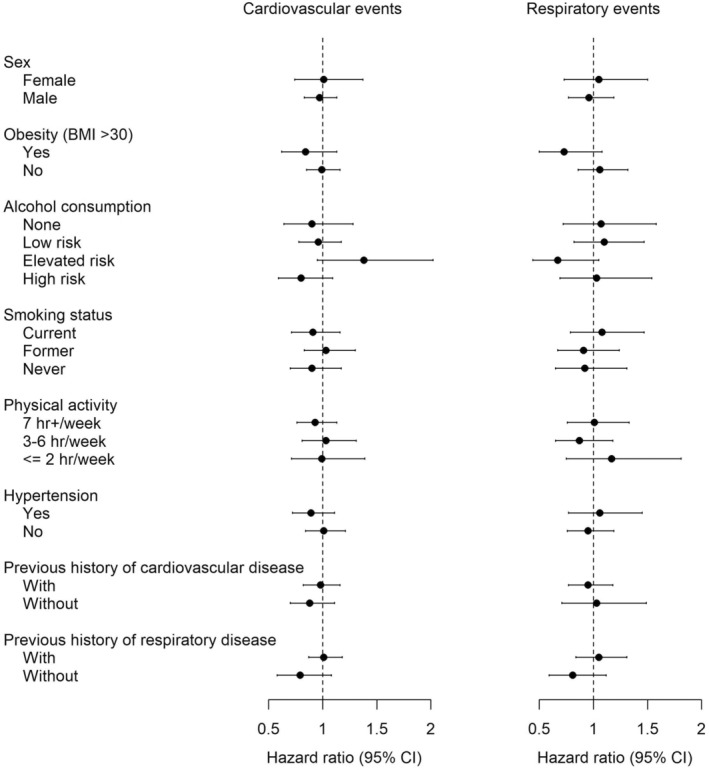
Burning candles at home emit small particles and gases that pollute indoor air. Exposure to fine particles in outdoor air has been convincingly linked to cardiovascular and respiratory events, while the associations with fine and ultrafine particles from candle burning remain unexplored. We examined the association between the use of candles and incident cardiovascular and respiratory events. We collected data on 6757 participants of the Copenhagen Aging and Midlife Biobank cohort recruited in 2009 and followed them up for the first hospital contact for incident cardiovascular and respiratory events until 2018. We investigated an association between the self-reported frequency of candle use in wintertime and cardiovascular and respiratory events, using Cox regression models adjusting for potential confounders. During follow-up, 1462 and 834 were admitted for cardiovascular and respiratory events, respectively. We found null associations between candle use and a hospital contact due to cardiovascular and respiratory events, with hazard ratios (HRs) and 95% confidence intervals (CI) of 0.97 (95% CI: 0.84, 1.11) and 0.98 (95% CI: 0.81, 1.18), respectively, among those using candles >4 times/week compared with <1 time/week. For cause-specific cardiovascular diseases, HRs were 1.10 (95% CI: 0.85, 1.43) for ischemic heart disease and 1.18 (95% CI: 0.77, 1.81) for myocardial infarction. For chronic obstructive pulmonary disease, HR was 1.26 (95% CI: 0.81, 1.97). We found no statistically significant associations between candle use and the risk of cardiovascular and respiratory events. Studies with improved exposure assessments are warranted.
在家中燃烧蜡烛会释放出细小的颗粒和气体,污染室内空气。室外空气中的细颗粒物已被证实与心血管和呼吸道事件有关,而燃烧蜡烛产生的细颗粒物和超细颗粒物与这些事件的关联仍未得到探索。我们研究了使用蜡烛与心血管和呼吸道事件的发生之间的关联。我们收集了 2009 年招募的哥本哈根老龄化和中年生物库队列的 6757 名参与者的数据,并对他们进行了随访,直到首次因心血管和呼吸道事件到医院就诊。我们使用 Cox 回归模型,在调整了潜在混杂因素后,调查了冬季报告的蜡烛使用频率与心血管和呼吸道事件之间的关联。在随访期间,分别有 1462 人和 834 人因心血管和呼吸道事件入院。我们发现,与心血管和呼吸道事件相关的医院就诊次数与蜡烛使用之间无关联,每周使用蜡烛 >4 次与每周使用蜡烛<1 次相比,风险比(HR)及其 95%置信区间(CI)分别为 0.97(95%CI:0.84,1.11)和 0.98(95%CI:0.81,1.18)。对于特定的心血管疾病,缺血性心脏病的 HR 为 1.10(95%CI:0.85,1.43),心肌梗死的 HR 为 1.18(95%CI:0.77,1.81)。对于慢性阻塞性肺疾病,HR 为 1.26(95%CI:0.81,1.97)。我们未发现蜡烛使用与心血管和呼吸道事件风险之间存在统计学显著关联。需要进行改善暴露评估的研究。