Animal Disease Diagnostic Division, Animal and Plant Quarantine Agency, Gimcheon, 39660, Korea.
College of Veterinary Medicine, Kyungbuk National University, 80, Daehak-ro, Daegu, 41566, Korea.
BMC Vet Res. 2022 Aug 30;18(1):327. doi: 10.1186/s12917-022-03407-0.
Porcine reproductive and respiratory syndrome virus (PRRSV) has caused huge economic losses in the global swine industry. Frequent genetic variations in this virus cause difficulties in controlling and accurately diagnosing PRRSV.
In this study, we investigated the genetic characteristics of PRRSV-1 and PRRSV-2 circulating in Korea from January 2018 to September 2021 and evaluated three one-step real-time reverse transcription polymerase chain reaction (RT-PCR) assays.
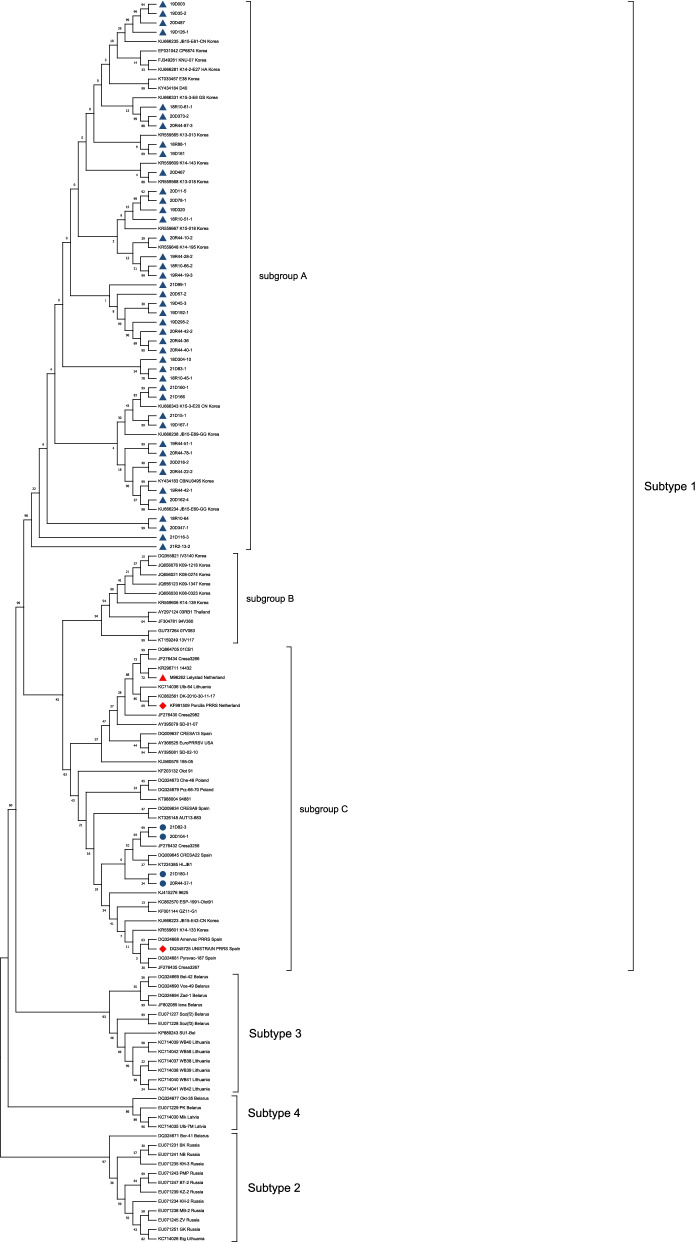
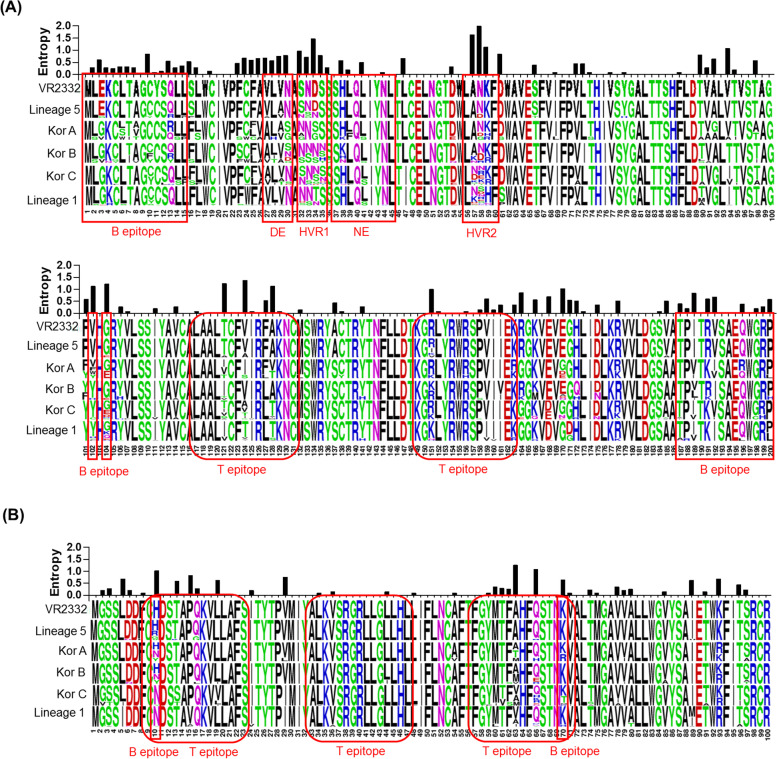
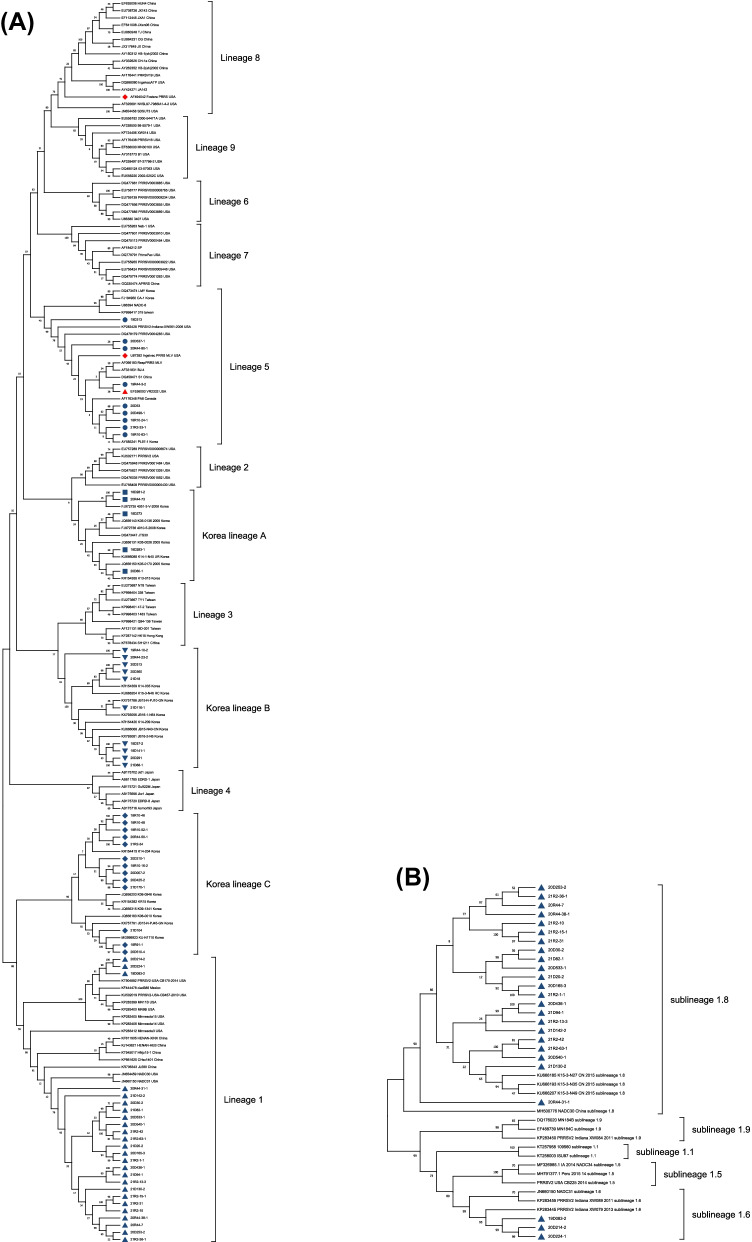
A total of 129 lung samples were collected, consisting of 47 samples for PRRSV-1, 62 samples for PRRSV-2, and 20 PRRSV-negative samples. Nucleotide sequence analysis of open reading frames (ORFs) 5, ORF6, and ORF7 genes from PRRSV samples showed that PRRSV-1 belonged to subgroup A (43/47, 91.49%) and subgroup C (4/47, 8.51%), whereas PRRSV-2 was classified as lineage 1 (25/62, 40.32%), Korean lineage (Kor) C (13/62, 20.97%), Kor B (10/62, 16.13%), lineage 5 (9/62, 14.52%), and Kor A (5/62, 8.06%). Amino acid sequence analysis showed that the neutralizing epitope and T cell epitope of PRRSV-1, and the decoy epitope region and hypervariable regions of PRRSV-2 had evolved under positive selection pressure. In particular, the key amino acid substitutions were found at positions 102 and 104 of glycoprotein 5 (GP5) in some PRRSV-2, and at positions 10 and 70 of membrane protein (M) in most PRRSV-2. In addition, one-step real-time RT-PCR assays, comprising two commercial tests and one test recommended by the World Organization for Animal Health (OIE), were evaluated.
The results revealed that two of the real-time RT-PCR assays had high sensitivities and specificities, whereas the real-time RT-PCR assay of the OIE had low sensitivity due to mismatches between nucleotides of Korean PRRSVs and forward primers. In this study, we genetically characterized recent PRRSV occurrences and evaluated three one-step real-time RT-PCR assays used in Korea.
猪繁殖与呼吸综合征病毒(PRRSV)在全球养猪业造成了巨大的经济损失。该病毒频繁发生遗传变异,给 PRRSV 的防控和准确诊断带来困难。
本研究调查了 2018 年 1 月至 2021 年 9 月期间在韩国流行的 PRRSV-1 和 PRRSV-2 的遗传特征,并评估了三种一步法实时 RT-PCR 检测方法。
共采集了 129 份肺组织样本,其中 PRRSV-1 样本 47 份,PRRSV-2 样本 62 份,PRRSV 阴性样本 20 份。对 PRRSV 样本的 ORF5、ORF6 和 ORF7 基因的核苷酸序列分析显示,PRRSV-1 属于亚群 A(43/47,91.49%)和亚群 C(4/47,8.51%),而 PRRSV-2 被分为 1 型(25/62,40.32%)、韩国 1 型(Kor)C 型(13/62,20.97%)、Kor B 型(10/62,16.13%)、5 型(9/62,14.52%)和 Kor A 型(5/62,8.06%)。氨基酸序列分析表明,PRRSV-1 的中和表位和 T 细胞表位,以及 PRRSV-2 的诱饵表位区和高变区在正选择压力下发生了进化。特别是在一些 PRRSV-2 的 GP5 蛋白(GP5)的 102 位和 104 位以及大多数 PRRSV-2 的 M 蛋白(M)的 10 位和 70 位发现了关键的氨基酸替换。此外,还评估了包括两种商业检测方法和世界动物卫生组织(OIE)推荐的一种检测方法在内的一步法实时 RT-PCR 检测方法。
结果表明,两种实时 RT-PCR 检测方法具有较高的灵敏度和特异性,而 OIE 的实时 RT-PCR 检测方法由于韩国 PRRSV 的核苷酸与正向引物不匹配,灵敏度较低。本研究对韩国近期发生的 PRRSV 进行了基因特征分析,并对三种在韩国使用的一步法实时 RT-PCR 检测方法进行了评估。