Lobban Romario, Biswas Ankan, Ruiz-Márquez Kevin J, Bellan Leon M
Department of Mechanical Engineering, Vanderbilt University Nashville TN 37235 USA
Department of Chemical and Biomolecular Engineering, Vanderbilt University Nashville TN 37235 USA.
RSC Adv. 2022 Aug 9;12(34):21885-21891. doi: 10.1039/d2ra02938c. eCollection 2022 Aug 4.
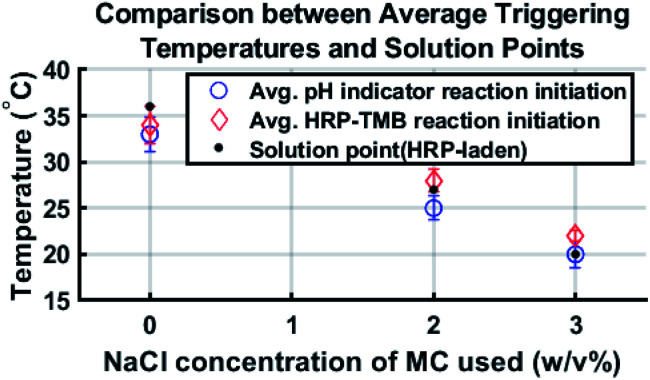
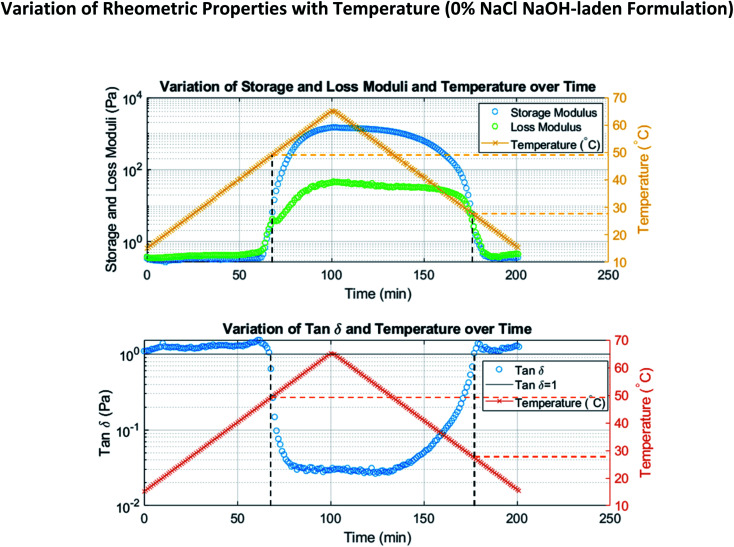
Much work has been done on the use of heating to trigger reactions the temperature-dependent removal of a barrier or constraint separating reagents. Far less work, however, has been done on the use of cooling to achieve a similar goal. Numerous applications, such as those involving components or materials susceptible to persistent low temperatures and cases in which energy for heating is not available, would benefit from this inverse approach. Hence, in this study we explore whether physically crosslinked hydrogels can be reliably used as thermoresponsive constraints that allow reagents to react only upon cooling. We achieve this by loading reagents into adjacent blocks of thermoresponsive hydrogel and showing that these reagents can only react with each other after the temperature of the hydrogel falls below its lower critical solution temperature (LCST). Above the LCST, the reagents remain sequestered in separate gels and no reaction occurs; this "OFF" state is stable for extended periods. When the system is allowed to cool, the hydrogels liquify and flow into each other, allowing mixing of the embedded reagents ("ON" state). We tune the hydrogels' LCSTs using NaCl, quantify the NaCl's tuning effect using rheometry, and determine that reactions are triggered reproducibly at temperatures similar to the tuned LCSTs. We also demonstrate generalizability of the concept by exploring situations involving radically different reaction types. This concept therefore constitutes a new approach to autonomous material behavior based on cooling.
在利用加热引发反应方面已经开展了大量工作,即通过温度依赖性方式去除分隔试剂的屏障或限制因素。然而,在利用冷却实现类似目标方面所做的工作要少得多。许多应用,例如涉及易受持续低温影响的组件或材料的应用,以及无法获得加热能量的情况,都将从这种反向方法中受益。因此,在本研究中,我们探讨了物理交联水凝胶是否可以可靠地用作热响应性限制因素,使试剂仅在冷却时发生反应。我们通过将试剂加载到热响应性水凝胶的相邻块中来实现这一点,并表明这些试剂只有在水凝胶温度降至其低临界溶液温度(LCST)以下时才能相互反应。在LCST以上,试剂被隔离在单独的凝胶中,不发生反应;这种“关闭”状态在很长一段时间内都是稳定的。当系统冷却时,水凝胶液化并相互流动,使嵌入的试剂混合(“开启”状态)。我们使用氯化钠调节水凝胶的LCST,使用流变学量化氯化钠的调节效果,并确定反应在与调节后的LCST相似的温度下可重复触发。我们还通过探索涉及截然不同反应类型的情况来证明该概念的通用性。因此,这一概念构成了一种基于冷却的自主材料行为的新方法。