Collaborative Innovation Center of Yangtze River Delta Region Green Pharmaceuticals, Zhejiang University of Technology, Hangzhou, Zhejiang, 310014, P.R. China.
The First Affiliated Hospital of Zhejiang Chinese Medical University, Hangzhou, Zhejiang, 310006, P.R. China.
Comb Chem High Throughput Screen. 2023;26(7):1424-1436. doi: 10.2174/1386207325666220827152654.
The aim of the study was to explore the efficacy as well as the mechanism of action of Pitongshu (PTS) on rats with functional dyspepsia (FD) induced by iodoacetamide gavage and tail clamping.
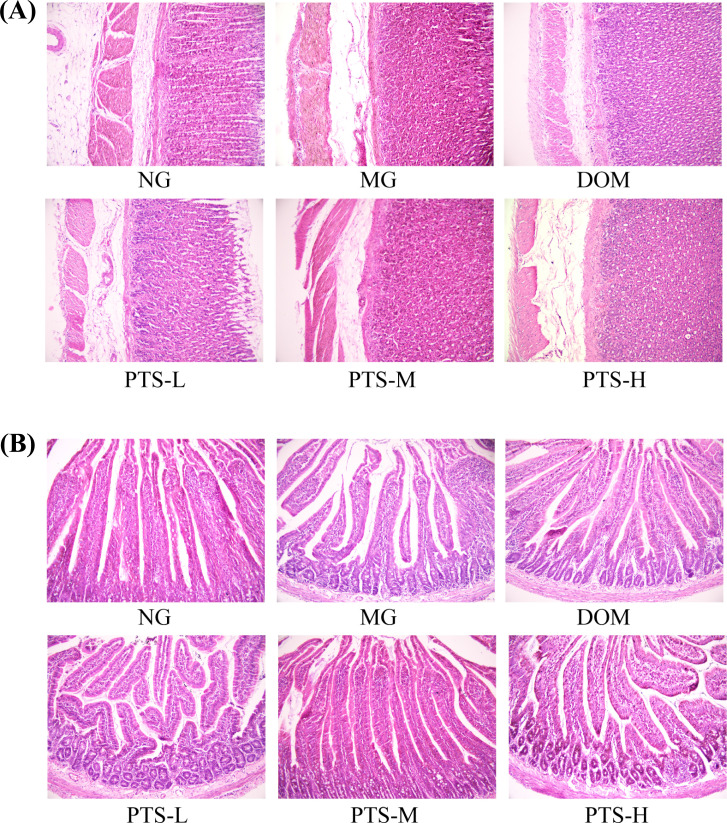
The bioactive components of PTS were obtained from the Traditional Chinese Medicine Systems Pharmacology Database and Analysis Platform (TCMSP), whereas the potential targets of PTS were obtained from the Similarity Ensemble Approach (SEA), TCMSP, and Swiss Target Prediction Database. The disease targets were obtained from the DisGeNET database, whereas Gene Ontology (GO) and Kyoto Encyclopedia of Genes and Genomes (KEGG) enrichment analyses were performed using the R Software. The method of iodoacetamide gavage combined with tail clamping was used to establish the FD rat model in this study. Body weight, food intake, gastrointestinal motility, gastric acidity and secretion, and the mechanical pain threshold of rats were measured. The open-field test was also performed. The stomach and duodenum were histologically observed. The levels of serotonin (5-HT), Calcitonin Gene-Related Peptide (CGRP), Motilin (MTL), and Gastrin (GAS) in gastric tissues were detected by ELISA.
A total of 139 bioactive components and 17 potential targets of PTS were identified through a network pharmacology approach. The results of GO and KEGG enrichment analyses indicated that PTS could reduce the 5-HT secretion of gastric tissues through the serotonergic synaptic pathway and alleviate the symptoms of FD, indicating that PTS plays a therapeutic role. The results of animal experiments showed that PTS could increase body weight and food intake, improve autonomous activity, and decrease gastric acidity and secretion in FD rats. Furthermore, gastric sensitivity increased in FD rats, and PTS treatment could significantly decrease it. The results of ELISA showed that the overexpression of 5-HT and CGRP was decreased after PTS treatment in FD rats. Lastly, PTS could significantly improve gastrointestinal motility, as well as the levels of GAS and MTL in FD rats.
PTS may reduce 5-HT secretion by regulating the serotonergic synaptic pathway, thereby reducing visceral sensitivity and alleviating the symptoms of FD.
本研究旨在探讨荜茇通栓(PTS)对碘乙酰胺灌胃加夹尾法诱导的功能性消化不良(FD)大鼠的疗效及其作用机制。
采用中药系统药理学数据库和分析平台(TCMSP)获取 PTS 的生物活性成分,采用相似成分集成方法(SEA)、TCMSP 和瑞士靶向预测数据库获取 PTS 的潜在靶点。从 DisGeNET 数据库获取疾病靶点,采用 R 软件进行基因本体(GO)和京都基因与基因组百科全书(KEGG)富集分析。本研究采用碘乙酰胺灌胃加夹尾法建立 FD 大鼠模型,测量大鼠体重、摄食量、胃肠动力、胃酸分泌和胃分泌、机械痛阈,进行旷场试验,观察胃十二指肠组织学变化,采用 ELISA 法检测胃组织中 5-羟色胺(5-HT)、降钙素基因相关肽(CGRP)、胃动素(MTL)和胃泌素(GAS)水平。
通过网络药理学方法,共鉴定出 PTS 的 139 种生物活性成分和 17 个潜在靶点。GO 和 KEGG 富集分析结果表明,PTS 可能通过 5-羟色胺能突触通路减少胃组织 5-HT 分泌,缓解 FD 症状,提示 PTS 发挥治疗作用。动物实验结果显示,PTS 可增加 FD 大鼠体重和摄食量,改善自主活动,降低胃酸分泌和胃分泌,提高 FD 大鼠胃敏感性,PTS 治疗可显著降低其胃敏感性。ELISA 结果显示,PTS 治疗可降低 FD 大鼠 5-HT 和 CGRP 过表达。最后,PTS 可显著改善 FD 大鼠的胃肠动力,提高胃动素和胃泌素水平。
PTS 可能通过调节 5-羟色胺能突触通路减少 5-HT 分泌,从而降低内脏敏感性,缓解 FD 症状。