Department of Epidemiology and Biostatistics, College of Health and Medical Sciences, Haramaya University, Harar, Ethiopia.
Department of Statistics, College of Computing and Informatics, Haramaya University, Haramaya, Ethiopia.
BMC Pregnancy Childbirth. 2022 Aug 31;22(1):671. doi: 10.1186/s12884-022-04994-4.
Pregnancy losses remain a neglected issue and it will be taking more than a century before a pregnant woman in Sub Sahara has the same chance of her baby being born alive as a woman in a high-income country. Pregnancy loss data are limited and not universal in Sub Saharan countries. This study was aimed to assess the magnitude and determinants of pregnancy loss in eastern Ethiopia.
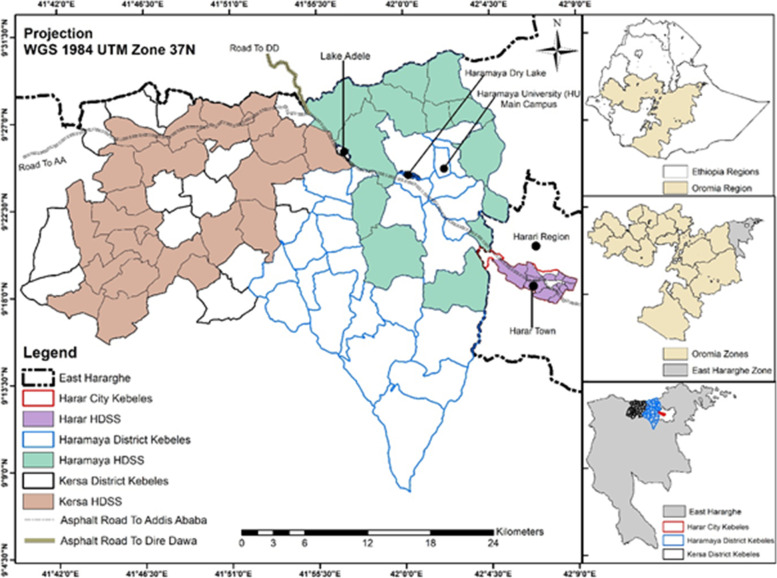
This study was conducted in, open continues and dynamic cohort of population, Kersa Health and Demographic Survillance site (HDSS) in Eastern Ethiopia in 2008-2019. All mothers who had known pregnancy outcomes during the period and reside in Kersa HDSS were considered. The prevalence proportions were calculated as the sum of all pregnancy loss divided by the number births in the specified year. Log-Binomial regression was used to determine factors associated with pregnancy loss. Prevalence Proportion Ratio (PPR) was used to report the magnitude and strength of association. A p-value of less than 0.05 was considered statistically significant.
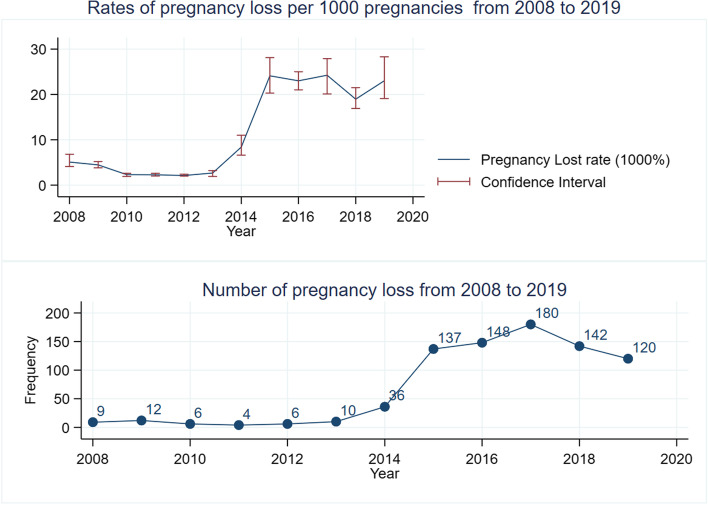
From 39,153 included pregnancies, 810 (20.7; 95%CI:19.32, 22.15 per 1000 births) experienced pregnancy loss. Stillbirth was higher than abortion (11.14 Vs. 9.55 per 1000 births). Lacking own income (aPPR:1.26; 95%CI: 1.01, 1.58), being daily laborer (aPPR:1.44; 95%:1.08, 306) history of previous pregnancy loss (aPPR:2.26, 95%CI:1.69, 3.03), unwanted pregnancy (aPPR:1.26; 95%CI:1.01, 1.80), not receiving antenatal care (aPPR:1.59; 95%CI: 1.19, 2.13) and not receive the TT-vaccine during pregnancy (aPPR:1.33; 95%CI: 1.08, 1.80) were positively associated with pregnancy loss.
The overall rate pregnancy loss was ranged between 19.32, 22.15 per 1000 births with higher still births than miscarriage or abortion. Pregnancy loss was positively associated with social factors reproductive health factors, and maternal health service utilization.
妊娠丢失仍然是一个被忽视的问题,撒哈拉以南的女性要等到一个多世纪后,她们的婴儿才能像高收入国家的女性那样有同样的机会存活下来。撒哈拉以南国家的妊娠丢失数据有限且不普及。本研究旨在评估东非埃塞俄比亚的妊娠丢失规模和决定因素。
本研究于 2008 年至 2019 年在东非的 Kersa 卫生和人口监测点(HDSS)进行,该研究是一项针对人群的开放性连续动态队列研究。所有在该期间已知妊娠结局并居住在 Kersa HDSS 的产妇均被视为研究对象。患病率比例计算为特定年份所有妊娠丢失除以出生人数的总和。采用对数二项式回归确定与妊娠丢失相关的因素。流行比例比(PPR)用于报告规模和关联强度。p 值<0.05 被认为具有统计学意义。
在纳入的 39153 次妊娠中,810 次(20.7;95%CI:19.32,22.15/1000 次分娩)经历了妊娠丢失。死产高于流产(11.14 比 9.55/1000 次分娩)。缺乏自有收入(aPPR:1.26;95%CI:1.01,1.58)、日薪工人(aPPR:1.44;95%:1.08,306)、有既往妊娠丢失史(aPPR:2.26,95%CI:1.69,3.03)、非意愿妊娠(aPPR:1.26;95%CI:1.01,1.80)、未接受产前保健(aPPR:1.59;95%CI:1.19,2.13)和未在妊娠期间接种 TT 疫苗(aPPR:1.33;95%CI:1.08,1.80)与妊娠丢失呈正相关。
总的妊娠丢失率在 19.32 到 22.15/1000 次分娩之间,死产高于流产或流产。妊娠丢失与社会因素、生殖健康因素和孕产妇保健服务的利用呈正相关。