Department of Neurology, Graduate School of Medicine, The University of Tokyo, Japan.
Department of Molecular Neurology, Graduate School of Medicine, The University of Tokyo, Japan.
Intern Med. 2023 Apr 1;62(7):1073-1076. doi: 10.2169/internalmedicine.9366-22. Epub 2022 Aug 30.
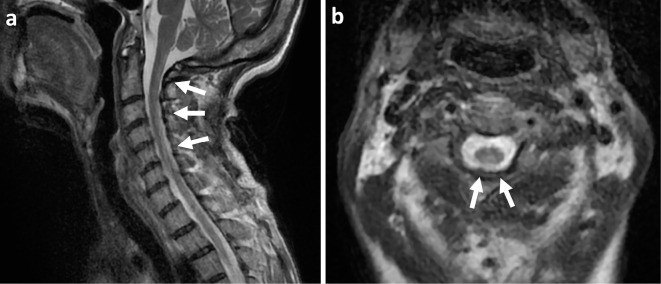
Copper deficiency (CD) is a rare complication of long-term treatment of Wilson's disease (WD) and is usually accompanied by high serum zinc levels. A 57-year-old woman with WD presented with limb weakness and sensory disturbance due to myeloneuropathy and macrocytic anemia after 36 years of treatment. Markedly reduced serum free copper values confirmed CD, which was considered to be caused by progressive dysphagia and severe diarrhea rather than zinc overdose because of the normal serum zinc levels. Discontinuing copper-reducing therapy and increasing copper intake improved her symptoms. Physicians should be alert for the risk of CD in WD patients, especially those with dysphagia.
铜缺乏症(CD)是长期治疗威尔逊病(WD)的罕见并发症,通常伴有高血清锌水平。一名 57 岁女性,WD 病史 36 年,因发生骨髓神经病和巨幼细胞性贫血而出现四肢无力和感觉障碍。显著降低的血清游离铜值证实了 CD 的存在,考虑到正常的血清锌水平,其原因可能是进行性吞咽困难和严重腹泻而非锌过量。停止铜还原治疗并增加铜的摄入改善了她的症状。医生应该警惕 WD 患者发生 CD 的风险,尤其是那些有吞咽困难的患者。