
《COVID-19 肺炎患者耳鼻喉科表现的临床意义:一项单中心回顾性队列研究》。
The Clinical Significance of Otolaryngology Manifestations in COVID-19 Pneumonia: A Single-center Retrospective Cohort Study.
机构信息
Clinical Research and Quality Management Center, University of the Ryukyus Hospital, University of the Ryukyus, Japan.
Department of General and Emergency Medicine, Japan Community Health-care Organization Sapporo Hokushin Hospital, Japan.
出版信息
Intern Med. 2022 Dec 1;61(23):3491-3496. doi: 10.2169/internalmedicine.0282-22. Epub 2022 Aug 30.
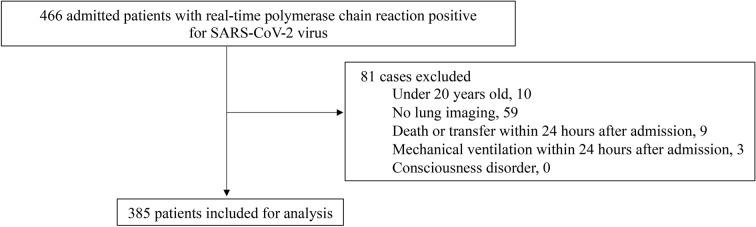
Objective Although the absence of a runny nose and sore throat, both ear-nose-throat (ENT) symptoms, suggests community-acquired pneumonia (CAP), the association between ENT symptoms and coronavirus disease 2019 (COVID-19) pneumonia remains unclear. We therefore investigated the association between ENT symptoms and COVID-19 pneumonia. Methods We retrospectively recruited consecutive confirmed COVID-19 inpatients with and without pneumonia admitted to a single institution from April 1, 2020, to July 31, 2021. After a descriptive analysis, we implemented univariable and multivariable regression analyses to assess the association between ENT symptoms and COVID-19 pneumonia. Results The present study included 385 patients. Pneumonia patients exhibited lower rates of positive runny nose and sore throat than non-pneumonia patients. Univariable analyses found mean odds ratios of 0.59 and 0.61 and 95% confidence intervals (CIs) of 0.30-1.16 and 0.32-1.17 for runny nose and sore throat, respectively, and multivariable analyses found mean odds ratios of 0.73 and 0.70 and 95% CIs of 0.34-1.56 and 0.34-1.46, respectively. Conclusion Our study found no statistically significant association between ENT symptoms and COVID-19 pneumonia. Clinicians should be aware that, unlike CAP, there is no correlation between ENT symptoms and pneumonia among patients with COVID-19, so it is necessary to consider the possibility of pneumonia even in the presence of ENT symptoms.
目的
虽然缺乏耳鼻喉(ENT)症状——即无鼻涕和喉咙痛——提示社区获得性肺炎(CAP),但 ENT 症状与 2019 年冠状病毒病(COVID-19)肺炎之间的关联仍不清楚。因此,我们调查了 ENT 症状与 COVID-19 肺炎之间的关系。
方法
我们回顾性招募了 2020 年 4 月 1 日至 2021 年 7 月 31 日期间在一家机构连续收治的确诊为 COVID-19 的住院患者,包括有和无肺炎的患者。在描述性分析之后,我们实施了单变量和多变量回归分析,以评估 ENT 症状与 COVID-19 肺炎之间的关系。
结果
本研究共纳入 385 例患者。肺炎患者的鼻涕和喉咙痛阳性率低于非肺炎患者。单变量分析发现,流鼻涕和喉咙痛的平均比值比分别为 0.59 和 0.61,95%置信区间(CI)分别为 0.30-1.16 和 0.32-1.17;多变量分析发现,流鼻涕和喉咙痛的平均比值比分别为 0.73 和 0.70,95%CI 分别为 0.34-1.56 和 0.34-1.46。
结论
我们的研究未发现 ENT 症状与 COVID-19 肺炎之间存在统计学显著关联。临床医生应注意,与 CAP 不同,COVID-19 患者的 ENT 症状与肺炎之间没有相关性,因此,即使存在 ENT 症状,也有必要考虑肺炎的可能性。
 Zotero 插件