Mackenzie Cancer Research Group, Department of Pathology and Biomedical Science, University of Otago Christchurch, Christchurch, New Zealand.
Metastasis Research Laboratory, GIGA-Cancer, University of Liège, Liege, Belgium.
Sci Rep. 2022 Sep 1;12(1):14845. doi: 10.1038/s41598-022-19032-8.
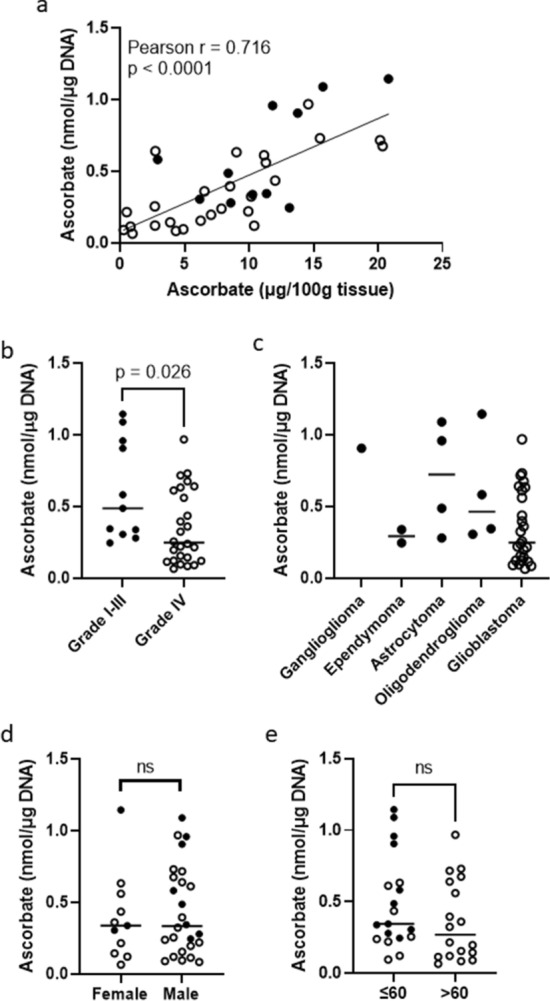
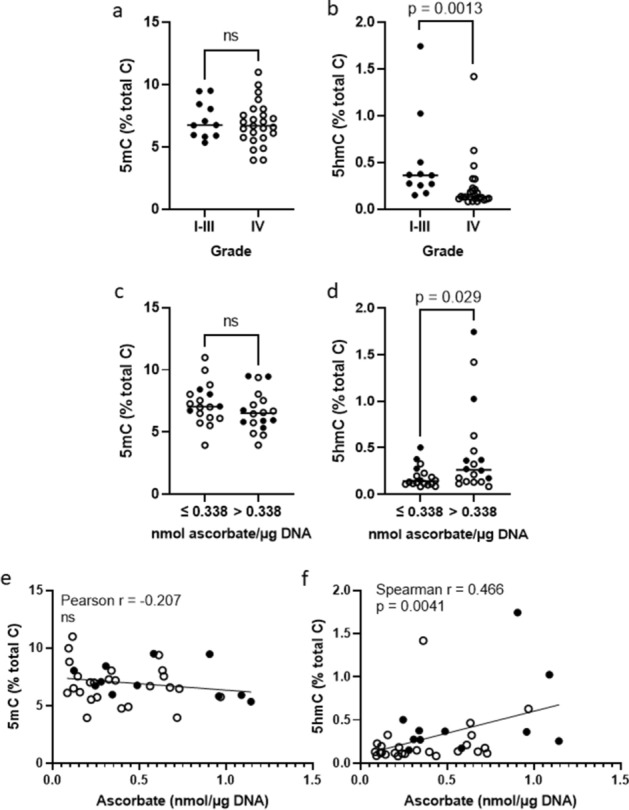
Gliomas are incurable brain cancers with poor prognosis, with epigenetic dysregulation being a distinctive feature. 5-hydroxymethylcytosine (5-hmC), an intermediate generated in the demethylation of 5-methylcytosine, is present at reduced levels in glioma tissue compared with normal brain, and that higher levels of 5-hmC are associated with improved patient survival. DNA demethylation is enzymatically driven by the ten-eleven translocation (TET) dioxygenases that require ascorbate as an essential cofactor. There is limited data on ascorbate in gliomas and the relationship between ascorbate and 5-hmC in gliomas has never been reported. Clinical glioma samples (11 low-grade, 26 high-grade) were analysed for ascorbate, global DNA methylation and hydroxymethylation, and methylation status of the O-6-methylguanine-DNA methyltransferase (MGMT) promoter. Low-grade gliomas contained significantly higher levels of ascorbate than high-grade gliomas (p = 0.026). Levels of 5-hmC were significantly higher in low-grade than high-grade glioma (p = 0.0013). There was a strong association between higher ascorbate and higher 5-hmC (p = 0.004). Gliomas with unmethylated and methylated MGMT promoters had similar ascorbate levels (p = 0.96). One mechanism by which epigenetic modifications could occur is through ascorbate-mediated optimisation of TET activity in gliomas. These findings open the door to clinical intervention trials in patients with glioma to provide both mechanistic information and potential avenues for adjuvant ascorbate therapy.
神经胶质瘤是一种无法治愈的脑癌,预后较差,表观遗传失调是其特征之一。5-羟甲基胞嘧啶(5-hmC)是 5-甲基胞嘧啶去甲基化的中间产物,在神经胶质瘤组织中的含量比正常脑组织低,并且较高水平的 5-hmC与患者生存改善相关。DNA 的去甲基化是由需要抗坏血酸作为必需辅助因子的 ten-eleven 易位(TET)双加氧酶酶促驱动的。目前关于神经胶质瘤中抗坏血酸的数据有限,并且神经胶质瘤中抗坏血酸与 5-hmC 之间的关系从未有报道过。对 11 例低级别和 26 例高级别临床神经胶质瘤样本进行了抗坏血酸、全基因组 DNA 甲基化和羟甲基化以及 O-6-甲基鸟嘌呤-DNA 甲基转移酶(MGMT)启动子甲基化状态的分析。低级别神经胶质瘤中的抗坏血酸水平明显高于高级别神经胶质瘤(p=0.026)。低级别神经胶质瘤中的 5-hmC 水平明显高于高级别神经胶质瘤(p=0.0013)。较高的抗坏血酸水平与较高的 5-hmC 之间存在强烈的相关性(p=0.004)。未甲基化和甲基化的 MGMT 启动子的神经胶质瘤具有相似的抗坏血酸水平(p=0.96)。表观遗传修饰发生的一种机制可能是通过抗坏血酸介导的神经胶质瘤中 TET 活性的优化。这些发现为神经胶质瘤患者的临床干预试验开辟了道路,提供了机制信息和潜在的辅助抗坏血酸治疗途径。