Alrashed Ahmed, Cahusac Peter, Mohzari Yahya A, Bamogaddam Reem F, Alfaifi Mashael, Mathew Maya, Alrumayyan Bashayer F, Alqahtani Basmah F, Alshammari Amjad, AlNekhilan Kholud, Binrokan Aljawharah, Alamri Khalil, Alshahrani Abdullah, Alshahrani Safar, Alanazi Ahmad S, Alhassan Batool M, Alsaeed Ali, Almutairi Wedad, Albujaidy Asma, AlJuaid Lama, Almalki Ziyad S, Ahmed Nehad, Alajami Hamdan N, Aljishi Hala M, Alsheef Mohammed, Alajlan Saleh A, Almutairi Faisal, Alsirhani Atheer, Alotaibi Manayer, Aljaber Melaf A, Bahammam Hammam A, Aldandan Hussain, Almulhim Abdulaziz S, Abraham Ivo, Alamer Ahmad
Administration of Pharmaceutical Services, Main Hospital, King Fahad Medical City, Riyadh, Saudi Arabia.
Pharmacology and Biostatistics/Comparative Medicine, Alfaisal University College of Medicine, King Faisal Specialist Hospital and Research Centre, Riyadh, Saudi Arabia.
Front Cardiovasc Med. 2022 Aug 16;9:978420. doi: 10.3389/fcvm.2022.978420. eCollection 2022.
Thrombotic complications of coronavirus disease 2019 (COVID-19) have received considerable attention. Although numerous conflicting findings have compared escalated thromboprophylaxis doses with a standard dose to prevent thrombosis, there is a paucity of literature comparing clinical outcomes in three different anticoagulation dosing regimens. Thus, we investigated the effectiveness and safety profiles of standard, intermediate, and high-anti-coagulation dosing strategies in COVID-19 critically ill patients.
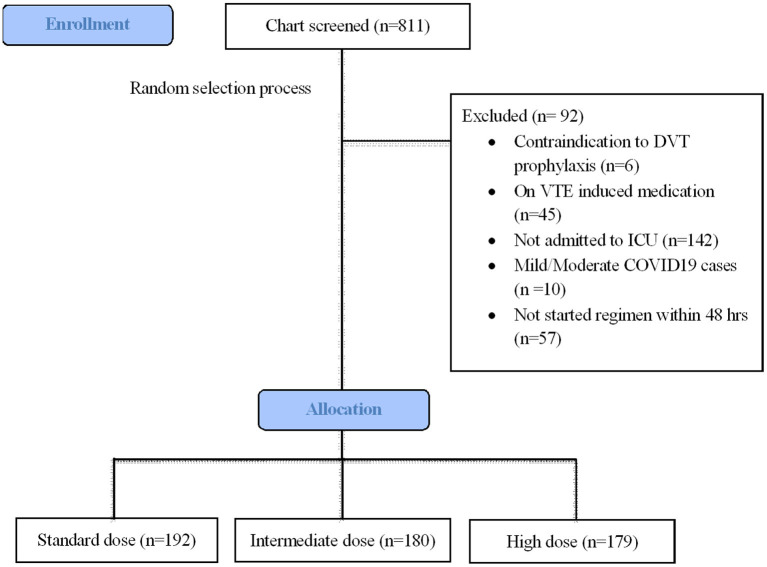
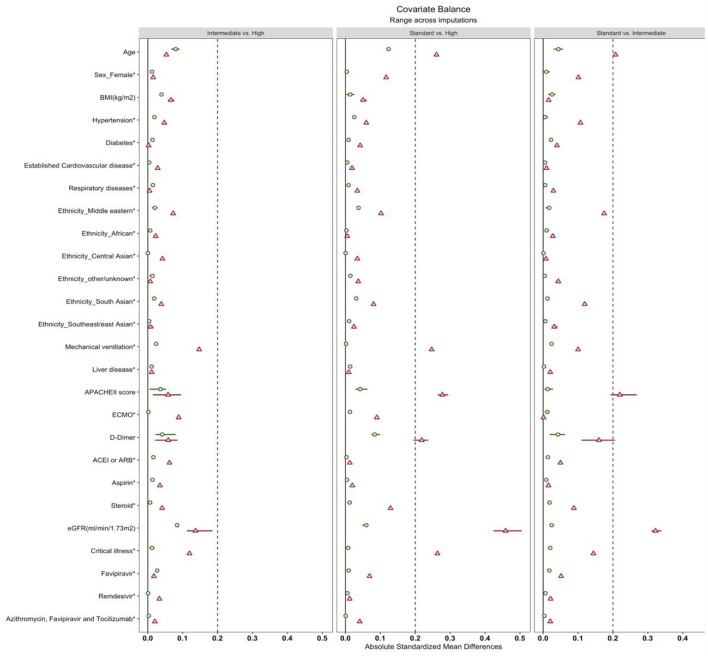
This retrospective multicenter cohort study of intensive care unit (ICU) patients from the period of April 2020 to August 2021 in four Saudi Arabian centers. Inclusion criteria were age ≥ 18 years, diagnosis with severe or critical COVID-19 infection, and receiving prophylactic anticoagulant dose within 24-48 h of ICU admission. The primary endpoint was a composite of thrombotic events, with mortality rate and minor or major bleeding serving as secondary endpoints. We applied survival analyses with a matching weights procedure to control for confounding variables in the three arms.
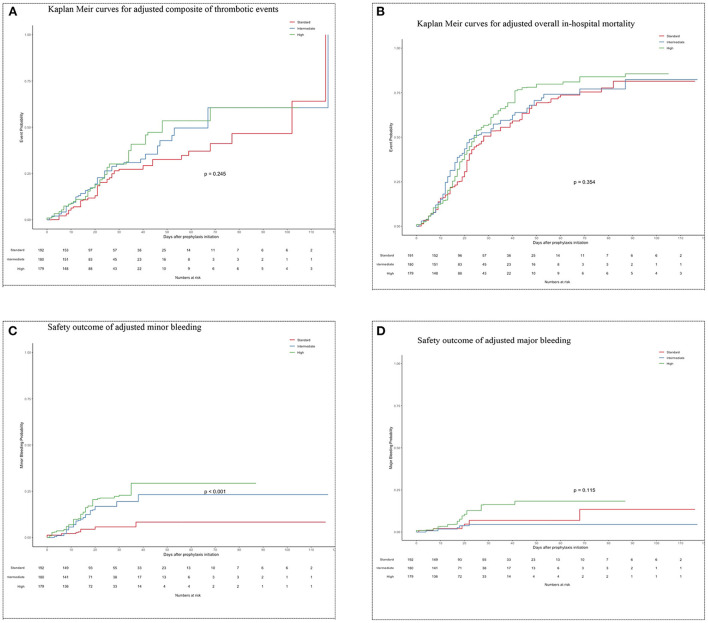
A total of 811 patient records were reviewed, with 551 (standard-dose = 192, intermediate-dose = 180, and high-dose = 179) included in the analysis. After using weights matching, we found that the standard-dose group was not associated with an increase in the composite thrombotic events endpoint when compared to the intermediate-dose group {19.8 vs. 25%; adjusted hazard ratio (aHR) =1.46, [95% confidence of interval (CI), 0.94-2.26]} or when compared to high-dose group [19.8 vs. 24%; aHR = 1.22 (95% CI, 0.88-1.72)]. Also, there were no statistically significant differences in overall in-hospital mortality between the standard-dose and the intermediate-dose group [51 vs. 53.4%; aHR = 1.4 (95% CI, 0.88-2.33)] or standard-dose and high-dose group [51 vs. 61.1%; aHR = 1.3 (95% CI, 0.83-2.20)]. Moreover, the risk of major bleeding was comparable in all three groups [standard vs. intermediate: 4.8 vs. 2.8%; aHR = 0.8 (95% CI, 0.23-2.74); standard vs. high: 4.8 vs. 9%; aHR = 2.1 (95% CI, 0.79-5.80)]. However, intermediate-dose and high-dose were both associated with an increase in minor bleeding incidence with aHR = 2.9 (95% CI, 1.26-6.80) and aHR = 3.9 (95% CI, 1.73-8.76), respectively.
Among COVID-19 patients admitted to the ICU, the three dosing regimens did not significantly affect the composite of thrombotic events and mortality. Compared with the standard-dose regimen, intermediate and high-dosing thromboprophylaxis were associated with a higher risk of minor but not major bleeding. Thus, these data recommend a standard dose as the preferred regimen.
2019冠状病毒病(COVID-19)的血栓形成并发症受到了广泛关注。尽管有大量相互矛盾的研究结果比较了增加的血栓预防剂量与标准剂量预防血栓形成的效果,但比较三种不同抗凝给药方案临床结局的文献却很匮乏。因此,我们研究了标准、中等和高抗凝给药策略在COVID-19重症患者中的有效性和安全性。
这是一项回顾性多中心队列研究,研究对象为2020年4月至2021年8月期间沙特阿拉伯四个中心的重症监护病房(ICU)患者。纳入标准为年龄≥18岁、诊断为重症或危重症COVID-19感染且在入住ICU后24 - 48小时内接受预防性抗凝药物治疗。主要终点是血栓形成事件的综合指标,死亡率以及轻微或严重出血作为次要终点。我们采用生存分析和匹配权重程序来控制三组中的混杂变量。
共审查了811份患者记录,其中551份(标准剂量组 = 192例,中等剂量组 = 180例,高剂量组 = 179例)纳入分析。在使用权重匹配后,我们发现与中等剂量组相比,标准剂量组在血栓形成事件综合终点方面没有增加{19.8%对25%;调整后风险比(aHR)= 1.46,[95%置信区间(CI),0.94 - 2.26]},与高剂量组相比时也是如此[19.8%对24%;aHR = 1.22(95% CI,0.88 - 1.72)]。此外,标准剂量组与中等剂量组之间的总体住院死亡率[51%对53.4%;aHR = 1.4(95% CI,0.88 - 2.33)]或标准剂量组与高剂量组之间[51%对61.1%;aHR = 1.3(95% CI,0.83 - 2.20)]没有统计学显著差异。而且,所有三组的严重出血风险相当[标准剂量组对中等剂量组:4.8%对2.8%;aHR = 0.8(95% CI,0.23 - 2.74);标准剂量组对高剂量组:4.8%对9%;aHR = 2.1(95% CI,0.79 - 5.80)]。然而,中等剂量组和高剂量组均与轻微出血发生率增加相关,aHR分别为2.9(95% CI,1.26 - 6.80)和3.9(95% CI,1.73 - 8.76)。
在入住ICU的COVID-19患者中,三种给药方案对血栓形成事件综合指标和死亡率没有显著影响。与标准剂量方案相比,中等和高剂量血栓预防与轻微出血风险增加相关,但与严重出血无关。因此,这些数据推荐标准剂量作为首选方案。