Varkaneh Hamed Kord, Poursoleiman Faezeh, Al Masri Mohammad Khaldoun, Alras Kamar Allayl, Shayah Yamen, Masmoum Mohd Diya, Alangari Fulwah Abdulaziz, Alras Abd Alfatah, Rinaldi Giulia, Day Andrew S, Hekmatdoost Azita, Abu-Zaid Ahmed, Kutbi Emad
Student Research Committee, Department of Clinical Nutrition and Dietetics, Faculty of Nutrition and Food Technology, Shahid Beheshti University of Medical Sciences, Tehran, Iran.
College of Medicine, Alfaisal University, Riyadh, Saudi Arabia.
Front Nutr. 2022 Aug 16;9:987921. doi: 10.3389/fnut.2022.987921. eCollection 2022.
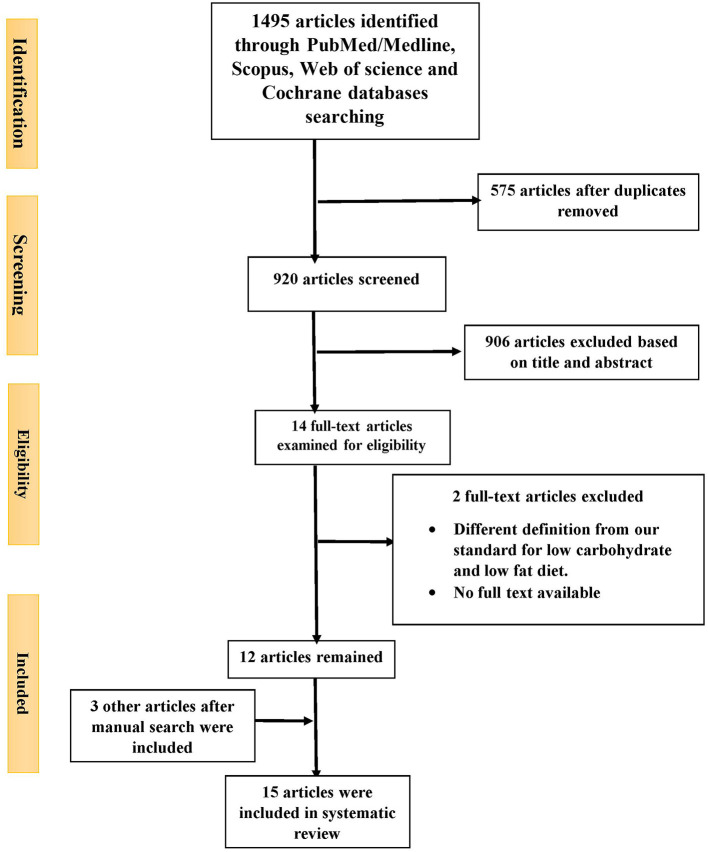
Although there is a consensus on beneficial effects of a low calorie diet in management of non-alcoholic fatty liver disease, the optimal composition of diet has not yet been elucidated. The aim of this review is to summarize the results of current randomized controlled trials evaluating the effects of low fat diet (LFD) vs. low carbohydrate diet (LCD) on NAFLD. This is a systematic review of all the available data reported in published clinical trials up to February 2022. The methodological quality of eligible studies was assessed, and data were presented aiming specific standard measurements. A total of 15 clinical trial studies were included in this systematic review. There is an overall lack of consensus on which dietary intervention is the most beneficial for NAFLD patients. There is also an overall lack of consensus on the definition of the different restrictive diets and the percentage of macronutrient restriction recommended. It seems that low calorie diets, regardless of their fat and carbohydrate composition, are efficient for liver enzyme reduction. Both LCD and LFD have similar effects on liver enzymes change; however, this improvement tends to be more marked in LFD. All calorie restrictive dietary interventions are beneficial for reducing weight, liver fat content and liver enzymes in individuals with NAFLD. Low fat diets seem to be markedly successful in reducing transaminase levels. Further research is needed to explore diet intensity, duration and long-term outcome.
尽管对于低热量饮食在非酒精性脂肪性肝病管理中的有益作用已达成共识,但饮食的最佳组成尚未阐明。本综述的目的是总结当前评估低脂饮食(LFD)与低碳水化合物饮食(LCD)对非酒精性脂肪性肝病影响的随机对照试验结果。这是对截至2022年2月发表的临床试验中报告的所有可用数据进行的系统综述。评估了符合条件研究的方法学质量,并针对特定标准测量呈现数据。本系统综述共纳入15项临床试验研究。对于哪种饮食干预对非酒精性脂肪性肝病患者最有益,总体上缺乏共识。对于不同限制饮食的定义以及推荐的宏量营养素限制百分比,也总体上缺乏共识。似乎低热量饮食,无论其脂肪和碳水化合物组成如何,都能有效降低肝酶。低碳水化合物饮食和低脂饮食对肝酶变化有相似影响;然而,这种改善在低脂饮食中往往更为明显。所有热量限制饮食干预对降低非酒精性脂肪性肝病个体的体重、肝脏脂肪含量和肝酶都有益。低脂饮食在降低转氨酶水平方面似乎非常成功。需要进一步研究来探索饮食强度、持续时间和长期结果。