Chawla Geetanjli, Azharuddin Muhammad, Ahmad Irshad, Hussain M Ejaz
Centre for Physiotherapy and Rehabilitation Sciences, Jamia Millia Islamia, New Delhi, India.
Faculty of Allied Health Sciences, Manav Rachna International Institute of Research and Studies, Haryana, India.
Oman Med J. 2022 Jul 31;37(4):e408. doi: 10.5001/omj.2022.72. eCollection 2022 Jul.
To determine the effects of whole-body vibration (WBV) training on depression, anxiety, stress, and quality of life (QoL) in college students.
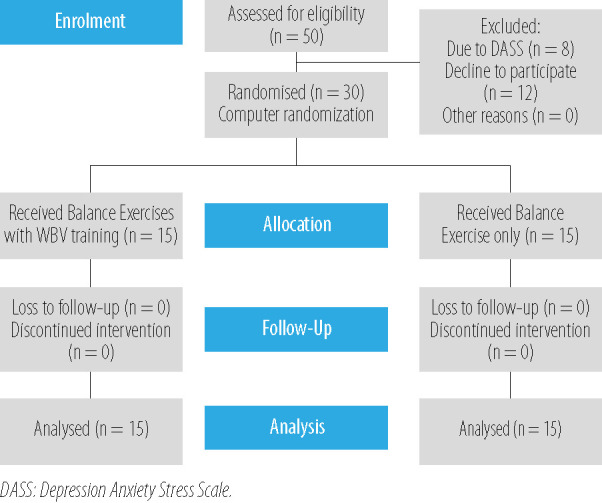
The participants comprised college students who led physically inactive lifestyles as revealed by their Medical Outcomes Study Form 36 (SF-36) scores, and with elevated scores of Depression Anxiety Stress Scale (DASS) test. They were randomly allocated to two groups of 15 each: (a) the WBV group (male = 3, female = 12) and (b) the exercise group (male = 6, female = 9). The participants in the WBV group performed prescribed exercises while they stood on a vibrating platform whereas those in the exercise group performed the same exercises but without the vibrating platform. After four weeks of twice-a-week training, DASS and SF-36 were measured. The pre- and post-scores were compared between the groups.
Depression ( < 0.001), anxiety ( < 0.001), and stress ( < 0.001) were found to reduce significantly for the WBV group compared to the exercise group. There was also significant within-group improvement in all the components of SF-36 ( < 0.040).
Exercising on the WBV platform may reduce depression, anxiety, and stress in college students and improve their overall QoL.
确定全身振动(WBV)训练对大学生抑郁、焦虑、压力和生活质量(QoL)的影响。
参与者为大学生,他们的医学结局研究简表36(SF - 36)评分显示其身体活动水平较低,且抑郁焦虑压力量表(DASS)测试得分较高。他们被随机分为两组,每组15人:(a)WBV组(男性 = 3人,女性 = 12人)和(b)运动组(男性 = 6人,女性 = 9人)。WBV组的参与者站在振动平台上进行规定的运动,而运动组的参与者进行相同的运动,但没有振动平台。经过每周两次、为期四周的训练后,测量DASS和SF - 36。比较两组的前后得分。
与运动组相比,WBV组的抑郁(<0.001)、焦虑(<0.001)和压力(<0.001)显著降低。SF - 36的所有组成部分在组内也有显著改善(<0.040)。
在WBV平台上锻炼可能会减轻大学生的抑郁、焦虑和压力,并改善他们的整体生活质量。