Oberste Max, Großheinrich Nicola, Wunram Heidrun-Lioba, Graf Johannes Levin, Ziemendorff Alischa, Meinhardt Axel, Fricke Oliver, Mahabir Esther, Bender Stephan
Department of Child and Adolescent Psychiatry and Psychotherapy, Medical Faculty, University of Cologne, Robert-Koch-Straße 10, 50931, Cologne, Germany.
Department of Social Sciences, Catholic University of Applied Science of North Rhine - Westphalia, Wörthstraße 10, 50688, Cologne, Germany.
Trials. 2018 Jul 3;19(1):347. doi: 10.1186/s13063-018-2747-8.
Moderate to vigorous endurance and strength-training exercise was suggested as a treatment option for major depression. However, there is little evidence to support this suggestion in adolescent patients. The present study investigates the effects of a whole-body vibration strength-training intervention on symptoms in medication-naïve adolescent inpatients experiencing a major depressive episode. Potential underlying endocrinological and neurobiological mechanisms are explored.
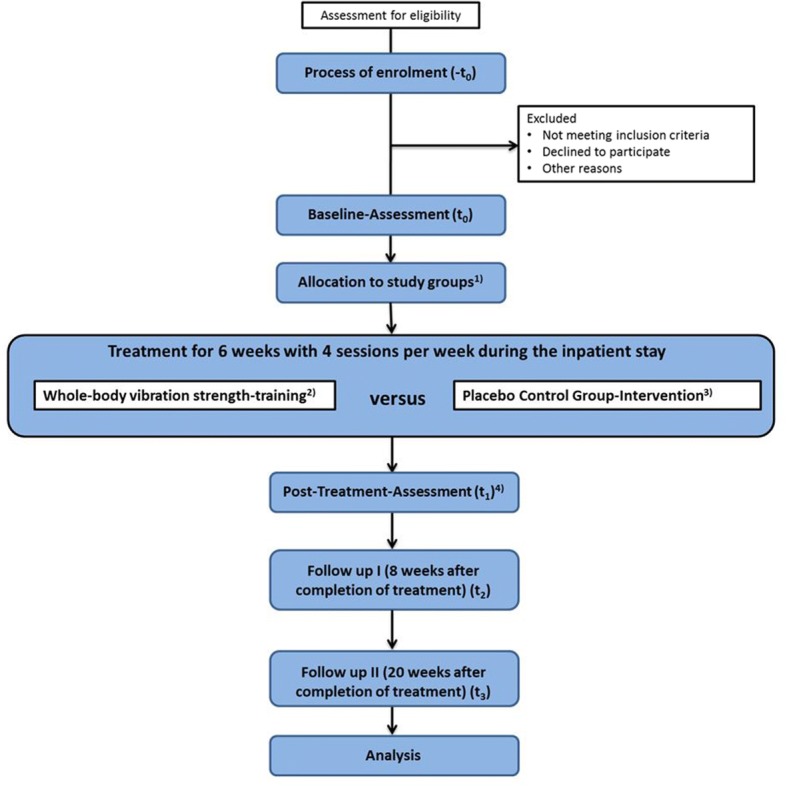
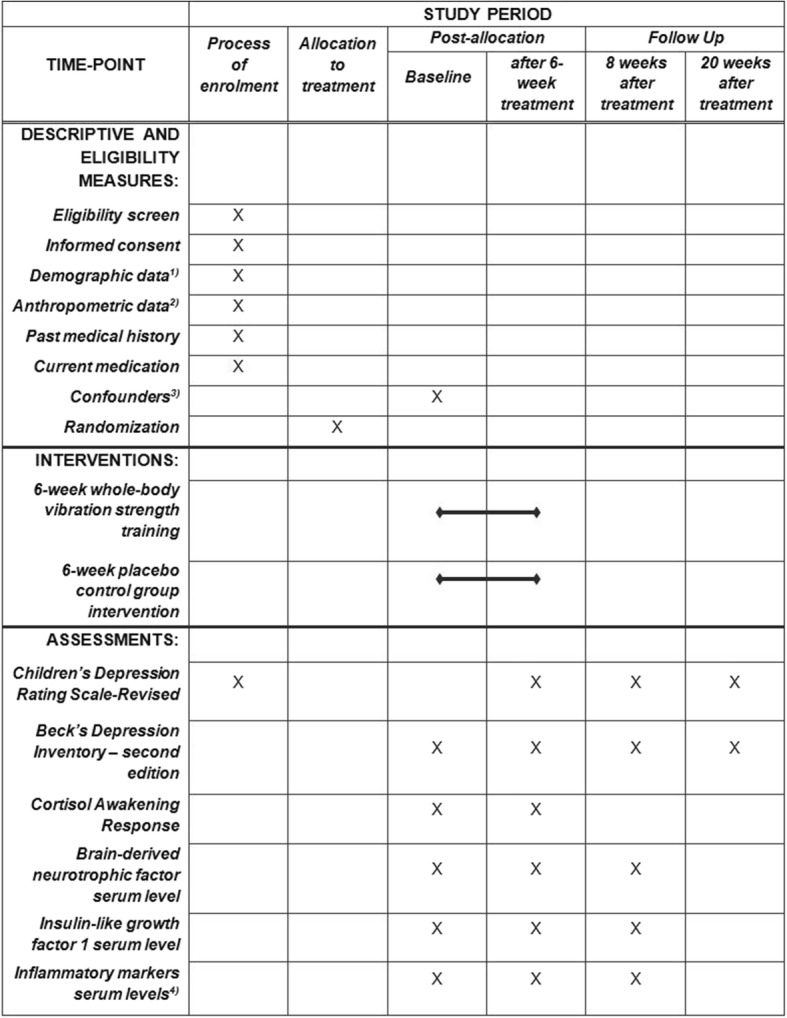
METHODS/DESIGN: A double-blinded randomized controlled trial is conducted at the University Hospital of Cologne in Germany, comparing a 6-week, whole-body vibration strength-training with a 6-week placebo-intervention, as add-on therapy to inpatient treatment as usual. Forty-one subjects (13-18 years of age) will be included in each of the two groups. The study is powered to detect (α = .05, β = .2) a medium effect size difference between the two groups (d = .5) in terms of patients' change in the Children's Depression Rating Scale raw-score, from baseline until the end of the intervention. As secondary endpoints, the effects of exercise treatment on patients' cortisol awakening response as well as on brain-derived neurotrophic factor, insulin-like growth factor 1 and inflammatory markers (tumor necrosis factor-alpha, interleukin-6 and C-reactive protein) serum levels will be assessed.
This study will provide evidence on the effectiveness of whole-body vibration strength-training as an add-on therapy in adolescent inpatients experiencing a major depressive episode. After completion of data collection, the present study will be the largest randomized controlled trial so far to investigate the effectiveness of an exercise intervention in inpatient adolescents suffering from a major depressive episode. Moreover, the present study may help to determine the underlying mechanisms of potential anti-depressant effects of exercise in depressed adolescent inpatients.
DRKS.de, German Clinical Trials Register (DRKS), Identifier: DRKS00011772 . Registered on 20 March 2017.
中等到剧烈的耐力和力量训练运动被认为是治疗重度抑郁症的一种选择。然而,几乎没有证据支持这一建议适用于青少年患者。本研究调查全身振动力量训练干预对初次接受药物治疗的青少年重度抑郁发作住院患者症状的影响。同时探索潜在的内分泌和神经生物学机制。
方法/设计:在德国科隆大学医院进行一项双盲随机对照试验,将为期6周的全身振动力量训练与为期6周的安慰剂干预进行比较,作为常规住院治疗的附加疗法。两组各纳入41名受试者(年龄13 - 18岁)。该研究旨在检测(α = 0.05,β = 0.2)两组之间在儿童抑郁评定量表原始分数上的中等效应量差异(d = 0.5),即从基线到干预结束时患者的变化。作为次要终点,将评估运动治疗对患者皮质醇觉醒反应以及脑源性神经营养因子、胰岛素样生长因子1和炎症标志物(肿瘤坏死因子-α、白细胞介素-6和C反应蛋白)血清水平的影响。
本研究将为全身振动力量训练作为青少年重度抑郁发作住院患者附加疗法的有效性提供证据。在完成数据收集后,本研究将成为迄今为止最大规模的随机对照试验,以调查运动干预对患有重度抑郁发作的住院青少年的有效性。此外,本研究可能有助于确定运动对抑郁青少年住院患者潜在抗抑郁作用的潜在机制。
DRKS.de,德国临床试验注册中心(DRKS),标识符:DRKS00011772。于2017年3月20日注册。