Department of Pulmonary Rehabilitation, Philipps-University of Marburg, German Center for Lung Research, Malterhoeh 1, 83471 Schoenau Am Koenigssee, Marburg, Germany.
Institute for Pulmonary Rehabilitation Research, Schoen Klinik Berchtesgadener Land - Schoenau am Koenigssee, Königsee, Germany.
Respir Res. 2021 May 4;22(1):138. doi: 10.1186/s12931-021-01688-x.
Whole-body vibration training (WBV) performed on a vibration platform can significantly improve physical performance in patients with chronic obstructive pulmonary disease. It has been suggested that an important mechanism of this improvement is based on an improvement in balance. Therefore, the aim of this study was to investigate the effects of WBV compared to conventional balance training.
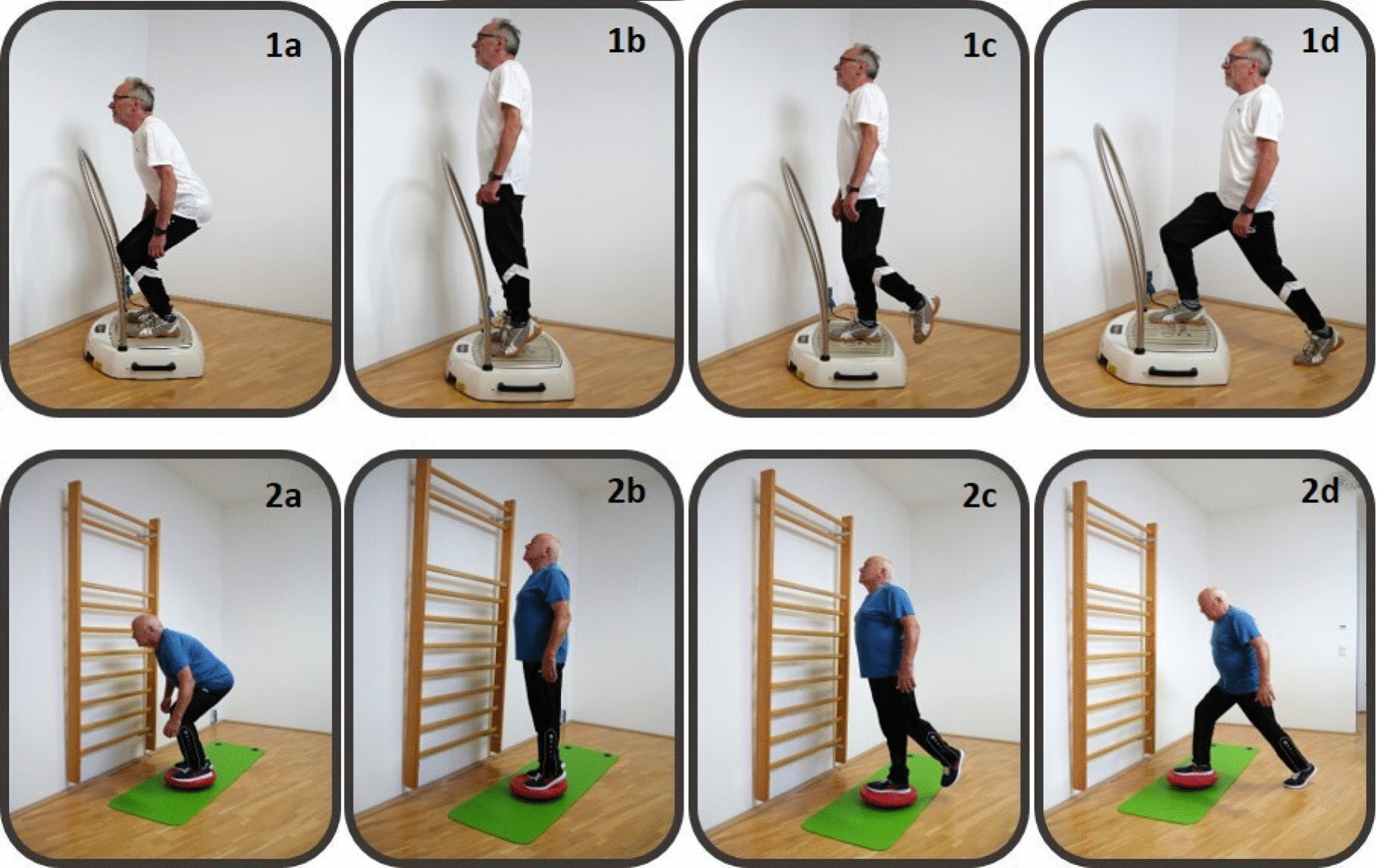
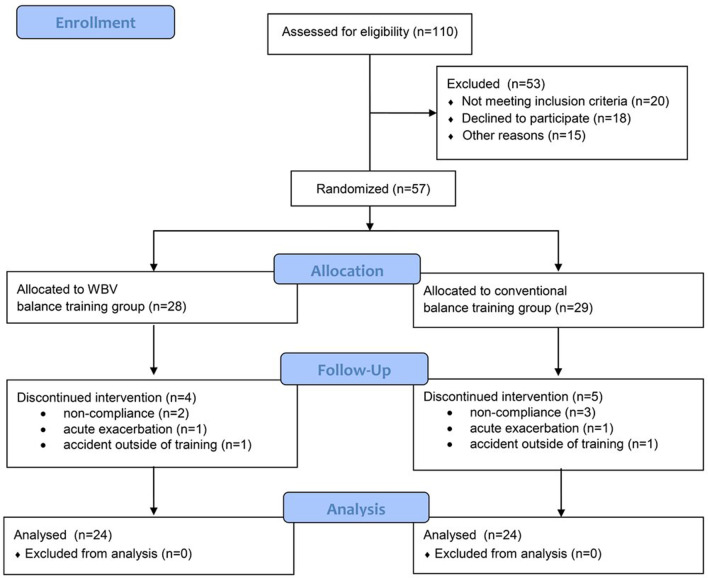
48 patients with severe COPD (FEV: 37 ± 7%predicted) and low exercise performance (6 min walk distance (6MWD): 55 ± 10%predicted) were included in this randomized controlled trial during a 3 week inpatient pulmonary rehabilitation. All patients completed a standardized endurance and strength training program. Additionally, patients performed 4 different balance exercises 3x/week for 2 sets of 1 min each, either on a vibration platform (Galileo) at varying frequencies (5-26 Hz) (WBV) or on a conventional balance board (BAL). The primary outcome parameter was the change in balance performance during a semi tandem stance with closed eyes assessed on a force measurement platform. Muscular power during a countermovement jump, the 6MWD, and 4 m gait speed test (4MGST) were secondary outcomes. Non-parametric tests were used for statistical analyses.
Static balance performance improved significantly more (p = 0.032) in favor of WBV (path length during semi-tandem stand: - 168 ± 231 mm vs. + 1 ± 234 mm). Muscular power also increased significantly more (p = 0.001) in the WBV group (+ 2.3 ± 2.5 W/kg vs. - 0.1 ± 2.0 W/kg). 6MWD improved to a similar extent in both groups (WBV: 48 ± 46 m, p < 0.001 vs. BAL: 38 ± 32 m; p < 0.001) whereas the 4MGST increased significantly only in the WBV-group (0.08 ± 0.14 m/s, p = 0.018 vs. 0.01 ± 0.11 m/s, p = 0.71).
WBV can improve balance performance and muscular power significantly more compared to conventional balance training.
Clinical-Trials registration number: NCT03157986; date of registration: May 17, 2017. https://clinicaltrials.gov/ct2/results?cond=&term=NCT03157986&cntry=&state=&city=&dist = .
全身振动训练(WBV)在振动平台上进行,可以显著提高慢性阻塞性肺疾病患者的身体表现。有人提出,这种改善的一个重要机制是基于平衡的改善。因此,本研究的目的是研究 WBV 与传统平衡训练的比较效果。
48 名患有严重 COPD(FEV:37 ± 7%预测值)和低运动表现(6 分钟步行距离(6MWD):55 ± 10%预测值)的患者在为期 3 周的住院肺康复期间被纳入这项随机对照试验。所有患者都完成了标准化的耐力和力量训练计划。此外,患者每周进行 4 次不同的平衡练习,每次 2 组,每组 1 分钟,分别在不同频率(5-26 Hz)的振动平台(Galileo)上进行(WBV)或在传统平衡板(BAL)上进行。主要结局参数是在闭眼的半串联站立时平衡表现的变化,使用力测量平台进行评估。在反跳跳和 6MWD 中评估的肌肉力量,以及 4 米步态速度测试(4MGST)是次要结局。使用非参数检验进行统计分析。
静态平衡表现显著改善(p=0.032),有利于 WBV(半串联站立时的路径长度:-168 ± 231 mm 与+1 ± 234 mm)。肌肉力量也显著增加(p=0.001),在 WBV 组中增加了(+2.3 ± 2.5 W/kg 与-0.1 ± 2.0 W/kg)。6MWD 在两组中都有相似的改善(WBV:48 ± 46 m,p < 0.001 与 BAL:38 ± 32 m;p < 0.001),而 4MGST 仅在 WBV 组中显著增加(0.08 ± 0.14 m/s,p = 0.018 与 0.01 ± 0.11 m/s,p = 0.71)。
与传统平衡训练相比,WBV 可以显著提高平衡表现和肌肉力量。
临床试验注册号:NCT03157986;注册日期:2017 年 5 月 17 日。https://clinicaltrials.gov/ct2/results?cond=&term=NCT03157986&cntry=&state=&city=&dist=。