Psychology Department, Ben Gurion University of the Negev, Beer-Sheba, Israel.
Zlotowski Center for Neuroscience, Ben Gurion University of the Negev, Beer-Sheba, Israel.
Autism Res. 2022 Oct;15(10):1917-1928. doi: 10.1002/aur.2794. Epub 2022 Aug 20.
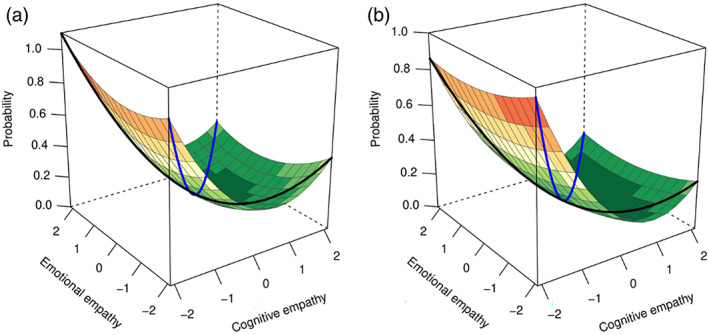
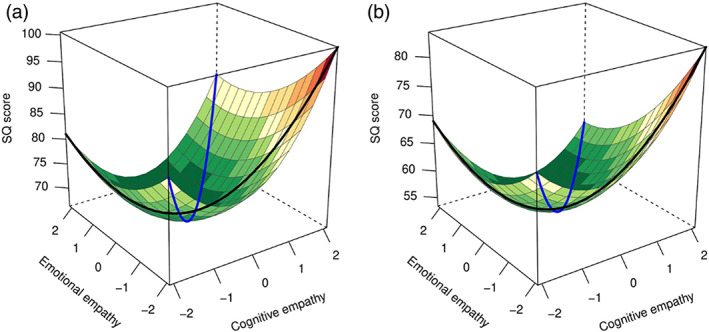
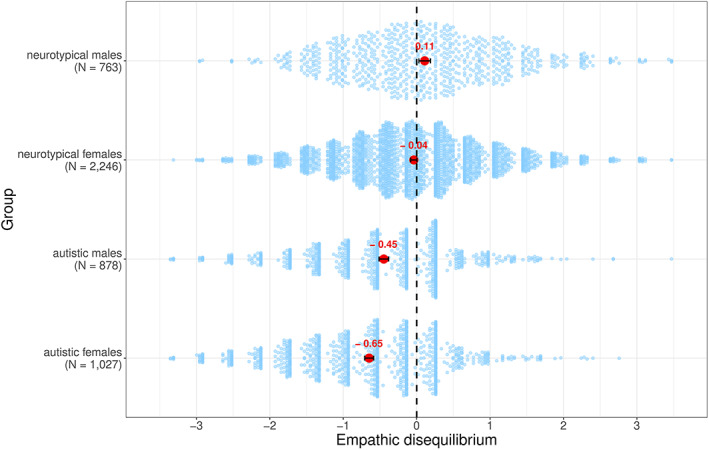
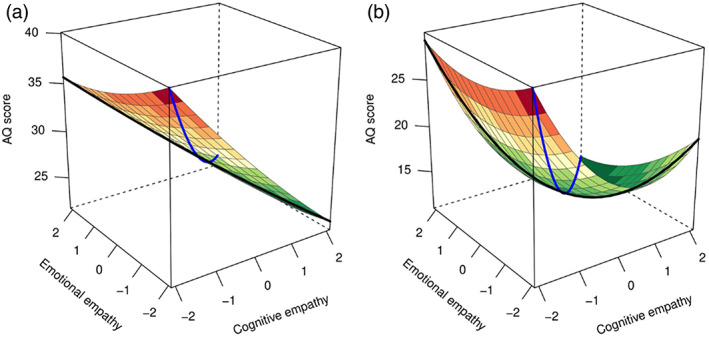
A large body of research showed that autistic people have intact emotional (affective) empathy alongside reduced cognitive empathy. However, there are mixed findings and these call for a more subtle understanding of empathy in autism. Empathic disequilibrium refers to the imbalance between emotional and cognitive empathy and is associated with a higher number of autistic traits in the typical population. Here we examined whether empathic disequilibrium predicts both the number of autistic traits and autism diagnosis. In a large sample of autistic (N = 1905) and typical individuals (N = 3009), we examined empathic disequilibrium and empathy as predictors of autistic traits and autism diagnosis, using a polynomial regression with response surface analysis. Empathy and autistic traits were measured using validated self-report questionnaires. Both empathic disequilibrium and empathy predicted linearly and non-linearly autism diagnosis and autistic traits. Specifically, a tendency towards higher emotional than cognitive empathy (empathic disequilibrium towards emotional empathy) predicted both autism diagnosis and the social domain of autistic traits, while higher cognitive than emotional empathy was associated with the non-social domain of autism. Empathic disequilibrium was also more prominent in autistic females. This study provides evidence that beyond empathy as was measured thus far, empathic disequilibrium offers a novel analytical approach for examining the role of empathy. Empathic disequilibrium allows for a more nuanced understanding of the links between empathy and autism. LAY SUMMARY: Many autistic individuals report feelings of excessive empathy, yet their experience is not reflected by most of the current literature, typically suggesting that autism is characterized by intact emotional and reduced cognitive empathy. To fill this gap, we looked at both ends of the imbalance between these components, termed empathic disequilibrium. We show that, like empathy, empathic disequilibrium is related to autism diagnosis and traits, and thus may provide a more nuanced understanding of empathy and its link with autism.
大量研究表明,自闭症患者的情感(情感)同理心完好无损,而认知同理心却降低了。然而,研究结果喜忧参半,这需要对自闭症中的同理心有更微妙的理解。同理心失衡是指情感同理心和认知同理心之间的不平衡,与典型人群中更多的自闭症特征有关。在这里,我们研究了同理心失衡是否可以预测自闭症特征的数量和自闭症诊断。在一个由自闭症患者(N=1905)和典型个体(N=3009)组成的大样本中,我们使用多项式回归和响应面分析,检查同理心失衡和同理心作为自闭症特征和自闭症诊断的预测指标。同理心和自闭症特征使用经过验证的自我报告问卷进行测量。同理心失衡和同理心都线性和非线性地预测了自闭症诊断和自闭症特征。具体而言,与认知同理心相比,情绪同理心更高的倾向(情感同理心的同理心失衡)预测了自闭症诊断和自闭症特征的社交领域,而与认知同理心相比,情绪同理心更高与自闭症的非社交领域相关。同理心失衡在自闭症女性中也更为突出。这项研究提供的证据表明,除了迄今为止所测量的同理心之外,同理心失衡为检查同理心的作用提供了一种新颖的分析方法。同理心失衡使我们能够更细致地了解同理心与自闭症之间的联系。
非专业人士翻译,仅供参考。