Canfield Don E, Kraft Beate
Department of Biology and Nordcee, University of Southern Denmark, Campusvej 55, Odense, Denmark.
Danish Institute for Advanced Studies (DIAS), Denmark.
Environ Microbiol. 2022 Nov;24(11):5332-5344. doi: 10.1111/1462-2920.16192. Epub 2022 Oct 18.
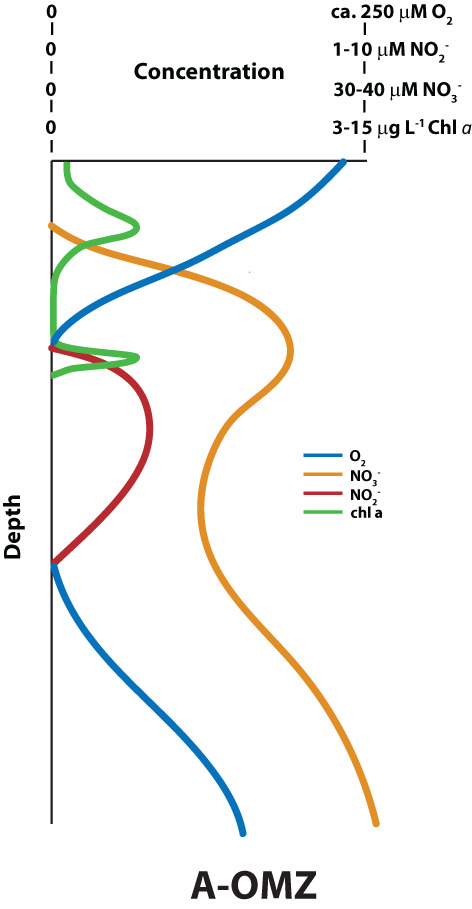
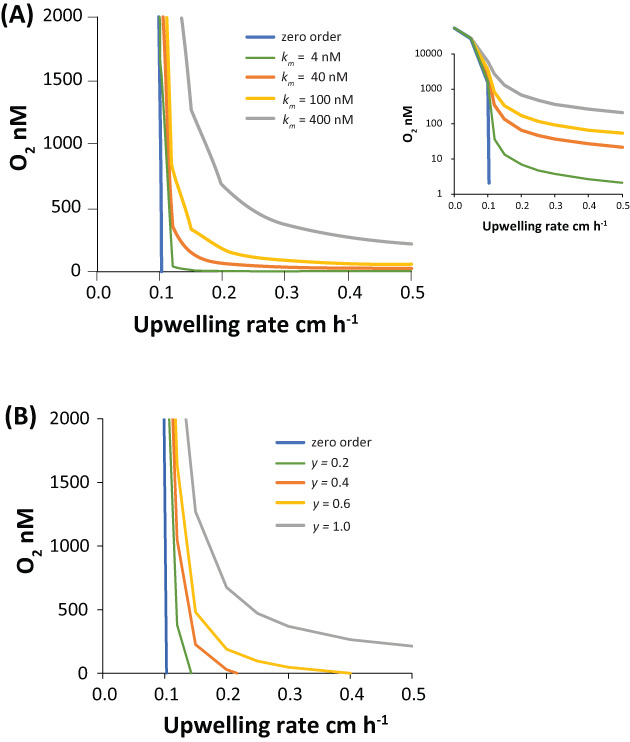
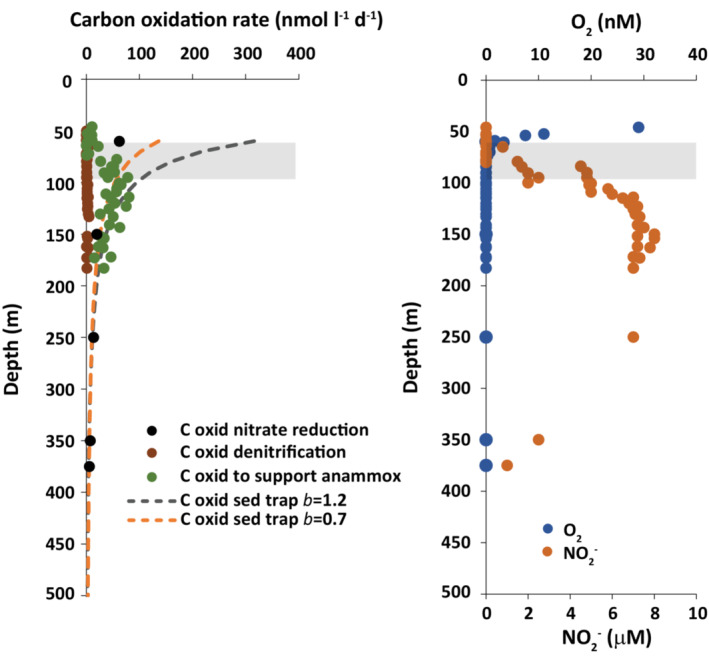
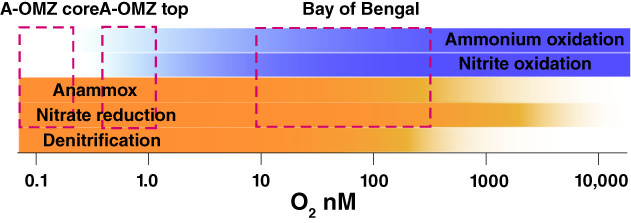
Aerobic processes require oxygen, and anaerobic processes are typically hindered by it. In many places in the global ocean, oxygen is completely removed at mid-water depths forming anoxic oxygen minimum zones (A-OMZs). Within the oxygen gradients linking oxygenated waters with A-OMZs, there is a transition from aerobic to anaerobic microbial processes. This transition is not sharp and there is an overlap between processes using oxygen and those using other electron acceptors. This review will focus on the oxygen control of aerobic and anaerobic metabolisms and will explore how this overlap impacts both the carbon and nitrogen cycles in A-OMZ environments. We will discuss new findings on non-phototrophic microbial processes that produce oxygen, and we focus on how oxygen impacts the loss of fixed nitrogen (as N ) from A-OMZ waters. There are both physiological and environmental controls on the activities of microbial processes responsible for N loss, and the environmental controls are active at extremely low levels of oxygen. Understanding how these controls function will be critical to understanding and predicting how fixed-nitrogen loss in the oceans will respond to future global warming.
需氧过程需要氧气,而厌氧过程通常会受到氧气的阻碍。在全球海洋的许多地方,氧气在中水深度被完全消耗,形成缺氧的低氧区(A-OMZs)。在连接含氧水体与A-OMZs的氧梯度范围内,存在从需氧微生物过程到厌氧微生物过程的转变。这种转变并不明显,使用氧气的过程和使用其他电子受体的过程之间存在重叠。本综述将聚焦于需氧和厌氧代谢的氧控制,并探讨这种重叠如何影响A-OMZ环境中的碳和氮循环。我们将讨论关于产生氧气的非光合微生物过程的新发现,并关注氧气如何影响A-OMZ水体中固定氮(以N形式)的损失。负责氮损失的微生物过程的活动受到生理和环境控制,且环境控制在极低的氧气水平下也很活跃。了解这些控制如何发挥作用对于理解和预测海洋中固定氮损失将如何应对未来全球变暖至关重要。