Department of Microbiology, NYU School of Medicine, New York, NY, United States of America.
Department of Medicine, NYU School of Medicine, New York, NY, United States of America.
PLoS One. 2022 Sep 2;17(9):e0272986. doi: 10.1371/journal.pone.0272986. eCollection 2022.
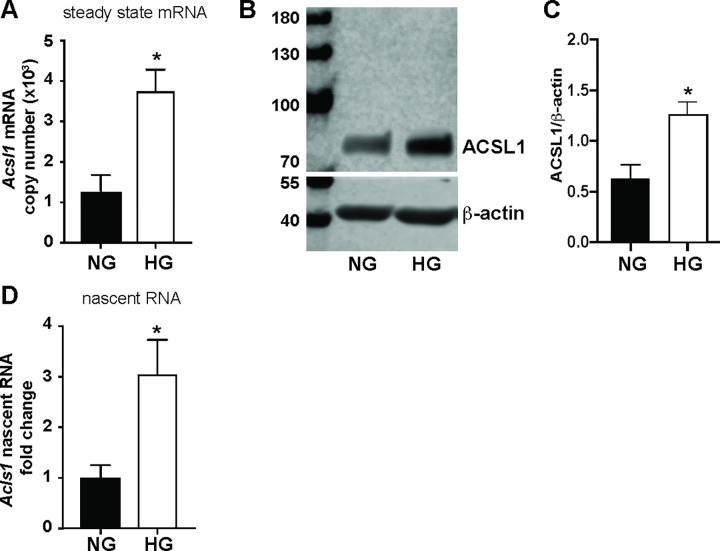
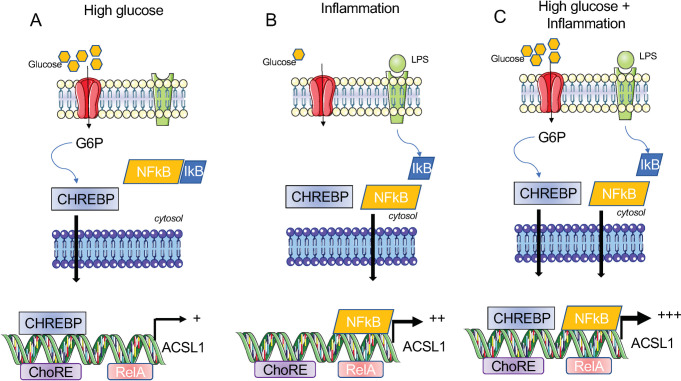
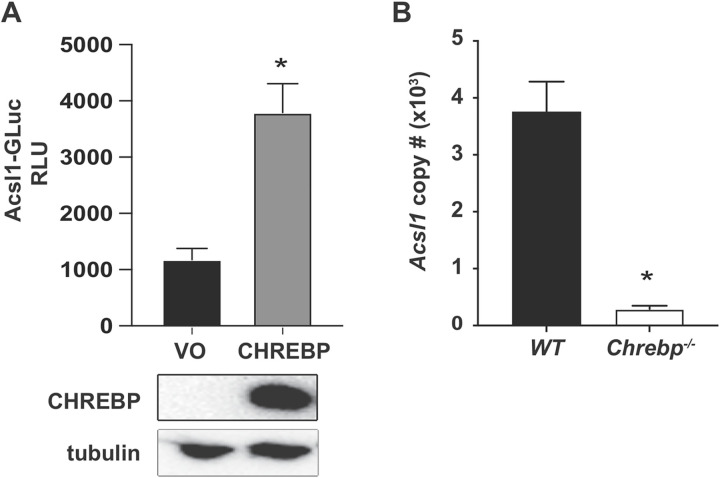
Acyl-CoA synthetase 1 (ACSL1) is an enzyme that converts fatty acids to acyl-CoA-derivatives for lipid catabolism and lipid synthesis in general and can provide substrates for the production of mediators of inflammation in monocytes and macrophages. Acsl1 expression is increased by hyperglycemia and inflammatory stimuli in monocytes and macrophages, and promotes the pro-atherosclerotic effects of diabetes in mice. Yet, surprisingly little is known about the mechanisms underlying Acsl1 transcriptional regulation. Here we demonstrate that the glucose-sensing transcription factor, Carbohydrate Response Element Binding Protein (CHREBP), is a regulator of the expression of Acsl1 mRNA by high glucose in mouse bone marrow-derived macrophages (BMDMs). In addition, we show that inflammatory stimulation of BMDMs with lipopolysaccharide (LPS) increases Acsl1 mRNA via the transcription factor, NF-kappa B. LPS treatment also increases ACSL1 protein abundance and localization to membranes where it can exert its activity. Using an Acsl1 reporter gene containing the promoter and an upstream regulatory region, which has multiple conserved CHREBP and NF-kappa B (p65/RELA) binding sites, we found increased Acsl1 promoter activity upon CHREBP and p65/RELA expression. We also show that CHREBP and p65/RELA occupy the Acsl1 promoter in BMDMs. In primary human monocytes cultured in high glucose versus normal glucose, ACSL1 mRNA expression was elevated by high glucose and further enhanced by LPS treatment. Our findings demonstrate that CHREBP and NF-kappa B control Acsl1 expression under hyperglycemic and inflammatory conditions.
酰基辅酶 A 合成酶 1(ACSL1)是一种将脂肪酸转化为酰基辅酶 A 衍生物的酶,用于一般的脂肪分解和脂质合成,并可为单核细胞和巨噬细胞中炎症介质的产生提供底物。高血糖和炎症刺激可使单核细胞和巨噬细胞中的 Acsl1 表达增加,并促进小鼠的糖尿病动脉粥样硬化作用。然而,人们对 Acsl1 转录调控的机制知之甚少。在这里,我们证明葡萄糖感应转录因子碳水化合物反应元件结合蛋白(CHREBP)是高葡萄糖诱导鼠骨髓来源的巨噬细胞(BMDM)中 Acsl1 mRNA 表达的调节剂。此外,我们还表明,脂多糖(LPS)对 BMDM 的炎症刺激可通过转录因子 NF-κB 增加 Acsl1 mRNA。LPS 处理还增加了 ACSL1 蛋白的丰度,并将其定位到膜上,从而发挥其活性。使用包含启动子和上游调控区的 Acsl1 报告基因,该基因具有多个保守的 CHREBP 和 NF-κB(p65/RELA)结合位点,我们发现 CHREBP 和 p65/RELA 表达后 Acsl1 启动子活性增加。我们还表明,CHREBP 和 p65/RELA 在 BMDM 中占据 Acsl1 启动子。在高糖与正常葡萄糖培养的原代人单核细胞中,ACSL1 mRNA 表达在高糖条件下升高,并用 LPS 处理进一步增强。我们的发现表明,CHREBP 和 NF-κB 在高血糖和炎症条件下控制 Acsl1 的表达。