School of Kinesiology, Auburn University, Auburn, Alabama, United States of America.
Program in Public Health, Renaissance School of Medicine, Stony Brook University, Stony Brook, NY, United States of America.
PLoS One. 2022 Sep 2;17(9):e0274121. doi: 10.1371/journal.pone.0274121. eCollection 2022.
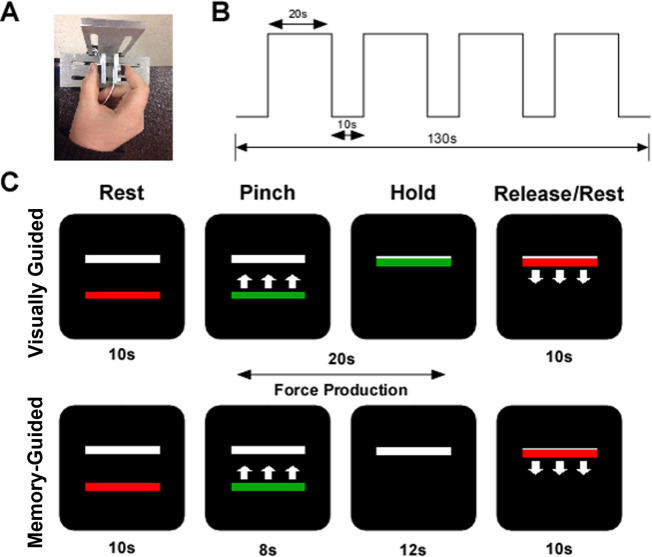
Sleep loss is a common phenomenon with consequences to physical and mental health. While the effects of sleep restriction on working memory are well documented, it is unknown how sleep restriction affects continuous force control. The purpose of this study was to determine the effects of sleep restriction on visually and memory-guided force production magnitude and variability. We hypothesized that both visually and memory-guided force production would be impaired after sleep restriction. Fourteen men participated in an eleven-day inpatient sleep study and completed a grip force task after two nights of ten hours' time in bed (baseline); four nights of five hours' time in bed (sleep restriction); and one night of ten hours' time in bed (recovery). The force task entailed four 20-second trials of isometric force production with the thumb and index finger targeting 25% of the participant's maximum voluntary contraction. During visually guided trials, participants had continuous visual feedback of their force production. During memory-guided trials, visual feedback was removed for the last 12 seconds of each trial. During both conditions, participants were told to maintain the target force production. After sleep restriction, participants decreased the magnitude of visually guided, but not memory-guided, force production, suggesting that visual attention tasks are more affected by sleep loss than memory-guided tasks. Participants who reported feeling more alert after sleep restriction and recovery sleep produced higher force during memory-guided, but not visually guided, force production, suggesting that the perception of decreased alertness may lead to more attention to the task during memory-guided visual tasks.
睡眠不足是一种常见现象,会对身心健康造成影响。虽然睡眠限制对工作记忆的影响已有充分的研究记录,但睡眠限制对连续力控制的影响尚不清楚。本研究旨在确定睡眠限制对视觉和记忆引导的力产生幅度和可变性的影响。我们假设,在睡眠限制后,视觉和记忆引导的力产生都会受到影响。14 名男性参与了为期 11 天的住院睡眠研究,并在两晚 10 小时卧床时间(基线)、四晚 5 小时卧床时间(睡眠限制)和一晚 10 小时卧床时间(恢复)后完成了握力任务。力任务包括四个 20 秒的等长力产生试验,拇指和食指的目标是参与者最大自主收缩的 25%。在视觉引导试验中,参与者可以连续看到自己的力产生反馈。在记忆引导试验中,视觉反馈在每个试验的最后 12 秒被移除。在两种情况下,参与者都被告知要保持目标力的产生。睡眠限制后,参与者减少了视觉引导的力产生幅度,但不影响记忆引导的力产生,这表明视觉注意力任务比记忆引导任务更容易受到睡眠不足的影响。睡眠限制和恢复睡眠后感觉更警觉的参与者在记忆引导的力产生中产生更高的力,但在视觉引导的力产生中则不然,这表明警觉度下降的感觉可能会导致在记忆引导的视觉任务中更加关注任务。