Biomathematics Laboratory, Department of Applied Mathematics, School of Mathematical Science, Tarbiat Modares University, Tehran, Iran.
Applied Systems Biology, Leibniz-Institute for Natural Product Research and Infection Biology - Hans-Knöll-Institute, Jena, Germany.
Sci Rep. 2022 Sep 2;12(1):14998. doi: 10.1038/s41598-022-18987-y.
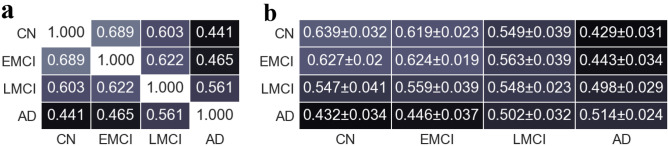
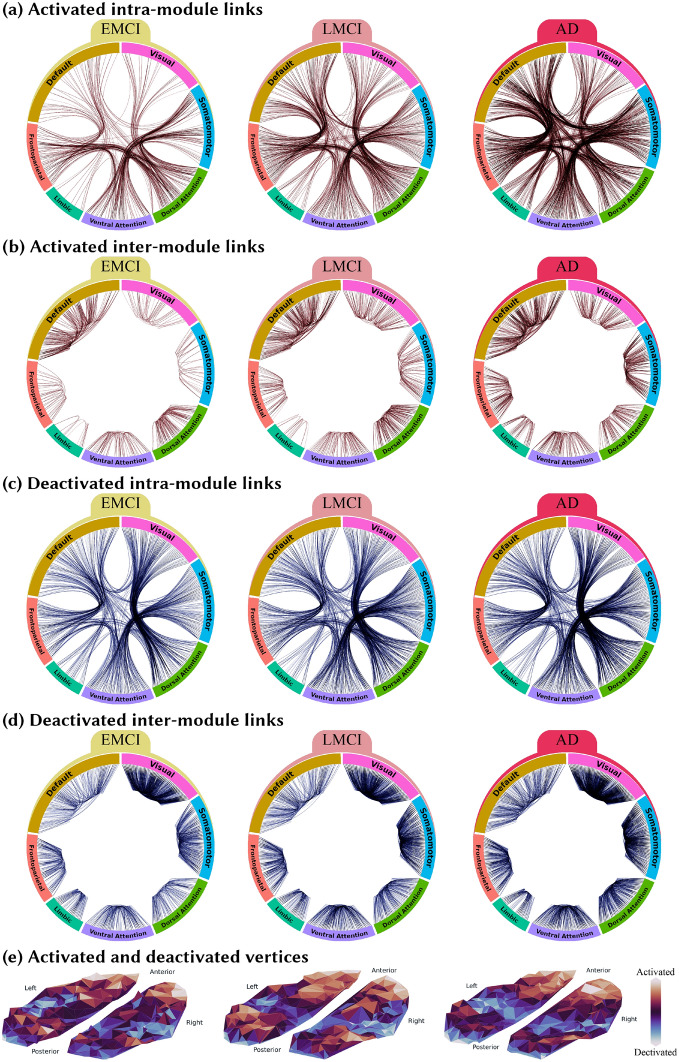
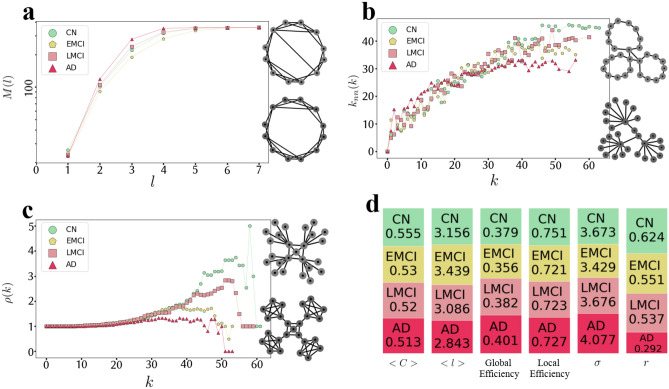
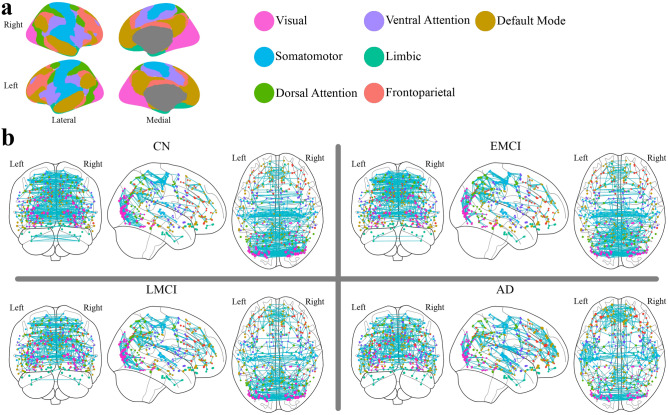
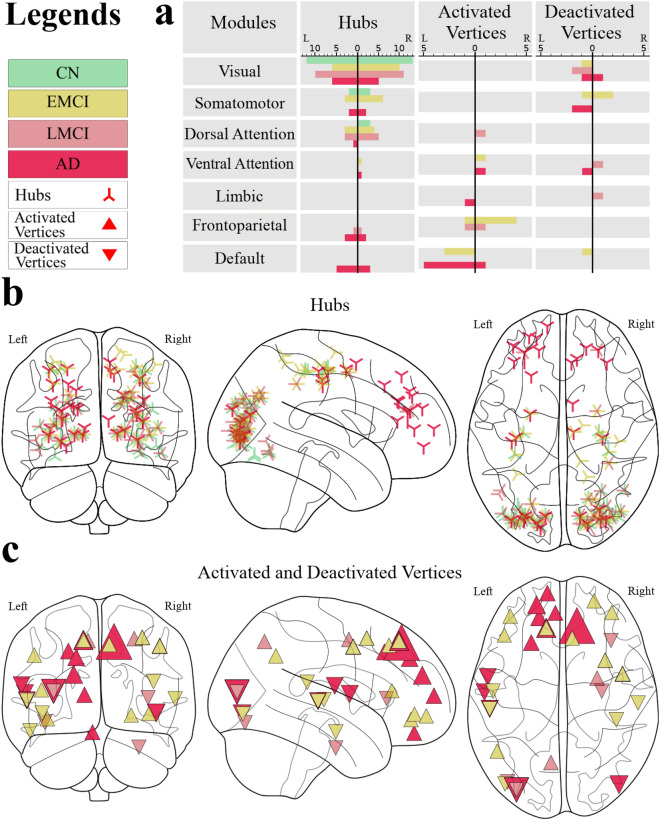
Alzheimer's disease (AD) is a progressive disorder associated with cognitive dysfunction that alters the brain's functional connectivity. Assessing these alterations has become a topic of increasing interest. However, a few studies have examined different stages of AD from a complex network perspective that cover different topological scales. This study used resting state fMRI data to analyze the trend of functional connectivity alterations from a cognitively normal (CN) state through early and late mild cognitive impairment (EMCI and LMCI) and to Alzheimer's disease. The analyses had been done at the local (hubs and activated links and areas), meso (clustering, assortativity, and rich-club), and global (small-world, small-worldness, and efficiency) topological scales. The results showed that the trends of changes in the topological architecture of the functional brain network were not entirely proportional to the AD progression. There were network characteristics that have changed non-linearly regarding the disease progression, especially at the earliest stage of the disease, i.e., EMCI. Further, it has been indicated that the diseased groups engaged somatomotor, frontoparietal, and default mode modules compared to the CN group. The diseased groups also shifted the functional network towards more random architecture. In the end, the methods introduced in this paper enable us to gain an extensive understanding of the pathological changes of the AD process.
阿尔茨海默病(AD)是一种与认知功能障碍相关的进行性疾病,会改变大脑的功能连接。评估这些改变已成为一个日益受到关注的话题。然而,少数研究从复杂网络的角度研究了 AD 的不同阶段,涵盖了不同的拓扑尺度。本研究使用静息态 fMRI 数据,从认知正常(CN)状态,通过早期和晚期轻度认知障碍(EMCI 和 LMCI),到阿尔茨海默病,分析功能连接改变的趋势。分析在局部(枢纽和激活链路和区域)、中尺度(聚类、配分和丰富俱乐部)和全局(小世界、小世界程度和效率)拓扑尺度上进行。结果表明,功能脑网络拓扑结构变化的趋势与 AD 进展并不完全成正比。存在着与疾病进展有关的非线性变化的网络特征,特别是在疾病的最早阶段,即 EMCI。此外,与 CN 组相比,患病组参与了躯体运动、额顶叶和默认模式模块。患病组还将功能网络向更随机的结构转移。最后,本文介绍的方法使我们能够广泛了解 AD 过程的病理变化。