Department of Arid Land Agriculture, College of Agriculture and Food Sciences, King Faisal University, PO Box 31982, Al-Ahsa, Saudi Arabia.
Date Palm Research Center of Excellence, King Faisal University, PO Box 31982, Al-Ahsa, Saudi Arabia.
Sci Rep. 2022 Sep 2;12(1):15027. doi: 10.1038/s41598-022-19399-8.
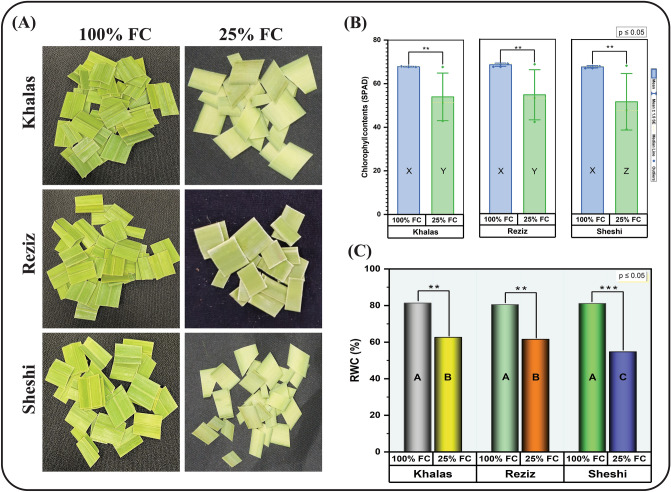
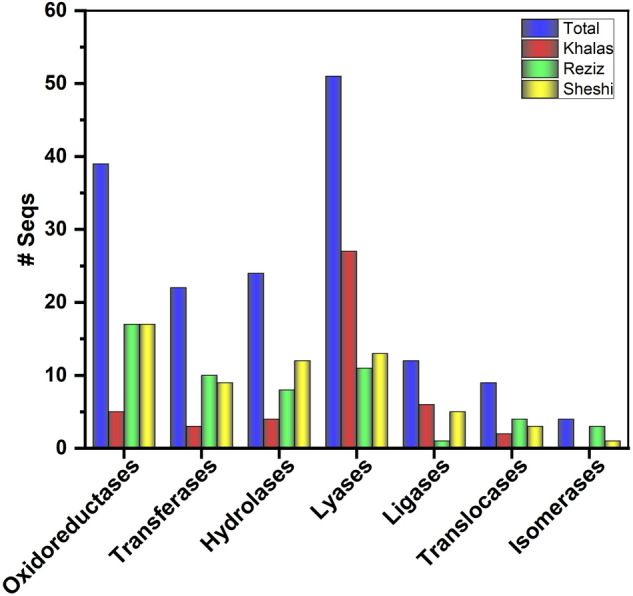
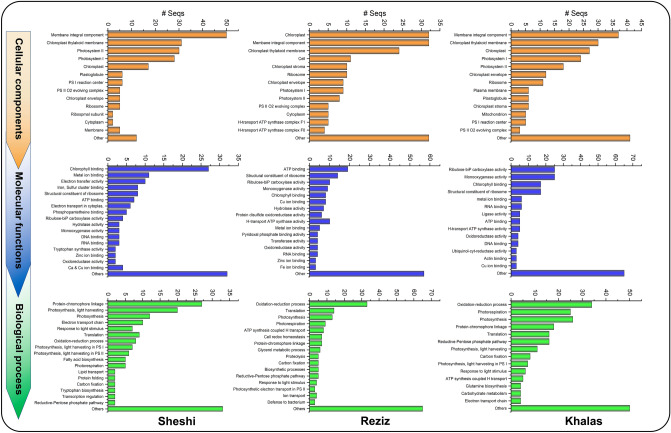
Date palm is an important staple crop in Saudi Arabia, and about 400 different date palm cultivars grown here, only 50-60 of them are used commercially. The most popular and commercially consumed cultivars of these are Khalas, Reziz, and Sheshi, which are also widely cultivated across the country. Date palm is high water-demanding crop in oasis agriculture, with an inherent ability to tolerate drought stress. However, the mechanisms by which it tolerates drought stress, especially at the transcriptomic level, are still elusive. This study appraised the physiological and molecular response of three commercial date palm cultivars Khalas, Reziz, and Sheshi at two different field capacities (FC; 100% and 25%) levels. At 25% FC (drought stress), leaf relative water content, chlorophyll, photosynthesis, stomatal conductance, and transpiration were significantly reduced. However, leaf intercellular CO concentration and water use efficiency increased under drought stress. In comparison to cvs. Khalas and Reziz, date palm cv. Sheshi showed less tolerance to drought stress. A total of 1118 drought-responsive expressed sequence tags (ESTs) were sequenced, 345 from Khalas, 391 from Reziz, and 382 from Sheshi and subjected to functional characterization, gene ontology classification, KEGG pathways elucidation, and enzyme codes dissemination. Three date palm cultivars deployed a multivariate approach to ameliorate drought stress by leveraging common and indigenous molecular, cellular, biological, structural, transcriptional and reproductive mechanisms. Approximately 50% of the annotated ESTs were related to photosynthesis regulation, photosynthetic structure, signal transduction, auxin biosynthesis, osmoregulation, stomatal conductance, protein synthesis/turnover, active transport of solutes, and cell structure modulation. Along with the annotated ESTs, ca. 45% of ESTs were novel. Conclusively, the study provides novel clues and opens the myriads of genetic resources to understand the fine-tuned drought amelioration mechanisms in date palm.
椰枣是沙特阿拉伯的一种重要主食作物,这里种植着大约 400 种不同的椰枣树品种,其中只有 50-60 种用于商业用途。在这些品种中,最受欢迎和商业上消费最多的品种是 Khalas、Reziz 和 Sheshi,它们也在全国范围内广泛种植。椰枣是绿洲农业中高需水作物,具有内在的耐旱能力。然而,它耐受干旱胁迫的机制,特别是在转录组水平上,仍然难以捉摸。本研究评估了三种商业椰枣树品种 Khalas、Reziz 和 Sheshi 在两种不同田间持水量(FC;100%和 25%)水平下的生理和分子反应。在 25% FC(干旱胁迫)下,叶片相对含水量、叶绿素、光合作用、气孔导度和蒸腾作用显著降低。然而,在干旱胁迫下,叶片胞间 CO 浓度和水分利用效率增加。与 cvs. Khalas 和 Reziz 相比,椰枣树 cv. Sheshi 对干旱胁迫的耐受性较低。共测序了 1118 个干旱响应表达序列标签(EST),其中 Khalas 有 345 个,Reziz 有 391 个,Sheshi 有 382 个,并进行了功能特征分析、基因本体分类、KEGG 途径阐明和酶码传播。三种椰枣树品种通过利用共同和本土的分子、细胞、生物、结构、转录和生殖机制,采用多元方法来减轻干旱胁迫。约 50%的注释 EST 与光合作用调控、光合作用结构、信号转导、生长素生物合成、渗透调节、气孔导度、蛋白质合成/周转、溶质主动运输和细胞结构调节有关。除了注释的 EST 外,大约 45%的 EST 是新的。总之,该研究提供了新的线索,并为理解椰枣中精细的干旱缓解机制打开了无数的遗传资源。